It's Turtles All The Way Down


Source
There's something about this movie that just moves something in me. It is painfully intimate, in a quiet way and leaves you asking "what goes on I'm my head when the world is quiet."
The movie is adapted from John Green’s 2017 novel and it follows Aza Holmes, a teenager living with obsessive-compulsive disorder, played by Isabela Merced. On paper, it sounds like a typical YA coming-of-age story, with the plot basically: missing billionaire, teenage romance, friendship drama, grief. What makes the film outstanding isn’t the plot itself, But the fact that it gives an inside view of what it feels like to live inside an intrusive thought spiral that never fully turns off.

The biggest theme in this movie is what it feels like to have an OCD. Understands OCD Without Romanticizing It, most I've watched about mental illness portrays mental illness either as a quirky personality trait or make it overly dramatic, but this movie isn't like that, it's raw. Aza’s OCD is not presented as some aesthetic sadness or “deep thinker” syndrome. It is exhausting and Repetitive. The audience can also feel this as we are dragged into her thought spirals, which is clearly captured through internal narration, visual distortion, and repetitive internal dialogue. Aza is terrified of bacteria, infection, and losing control of her body. Aza herself knows that her fears aren’t rational, but nevertheless she leans into it. The movie shows the humiliation and shame that often comes with OCD, being smart and knowing a thought is irrational but still being unable to escape it. Even people with OCD praised how accurate the film felt emotionally, especially the “thought spirals” and inability to fully enjoy important moments because anxiety interrupts everything.


Isabela Merced gave a stellar performance playing Aza. Aza is an incredibly difficult character to play because most of the conflict is internal. Merced has to communicate panic through small facial changes, hesitation, silence, and physical tension because there are no huge emotional monologues or explosive breakdowns every ten minutes. You can feel how tired Aza is. Tired of constantly fighting with her own brain, tired of disappointing people, tired of failing to behave “normally.” I will say the fact that Merced was also able to portray Aza as funny, awkward, sarcastic, intelligent, and deeply human and not entirely tragic is impressive. Outside the OCD Aza still exists as human, she has a personality outside her disorder. Isabela Merced’s basically carried this movie with the way she portray Aza.


Ironically, the strongest relationship in their movie is not between Aza and Davis. It's between Aza and Daisy and I can't talk about this movie without mentioning Daisy (Cree Cicchino) and the love story between her and Aza. Honestly she my favourite character with her chaotic energy, humor, impulsiveness, and emotional vulnerability. She makes the perfect friend for Aza because she is loud where Aza is quiet. Reckless where Aza is cautious. Their friendship feels real and believable in a way many movie friendships in other movies fail to capture. They annoy each other, misunderstand each other, depend on each other, hurt each other but you can tell how much they love eachother. The movie quietly argues that friendship can sometimes be more emotionally significant than romance, especially during adolescence. The romantic storyline with Davis, played by Felix Mallard, is sweet but not well explored as in the novel. Davis often feels more symbolic than fully developed.

OCD doesn’t take breaks, even in big moments.”
And honestly, this quote wraps the movie in a neat little bow. The film understands that mental illness doesn’t pause itself for romance or character development. Aza doesn’t magically “heal” because someone loves her. The movie refuses to take the predictable typical Hollywood ending where love cures psychological suffering. Still, the romance is an important theme. It shows how difficult intimacy becomes when someone feels disconnected from their own body and thoughts. It shows how it affects those around people with mental health issues and how it can be alot not just for the sick person but also people around.
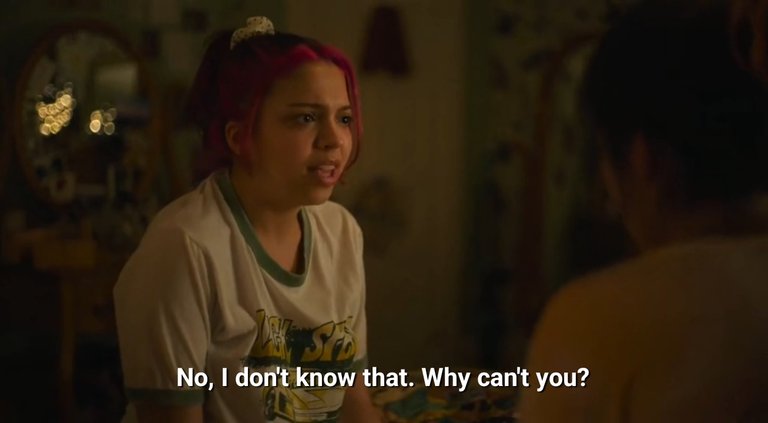
This movie seems real but it occasionally struggles with pacing because the emotional and psychological standpoint is far more compelling than the external plot.
The mystery of Davis dad missing exists mostly as a narrative excuse to reconnect Aza and Davis. Once that is achieved it faded off. If someone watches it expecting a tightly structured mystery-drama, they’ll probably leave disappointed. The plot feels secondary as more focus is put on Aza’s mental state: circular, repetitive, unfinished which works emotionally, but it can make the narrative feel shapeless at times.
I really loved the ending because it rejects fantasy. Aza’s OCD doesn’t disappear. She didn't become suddenly better, her life isn’t magically fixed, the romance doesn’t become some perfect cure. Instead, the movie movies in the direction of: healing is not the absence of struggle. It’s learning how to continue living alongside it. A lot of reviewers with OCD appreciated that the ending preserved the novel’s honesty instead of forcing a clean Hollywood resolution.

Turtles All the Way Down is probably one of the most emotionally accurate portrayals of OCD in mainstream young adult cinema. Although it had some flaws like the pacing drifts, supporting characters needed more depth, the plot never fully lands. But emotionally, it moves something in, it shows the painful and unfiltered part of having mental illness, how it affects everything; be it relationship or friendship, and even the people around. It's not just about OCD, grief or loss, because once the credit rolls you finally understand that you are worthy of being loved, crazy or not.
It's Still Abeegail 💗✨
Thank you for Reading,
The first image is source, while the rest are screenshot from the movie.