A Review of the Movie Loving Vincent

A central question in the film, Loving Vincent is, did Vincent van Gogh kill himself? However, the mystery of van Gogh's death is not the heart of the movie. The character who serves as the antagonist in this film investigates a larger issues. He strives to discover the essence of van Gogh, to plumb the depths of this artist's despair and to understand the peculiar man who left behind a legacy of extraordinary art.
Most of us know the broad outlines of Vincent van Gogh's life. He notoriously cut off his ear (or at least part of it), and was conspicuously mentally ill. We also are likely familiar with his most famous paintings.
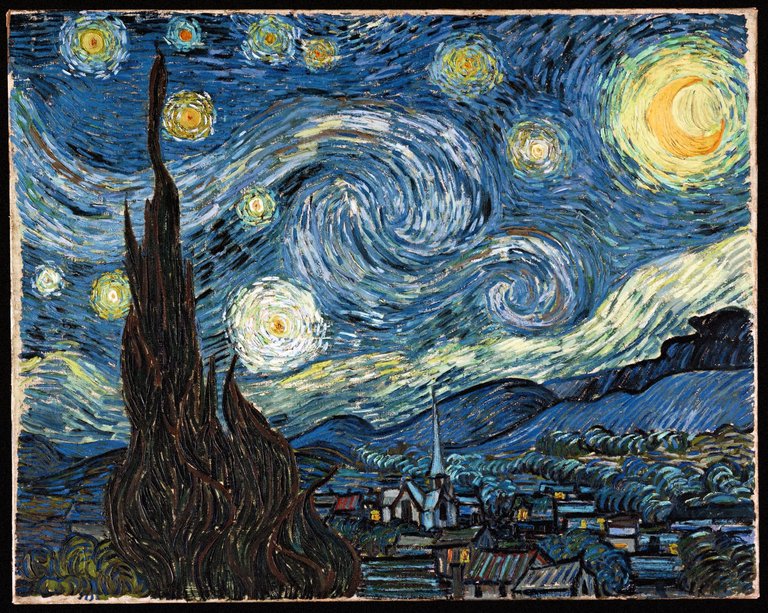
Starry Night, Vincent van Gogh, 1889, MOMA, public domain.

Although his career as an artist lasted 10 years, it was in the last few years that van Gogh produced his most recognized masterpieces. He was astonishingly prolific. He left as his legacy 900 paintings and 1100 drawings. The drawings were largely done in the early years, before he transitioned to painting.

Self Portrait, van Gogh, 1887, Art Institute of Chicago, public domain
.jpg)
If you are a fan of van Gogh's art, and have ever wondered about the man who created these magnificent paintings, then you should watch this movie. It is essentially a 94-minute, animated canvas that has been painted to evoke his vibrant art style.
In order to describe the unusual technique employed by the filmmakers I'll quote from their website, Loving Vincent:
We shot the film with actors, and literally painted over it frame by frame. This is a very laborious and time-consuming process
These painted frames were then animated using a process called rotoscoping. The result is spectacular.
Here is what the result looks like in the film's official trailer:
The filmmakers hired 125 artists from all over the world to paint the frames. These artists were trained in the characteristic style of van Gogh. The approximately 1,000 canvases comprise the movie, which is the first painted feature film.
We are offered the story of this artist's life through the eyes of an unsympathetic character, Armand Roulin. As is true for most of the characters in the film, Armand is drawn from life, literally. Here is a portrait of Armand, as painted by van Gogh in 1888.

Portrait of Armand Roulin, van Gogh 1888, Museum Folkwang, public domain
.jpg)
While Armand Roulin was an actual, living person, drawn from real events in van Gogh's life, his actions in this film are fictional. He is sent on a mission by his father (in the film) to deliver a letter a deceased Vincent had addressed to his brother, Theo van Gogh. At the time the journey begins, Armand discovers that Theo has also died.
Armand is not happy about fulfilling his father's request, so he reluctantly begins to search for someone who can deliver this letter to Theo's widow. This search becomes the device through which the filmmakers explore the last days of Vincent's life.
Eventually, Armand warms to the story of van Gogh. He is told this artist has committed suicide, but he questions that judgement.

Armand's father, Joseph Roulin: van Gogh, 1889, Kröller-Müller Museum, public domain. Note the word on Joseph's hat. He was the local postmaster. Van Gogh wrote his brother daily and so became close with the postmaster and his family.
_van_Gogh_Kroller.jpg)
Armand Roulin is an excellent agent to carry the plot of the movie forward. His father has to persuade him to take on the chore of delivering the letter, so he is antagonistic to van Gogh's life story. As he asks questions of those he meets he is gradually persuaded that van Gogh had a worthy life.
Much of his inquiry centers around van Gogh's reported suicide. He, and others, do not accept this self extinction as a fact. There were no witnesses to the act, which was a gunshot to the abdomen, so there is no way to be certain how this shot was delivered. However, Vincent lingered for two days after the event and asserted that no one else was to blame.
Visually, also, Armand is an excellent agent to carry the plot forward. His bright yellow coat distinguishes him in a crowd, or in a fight. Armand fights a lot. And he drinks a lot.
While the film is painted mostly in brilliant colors, there are segments that are painted in black and white. These black and white scenes help us to distinguish current episodes from past episodes.
One fascinating part of the film is that we are casually introduced to Vincent's art contemporaries. As he sits in a Paris café, we see a small bearded man with glasses--Toulouse Lautrec. These two artists were friends. Lautrec painted a highly-regarded picture of Vincent while they were in a café.

Vincent van Gogh, by Toulouse Lautrec, 1887, Van Gogh Museum. public domain.

We also have a scene (in black and white) where van Gogh and Paul Gauguin are fighting. These two artists had a tumultuous relationship which ended with the episode of van Gogh's self mutilation (ear incident).
This is an inspired film about a tragic life. From that tragedy great art was realized. There is no question that Vincent van Gogh was mentally ill. He was tortured by his illness. He was also tortured by life and by the people around him. In his father's eyes he was a failure. To the public he was a joke, a nuisance.
What was the source of his illness? The film does not tell us. He was certainly an alcoholic. He was certainly odd. His brother, Theo, suffered from syphilis. Was Vincent's mental illness a symptom of tertiary syphilis?
As azircon (who wrote the blog that prompted me to watch this movie) wrote, "Here is a penniless man in this tiny spartan apartment, but there are six original oil painting hanging in his wall, each worth at a minimum $10M..."
If life, and people, had been kinder to Vincent, would he have been able to handle his mental illness? If he hadn't been mentally ill, would he still have had the vision that produced his very remarkable work? One has to wonder.
A word about the actors. Through all that paint they are quite recognizable, and excellent. The budget for the film was a scant $5.5M, so it's not likely the actors brought home fat paychecks.
I hope my description of this movie and my display of Vincent van Gogh's beautiful art inspires readers to view the film. I watched it on YouTube. Here is a link to that site:
Just click on the YouTube link and it will play.
Thank you for reading my blog.
Peace and health to all.
Hive on!
Your movie review is fascinating as always! I'll admit that I know very little about paintings or Vincent van Gogh beyond his famous artwork, Starry Night, or how he died. Your review makes me curious and I want to watch this film.
I think this is a one-of-a-kind movie. Animated canvas, you say? 125 artists to paint the frames? I see a lot of work and dedication went into creating this. I like that the focus of the movie is more about understanding a complicated person than his arts. And through Armand Roulin's eyes, viewers can learn more about the man behind the paintings. Adding this movie to my watch list immediately! Thanks for sharing and have a beautiful day. 🌹
Hello my friend @kemmyb. Thank you for that lovely review of my review.
You are right. The movie is about much more than art. It is about a man, mental illness, a struggle, and society's treatment of those who are perceived as different. There is kindness in this film. Also ignorance an brutality. In other words, it's very real.
I hope you do catch it. I think you will love watching this.
Dear @agmoore !
Madame!
It is not easy for a S.Korean man like me to understand your excellent English sentences, but I decided to offer some critique anyway!
I have never seen the film, Loving Vincent!
However, I know about Vincent van Gogh's life and works!
I don't particularly like his works, but I do admit that he has an exceptional ability to express his anxious and melancholic emotions in them!
The expressions, movements, and colors of the characters appearing in his works all symbolize his anxious, melancholic, and tragic life.
I surmise that the sadness, frustration, and despair of not having his talent as a painter recognized by the world drove him to his death!
I don't think it matters whether he committed suicide or not!
I'll have to watch the film Loving Vincent someday!
Thank you for good article!
I hope your health and long life!
Thank you for appreciating my post, @goldgrifin007.
I agree. They not only symbolize his state, but I think they help us to 'feel' his state. The power of his art (to me) is that I not only can see what he wants me to see, but I can feel it. That is remarkable. All those colors, all those dynamic brush strokes...together they communicate a sense of chaos, confusion and at the same time a great appreciation for beauty.
I do hope you see the film. It is memorable.
These questions stayed with me after reading your insightful review. You capture the tragedy of the man and the beauties of the art he left behind. Nicely done.
!discovery
Thank you, @esther-emmanuel. I have always been a fan of van Gogh's art, and have always been moved by his personal struggle. A high price to pay so that posterity could enjoy great art.
This post was shared and voted inside the discord by the curators team of discovery-it
Join our Community and follow our Curation Trail
Discovery-it is also a Witness, vote for us here
Delegate to us for passive income. Check our 80% fee-back Program
Thank you, @discovery-it! Your support is very much appreciated.
Honestly I've never liked van Gogh style, but i recognize he's been a great artist
My husband is not too fond of the style either, and he said he's not interested in the movie. I love it. Fascinating that as time went by his paintings became more colorful, more dynamic. I think it's the way he saw the world through his mental illness. I think that may be why he felt compelled to paint. He couldn't communicate with anyone otherwise, couldn't share what he saw and felt. But through art, through his brush, he had an outlet. I think :)
I wonder if his paints would be different if he lived now, that there is more awareness and treatments for mental illnesses
muy buen post, gracias por compartir
very good post, thanks for sharing