
Source
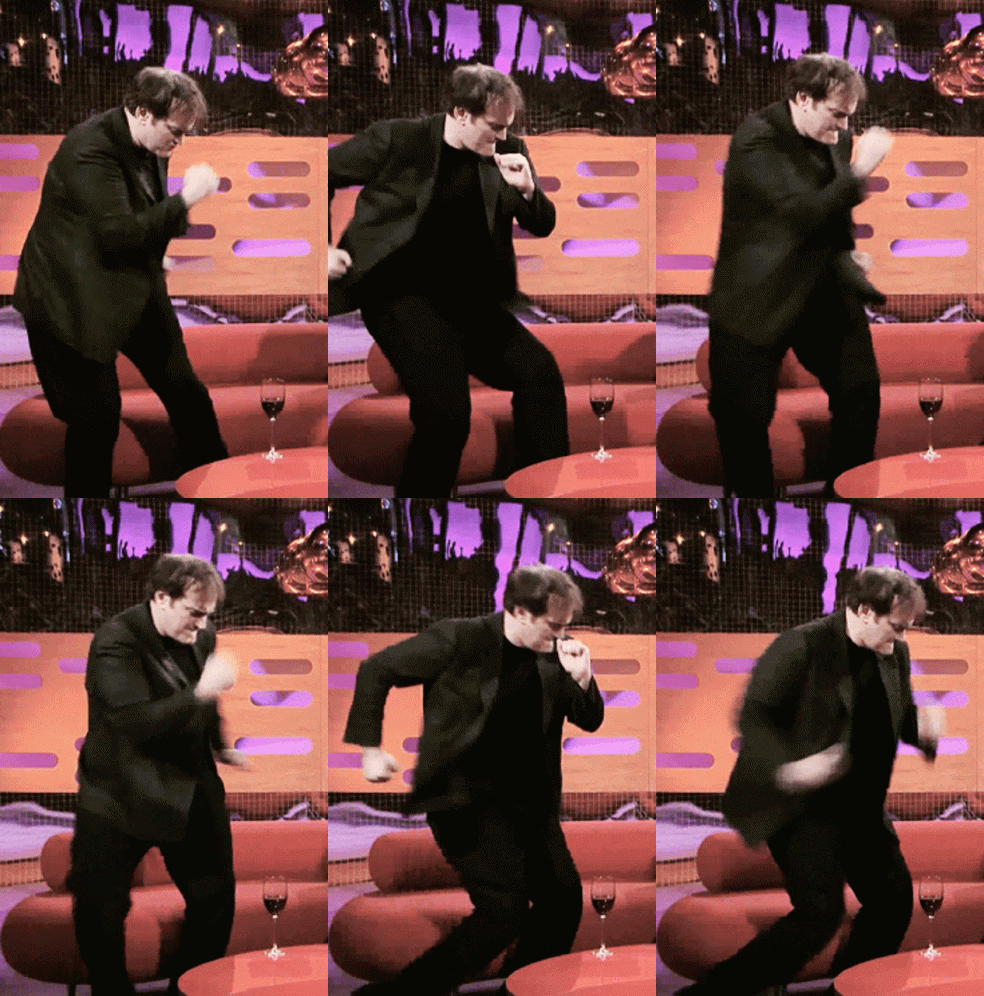
When we talk about action cinema, revenge studies, and immense amounts of violence executed with artistic precision, we are undoubtedly talking about one of the greatest filmmakers in cinema history. Yes, Quentin Tarantino, despite drawing inspiration from countless sources, has become one of the finest directors the seventh art has ever produced. For that reason, and because of the admiration I feel for his work, I decided to write this post.
Although many people reading this may not have followed his entire filmography, it is almost certain that they have watched, enjoyed, and perhaps even been shocked by at least one of his films. To answer the rhetorical question posed in the title, I should begin with the way Tarantino approaches action in his screenplays and films. His protagonists are usually outsiders. They are rarely the obvious choice, the kind of people most audiences would immediately identify as heroes. They carry violent or painful pasts that shape them, but those experiences never completely isolate them from the world around them.
When it comes to antagonists, the opposite tends to happen. Tarantino puts to use the vast cinematic education he acquired through the countless films he consumed as a teenager and young adult. That is why the villains in his movies leave such a lasting impression. They possess a magnetic quality that is impossible to ignore. Intelligent, sadistic, charismatic, mysterious, and eloquent, they often become as memorable as the heroes themselves. Most of the unforgettable villains scattered throughout his filmography share these traits.


Source
It is important to remember that Tarantino's cinematic roots are deeply connected to B movies. Not the blockbuster productions that dominate modern theaters, but rather the less celebrated side of the industry. Genres such as slasher films, exploitation cinema, spaghetti westerns, and zombie horror heavily influenced his imagination. Those movies fascinated a young Quentin, and from his debut feature Reservoir Dogs, we can already see the foundations of the style that would later define his career: sharp dialogue, unforgettable characters, carefully constructed tension, and sudden bursts of violence that somehow feel justified within the story.
In fact, that combination of violence and cinematic homage is perhaps the most recognizable element of his work. His films are, in many ways, love letters to the history of cinema. In Once Upon a Time in Hollywood, for example, audiences witnessed a brilliant alternate version of history crafted by a filmmaker who clearly understands and loves the medium. Throughout the film, we feel the looming danger surrounding the character portrayed by Margot Robbie, only to see the narrative take a completely different path in its unforgettable final act. If you have not seen it yet, I strongly recommend it.
Another aspect that deserves recognition is the visual power of Tarantino's films. Personally, I believe Kill Bill Vol. 1 and Vol. 2 represent the pinnacle of his visual style. Have you ever stopped to think about the choreography required to create those legendary sequences? The lighting, the framing, and even the exaggerated amounts of blood somehow enhance the experience instead of making it unbearable. Rather than pushing viewers away, those choices keep our eyes fixed on the screen. Tarantino is an icon, and I do not think I will ever grow tired of saying it.
His characters are also remarkably believable. In simpler terms, even when we know we are watching fiction, the people on screen feel real enough to connect with our perception of reality. Few examples illustrate this better than Inglourious Basterds. The unforgettable Hans Landa, brought to life by the extraordinary Christoph Waltz, immediately established himself as one of the greatest villains in modern cinema. Everyone is familiar with the historical horrors associated with the Nazis and the Gestapo, and Tarantino managed to create a character who feels both terrifyingly authentic and endlessly fascinating.
At first, I resisted Tarantino's films. Perhaps because many of them seemed connected to the type of cinema traditionally associated with male audiences. Yet nothing could be further from the truth. My first real encounter with his work came through Django Unchained and Leonardo DiCaprio's mesmerizing performance as the cruel slave owner who drives the story forward. Even today, I could watch that film thousands of times and still be captivated. Films such as Jackie Brown and Pulp Fiction are often considered his masterpieces by critics, but I chose not to focus on them because they are already the most discussed entries in his catalog.
The truth is that the art of cinematic homage acquired an entirely new dimension when Tarantino emerged in the early 1990s. He transformed alternative influences into mainstream success, and both audiences and critics embraced him for it. Decade after decade, his films continue to occupy places on lists of personal favorites across the world. Ultimately, I can do nothing but admire his contribution to cinema, popular culture, and our understanding of what movies can be. This is my perspective and my analysis. If you agree, wonderful. If not, feel free to share your thoughts and let's discuss them. After all, that is part of the fun, isn't it?

He's really something else, that I will definitely agree with. He is one of the few filmmakers that when he does something, you just know it is going to be good.
I started out with a sort of disdain for him though because my college roommate was absolutely obsessed with Reservoir Dogs and wouldn't shut up about it. He would watch it like every week and would invite people over to our shared apartment to have long discussions about it. The posters were featured prominently in our living room and when I watched it I was like "yeah, it's ok."
Over time he really honed his skills though and has a very distinct style that is all his own.