Film Review: Admiral (2008)

Russian cinema in the conventional sense began in 1908, with the production of the first live-action film Stenka Razin, a ten-minute silent short dedicated to the eponymous ill-fated leader of a Cossack uprising against the Russian Tsar. A century later, the film that was in many ways produced to celebrate the hundredth anniversary of Russian cinema was Admiral, a period epic dedicated to another larger-than-life yet tragic figure of Russian history—Alexander Kolchak, the naval commander who became one of the principal leaders of the White Movement during the Russian Civil War. This ambitious production, with its grand scale and revisionist historical perspective, represents both the capabilities and the limitations of post-Soviet Russian filmmaking.
The film, directed by Andrei Kravchuk, begins with a reference to the grandest film in the last century of Russian cinema. The prologue is set in 1964 Moscow, where in Mosfilm studios director Sergei Bondarchuk (played by his son Fyodor) directs War and Peace and insists that a mysterious elderly woman whom a Soviet apparatchik wants removed from the production because of her "problematic" anti-Soviet past remains part of the cast. This framing device immediately establishes the film's contemplative approach to history—the woman, we shall later learn, is Anna Timiryova, Kolchak's great love, who survived decades of Gulag imprisonment under Soviet rule. It is a poignant opening, connecting the grand Soviet cinematic tradition with the silenced histories it chose to ignore.
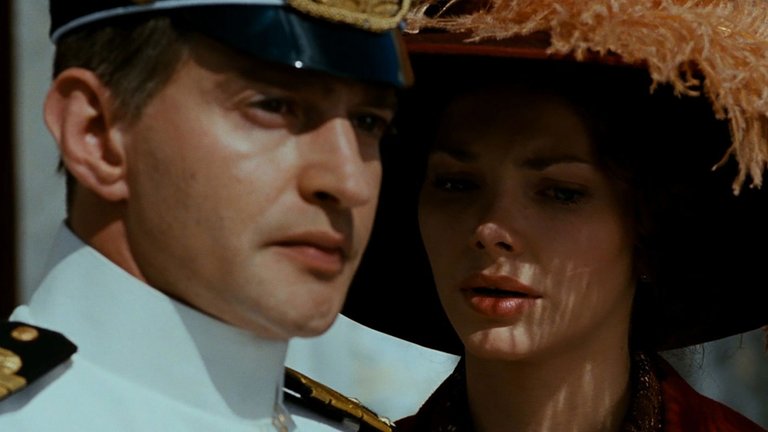
The plot then switches back in time to 1916, during the First World War. A Russian Imperial Navy destroyer is laying mines in front of German ports at the Baltic Sea when it is spotted by the German cruiser SMS Friedrich Carl. Hopelessly outgunned, Captain Alexander Kolchak (played by Konstantin Khabensky) nevertheless takes part in the engagement, hoping to lure the enemy vessel towards his freshly laid mines. The plan works, and the enemy vessel sinks. When he returns to the Russian naval base in Helsingfors, he receives a hero's welcome and is promoted to Rear Admiral. At a ball celebrating his promotion, his subordinate and friend Sergei Timiryov (played by Vladislav Vetrov) introduces him to his beautiful wife Anna (played by Elizaveta Boyarskaya). Kolchak is immediately smitten with her and pursues a passionate affair, despite having a wife, Sofia (played by Anna Kovalchuk), and a young son, Rostislav.
This romantic entanglement is soon overshadowed by more important historical events. Kolchak is further promoted to the rank of Vice Admiral by Tsar Nicholas II (played by Nikolai Burlyayev) and appointed as commander of the Black Sea Fleet in Sevastopol. There he receives news of the February Revolution, during which mutinous Baltic Fleet sailors executed their officers, with Timiryov and Anna barely escaping with their lives. He reluctantly accepts revolutionary soviet authority and surrenders his sidearms to the sailors. Alexander Kerensky (played by Viktor Verzhbitsky), head of the newly created Provisional Government, offers him a cabinet position, but Kolchak resigns, unhappy over the government's unwillingness to restore discipline in the armed forces. Kerensky instead sends him to America to advise the Entente allies—a convenient exile for a man whose principles make him uncomfortable in the new revolutionary order.
The situation in Russia becomes even more chaotic after the Bolsheviks oust Kerensky and seize power. Sofia and Rostislav barely escape with their lives, eventually ending up in emigration in Paris. In 1918, Kolchak comes to Siberia, where, due to his reputation as a war hero, he becomes a rallying figure for all anti-Bolshevik forces and one of the most prominent leaders of the White Movement during the Civil War. He declares himself Supreme Leader of Russia, and forces under his command advance westwards towards Moscow. Anna, whose husband has left the country, joins him as his common-law wife in Omsk, the seat of his government. Their love affair, having survived revolution and separation, now plays out against the backdrop of civil war and political collapse.
In 1919, the fortunes of war turn against the Whites, who are forced into retreat before the reinvigorated Red Army. Kolchak is forced to evacuate Omsk and travel eastwards, hoping to re-establish his base in Irkutsk. Yet he is betrayed by his allies—the French general Maurice Janin (played by Richard Bohringer) and the Czechoslovak Legion—who, in exchange for safe passage out of Siberia, hand him over to the local Bolsheviks. Despite friendly White troops desperately trying to reach Irkutsk to save him, Kolchak is shot on 6 February 1920. Anna survives, and although she would spend decades in Gulags under Soviet rule, she is rehabilitated in 1960 and, as an old woman, takes part in Bondarchuk's film—completing the circle that began the picture.
Russian cinema has extensively covered the Civil War period, but most of those films were made during the Soviet era, and consequently the Whites were portrayed as villains—reactionary counter-revolutionaries fighting against the inevitable triumph of the proletariat. Admiral goes in a completely different direction, taking the revisionist approach officially promoted during the Yeltsin years and, to a degree, continued under Putin. The Whites are portrayed as patriots, and their leaders, like Kolchak, are celebrated as heroes and martyrs who gave their lives in a noble attempt to save Russia from the horrors of Communism. This ideological rehabilitation is perhaps the film's most striking departure from the Soviet cinematic tradition.
Apart from this ideological shift, the script by Zoya Kudriya and Vladimir Valutsky takes inspiration from some distinctively non-Soviet sources, namely grand Hollywood romantic spectacles. Doctor Zhivago, David Lean's romantic drama that takes place in Civil War-era Siberia, is the most obvious example. Another is Cameron's Titanic, another period romantic drama framed by an epilogue set decades in the future. These influences are evident in the film's structure and its prioritisation of the love story over political complexity—though whether this approach serves the material well is open to question.
On a strictly technical level, Admiral is a reasonably well-made film. The spectacular naval battle at the start, with its use of CGI which was quite passable for its time, represents one of the rare and commendable displays of naval combat in cinema, especially when it deals with surface action in the First World War—something that most filmmakers, even in Hollywood, have generally avoided. The attention to period detail in the ships and uniforms is impressive, and the sequence effectively establishes Kolchak as a man of courage and tactical ingenuity.
The film is less successful when the action takes place on land. The chaotic and extremely bloody battles during the Siberian campaign might be spectacular, and are quite graphic with people losing limbs, but they lack much emotional impact. We see soldiers fighting and dying, but we rarely care about them as individuals. The human cost of the Civil War is displayed but not truly felt, and the battle scenes devolve into impressive but hollow spectacle.
While Khabensky (who would in 2017 play Kolchak's archnemesis Trotsky in an eponymous miniseries) plays the title character well, conveying both the man's upright principles and his emotional turbulence, there is little chemistry with Elizaveta Boyarskaya. Their love scenes are competently executed but rarely stir the emotions that a grand romance requires. Boyarskaya is beautiful and performs adequately, but the passion that supposedly drove these two people to risk everything for each other never quite convinces on screen.
The film also suffers because of an uninspired musical score by Gleb Matveychuk and Ruslan Muratov. In a film of this scale and emotional ambition, the music ought to swell the heart and underscore the tragedy of history; instead, it feels generic and forgettable, doing little to elevate the material.
A much more notable flaw is structural. The two-hour film is roughly divided into two parts—the first that deals with the First World War and the chaos of Revolution, showing the protagonist getting exiled from Russia, and the second, which begins with Kolchak already established as Supreme Ruler. What happened in between might have been a much more interesting story, but the geopolitics, shifting alliances, and absolute chaos of civil war in Siberia might have been too complicated for director Kravchuk, who until that time was best known as the author of the 2005 film The Italian. The film depends on some foreknowledge of the First World War, the Russian Revolution, and the complex and often controversial role of foreign powers in the civil war. Admiral was in 2009 expanded into a ten-part miniseries aired on Russian state television, which filled some of those gaps, but the international audience is almost exclusively familiar with the cinema version, and for them, the narrative shortcuts remain problematic.
Admiral was a big commercial hit in Russia, although the reviews were mixed. Some of the criticism came from historians, who disliked the cavalier attitude towards real history. The naval battle at the beginning, for instance, did not actually happen—it is an invented episode designed to establish Kolchak's heroism. More seriously, Admiral, in an attempt to compensate for decades of demonisation of its protagonist under Soviet rule, went in the opposite direction and ignored some of his flaws—his taking of power by coup and declaring himself dictator, his lack of political skills that alienated supporters and allies, and, finally, his harsh yet inefficient rule that made Siberian peasants look at the Bolsheviks as the lesser evil. In its desire to rehabilitate Kolchak, the film perhaps swings too far in the other direction, replacing one historical distortion with another.
Ultimately, Admiral is an ambitious but flawed epic—a film that honours Russian cinema's centenary with impressive production values and a commendable willingness to revisit contested history, but which ultimately falls short of the grand artistic achievement its subject matter demands.
RATING: 5/10 (++)
==
Blog in Croatian https://draxblog.com
Blog in English https://draxreview.wordpress.com/
InLeo blog https://inleo.io/@drax.leo
InLeo: https://inleo.io/signup?referral=drax.leo
Leodex: https://leodex.io/?ref=drax
Hiveonboard: https://hiveonboard.com?ref=drax
Rising Star game: https://www.risingstargame.com?referrer=drax
1Inch: https://1inch.exchange/#/r/0x83823d8CCB74F828148258BB4457642124b1328e
BTC donations: 1EWxiMiP6iiG9rger3NuUSd6HByaxQWafG
ETH donations: 0xB305F144323b99e6f8b1d66f5D7DE78B498C32A7
BCH donations: qpvxw0jax79lhmvlgcldkzpqanf03r9cjv8y6gtmk9
⚠️⚠️⚠️ ALERT ⚠️⚠️⚠️
HIVE coin is currently at a critically low liquidity. It is strongly suggested to withdraw your funds while you still can.
Congratulations @drax! You have completed the following achievement on the Hive blockchain And have been rewarded with New badge(s)
You can view your badges on your board and compare yourself to others in the Ranking
If you no longer want to receive notifications, reply to this comment with the word
STOP