Film Review: Bandit Queen (1994)

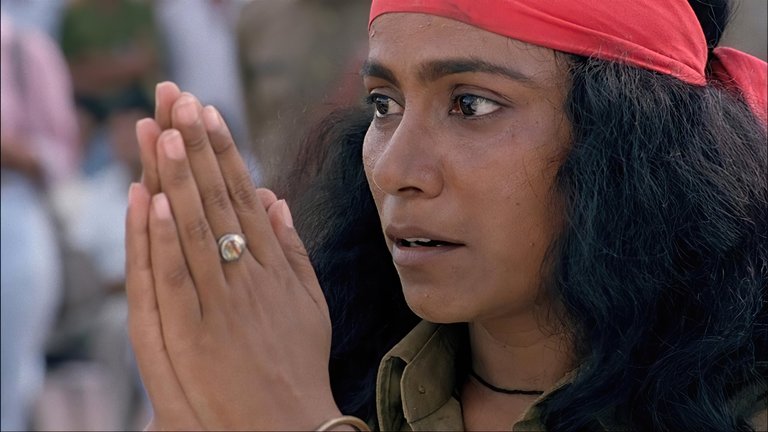
The Indian cinema industry is famously the biggest in the world, at least in terms of sheer feature films produced, much outpacing Hollywood in volume. For many decades, this state of affairs existed, yet despite that industrial might, there are relatively few Indian filmmakers that actually managed to become known outside its boundaries and became household names in global cinema. Usually, it takes extraordinary talents or extraordinary films to break such boundaries. In this regard, Shekhar Kapur managed to do that with his 1994 crime biopic Bandit Queen, an Indian film dedicated to truly extraordinary real-life personality Phoolan Devi.
The film is based on India's Bandit Queen: The True Story of Phoolan Devi, a 1991 book by British Indian human rights activist Mala Sen. Sen partially based her work on prison interviews with Phoolan Devi (1963 – 2001), an Indian lady dacoit (bandit) whose Robin Hood-like exploits caused much controversy but also made her a popular figure among lower castes, eventually serving as the basis for her political career. Mala Sen also wrote the script for the film.
The plot begins in 1968 with Phoolan Devi (Sunita Bhatt) as an 11-year-old daughter of an impoverished villager from the lower Mallah caste in rural Uttar Pradesh. Her family is so poor that her father sells her for a bicycle and a cow to Putillal (Aditya Srivastava), an adult man who beats her and abuses her so much that she runs back to her parents. This act of rebellion marks her later as an „easy” woman, especially when she, as an adult (played by Seema Biswas), begins getting attention from young men from the upper Takur caste that run the village. Rejection of their advances leads to her expulsion from the village and a series of misadventures that would ultimately bring her into the ranks of a local bandit gang led by Babu Gujjar (Aniruddh Agarwal)) in 1979. Gujjar's young lieutenant, Vikram Mallah (Nirmal Pandey), falls in love with Phoolan. Revolted by the way she is sexually abused by Gujjar, he kills him and takes over the gang, treating Phoolan as an equal.
Vikram and Phoolan enjoy their time together, even when Phoolan starts taking revenge on men who had wronged her, including her former husband, who gets viciously beaten. However, Vikram gets killed by Takur Sri Ram (Govind Namdev), the gang leader who has been released from prison. He reasserts his authority by having Phoolan gang-raped, stripped, and publicly humiliated in August 1980. Phoolan is traumatised but gradually recovers and meets Vikram's old friend Man Singh. Man Singh decides to bring her to the large gang led by Baba Mustakim, a Muslim dacoit who doesn't care about caste divisions. He agrees to let Man and Phoolan have their own gang, and in a few months Phoolan leads a series of raids and robberies, giving plenty of loot to the poor. After learning that Takur Sri Ram might attend a wedding in the village of Behmai, Phoolan goes there in February 1981 and massacres the local Takurs, considering them responsible for her rape. This makes the central government in New Delhi to intervene, and after her gang is hunted down, she agrees to the offer of a peaceful surrender in 1983, receiving an 11-year prison sentence for her crimes.
Although the film is made in Hindi, anyone expecting a Bollywood film is going to see something completely different. Kapur directs the film in a simple matter-of-fact style, without bright colours or musical numbers. Instead, it functions as a conventional drama with a strong social and political message, very much like those appreciated by juries and audiences in festivals like Cannes, where the film had caught a lot of attention. While the script by Mala Sen brings strong feminist overtones, showing the protagonist as a victim of abuse not only on the basis of caste but also of her sex, the film also goes into genre territories associated with action, most notably the Western. The dry desert ravines of Uttar Pradesh, where the dacoits hid, look like they belonged to that very genre. Because of the scenes in which the heroine gets raped, as well as nudity, foul language, and graphic violence, Bandit Queen at times looks like an exploitation work belonging to the „rape and revenge” genre. However, it is through the film's anchoring in real events, and Kapur's uncompromising portrayal of injustices suffered by Phoolan, that Bandit Queen avoids commercial cinema clichés.
Bandit Queen is not an easy film to watch, especially during the repeated scenes of sexual abuse, but nevertheless, it shows great skill in direction from Shekhar Kapur. He manages to maintain attention even on an audience unfamiliar with the Indian caste system and complicated politics. Kapur's success for this film allowed him to come to Britain and direct another biopic directed towards a strong female historical character – Elizabeth. The film becomes even darker when considering the controversies related to Phoolan Devi's complaints about inaccurate portrayal, as well as her political career as a Member of the Lok Sabha, which ended with her assassination in 2001. Allegedly, this was motivated as revenge for the 1981 Behmai massacre.
RATING: 8/10 (+++)
==
Blog in Croatian https://draxblog.com
Blog in English https://draxreview.wordpress.com/
InLeo blog https://inleo.io/@drax.leo
InLeo: https://inleo.io/signup?referral=drax.leo
Leodex: https://leodex.io/?ref=drax
Hiveonboard: https://hiveonboard.com?ref=drax
Rising Star game: https://www.risingstargame.com?referrer=drax
1Inch: https://1inch.exchange/#/r/0x83823d8CCB74F828148258BB4457642124b1328e
BTC donations: 1EWxiMiP6iiG9rger3NuUSd6HByaxQWafG
ETH donations: 0xB305F144323b99e6f8b1d66f5D7DE78B498C32A7
BCH donations: qpvxw0jax79lhmvlgcldkzpqanf03r9cjv8y6gtmk9
Dear @drax !
That movie caused a huge shock among East Asian men!