Film Review: Bright (2017)

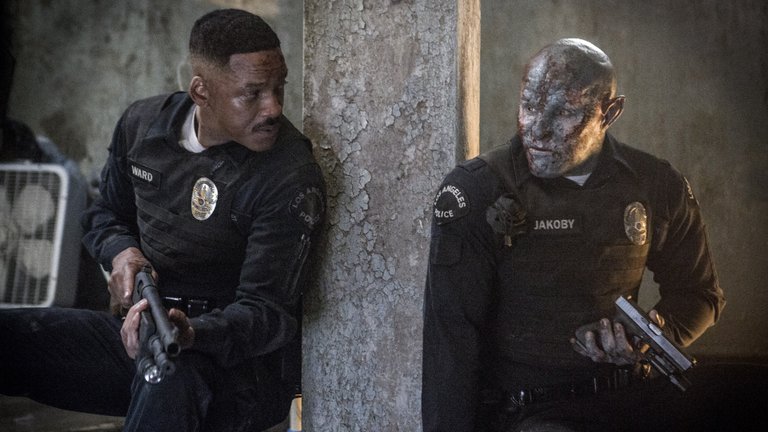
If, in the near future, the global entertainment industry falls under the hegemony of a single corporation, then it will most likely be Netflix. It's hard to avoid that impression today, and it has been hard to avoid over the past couple of years as the former DVD delivery service began its expansion into all world markets via streaming, with the production of original content as one of the cornerstones of its strategy. In doing so, Netflix's strategists showed little concern for how much it would cost or what potentially fatal consequences such a nonchalant attitude towards finances might have for the future of their company. One of numerous examples of their willingness to pour astronomical sums into projects whose audience appeal is far from clear is Bright, a full-length live-action film that at the end of 2017 gained a reputation as the most expensive in Netflix history—with around $100 million invested—but also one of the worst received by critics. Netflix, however, much like other Hollywood studios in similar situations, was not overly impressed by the critics' "raspberries" and announced a sequel, suggesting perhaps an even bolder attempt to create a franchise that might one day become Netflix's version of the Marvel Cinematic Universe.
Bright, on the other hand, could also be called a kind of unofficial spin-off or alternative version of other fictional universes, primarily Tolkien's. The story, however, is set in present-day Los Angeles, but in a parallel universe where the modern world, civilisation and technology coexist with magic and fantastical creatures such as elves, dwarves, orcs, dragons and centaurs. Los Angeles, meanwhile, is sadly quite similar to this universe in some details, particularly in the context of deep social divides and the associated racist and other prejudices in the City of Angels. Thus, elves are at the top of the social hierarchy, controlling the media, banks and top levels of government, while orcs are at the bottom, forced into low-paid jobs and condemned to poverty and crime; humans are somewhere in the middle and show hostility towards both. This also applies to the nominal protagonist, Los Angeles police officer Daryl Ward (Will Smith), whose superiors have assigned as his partner Nick Jacoby (Joel Edgerton), the first orc police officer, whom his human colleagues regard with contempt, while his fellow orcs consider him a traitor. Ward can't stand Jacoby either, but is forced to work with him when both become entangled in the hunt for a fabulously valuable magic wand that grants its possessor indescribable magical power, which is desired by corrupt humans as well as the extreme elven sect Inferna, led by Leilah (Noomi Rapace). The key to the hunt is the elf girl Tikka (Lucy Fry), one of the rare "bright" ones capable of wielding the wand.
Ayer has built a reputation over nearly two decades with films that thematically and tonally largely correspond to Training Day, his most successful work, dealing with the dark underbelly of Los Angeles from the perspective of its law enforcers. Bright in that sense represents a kind of variation on the theme, with the fantastical elements being little more than an excuse for more special effects or sometimes unsubtle allegories for social problems in the real world. It is precisely the latter that got under the skin of salon leftists prone to nitpicking criticism, for while the idea that orcs "play" African Americans and other oppressed minorities could still pass muster, the portrayal of elves as the elite could be read as a potentially antisemitic story—even if the human race in Bright is depicted as a bunch of bigots in the manner the Hollywood elite imagines Trump's voter base. However, the problems with potential political incorrectness are far smaller than the structural issues created by Landis's screenplay, which leaves the sometimes blackly humorous and grotesque interweaving of mythical creatures with the modern world unexplained, aside from a few brief allusions to some epic conflict with the Dark Lord a few thousand years ago. In addition to the underdevelopment of the basic concept, there is also the underdevelopment of numerous supporting characters, suggesting the screenwriters left that job for the sequels. This raises the question of whether Bright might have worked better as a miniseries. On the other hand, Ayer, thanks to good experience and ample resources, has managed to create a more or less convincing world and deliver a string of spectacular action scenes that work despite the clichés. And while Will Smith doesn't quite shine in a role laden with clichés, Edgerton makes a much better impression even under the grotesque mask that renders him unrecognisable. The rest of the cast is good too, even in routine and often thankless roles, which is why the under two hours pass by fairly quickly, making Bright a Netflix investment that might even pay off in the future.
RATING: 5/10 (++)
(Note: The text in the original Croatian version was posted here.)
Blog in Croatian https://draxblog.com
Blog in English https://draxreview.wordpress.com/
InLeo blog https://inleo.io/@drax.leo
LeoDex: https://leodex.io/?ref=drax
Hiveonboard: https://hiveonboard.com?ref=drax
InLeo: https://inleo.io/signup?referral=drax.leo
Rising Star game: https://www.risingstargame.com?referrer=drax
1Inch: https://1inch.exchange/#/r/0x83823d8CCB74F828148258BB4457642124b1328e
BTC donations: 1EWxiMiP6iiG9rger3NuUSd6HByaxQWafG
ETH donations: 0xB305F144323b99e6f8b1d66f5D7DE78B498C32A7
BCH donations: qpvxw0jax79lhmvlgcldkzpqanf03r9cjv8y6gtmk9