Film Review: Day Watch (Dnevnoy Dozor, 2006)

With the 2006 urban fantasy epic Day Watch (Dnevnoi Dozor), director Timur Bekmambetov achieved a rather rare feat in modern cinema: a sequel that is demonstrably superior to its predecessor. Yet, given that the predecessor in question is the 2004 film Night Watch—a commercially successful but critically lambasted work that stands as one of the more disappointing entries in Russian cinema of its time—this achievement isn’t exactly something to write home about. Night Watch was a profound disappointment, a film of immense style and vision that tragically forgot to bring a coherent story along for the ride. It was a visually arresting but narratively incoherent muddle, a dazzling proof of concept that failed to satisfy as a standalone film. Against that low bar, Day Watch manages to feel like a more complete, if still deeply flawed, piece of blockbuster filmmaking.
The script, co-written by Bekmambetov and Alexander Talal, is, despite the title, based on parts of Sergei Lukyanenko’s 1998 novel Night Watch, the same source material as the first film. It was originally supposed to be titled Night Watch Part II, but Focus Features, the American distributor, insisted on a different title to avoid confusion. In any case, most fans of Lukyanenko’s novels have noted that the script has generally strayed from the source material, continuing the first film’s trend of using the book’s mythology as a springboard for a more frenetic, visually driven spectacle rather than a faithful adaptation.
The ‘Day Watch’ of the title refers to the quasi-police force of the ‘Darks,’ one of two factions of ‘Others’—human-like beings with supernatural powers who have maintained a shaky truce with the ‘Lights’ for centuries. The protagonist, again played with weary charisma by Konstantin Khabensky, is Anton Gorodetsky, a Light Other who works for the Night Watch, the force that polices the Darks. At the end of the first film, his young son Yegor (Dmitry Martynov), also an Other, chose to join the Darks, leaving Anton heartbroken and many of his peers concerned about a prophecy that a child will bring about an apocalypse.
Day Watch begins with a prologue set centuries in the past, showcasing the historical figure of Timur, also known as Tamerlane (played by Emir Balgazin). As the Central Asian warlord conquers a city, he shows mercy to a defeated enemy soldier, only to be stabbed in the back. He survives by using the ‘Chalk of Fate,’ a magical artefact that can reverse the course of events, allowing him to kill his enemy instead. This prologue efficiently establishes the chalk as a central MacGuffin while nodding to Bekmambetov’s Kazakh heritage—a theme he expands upon later.
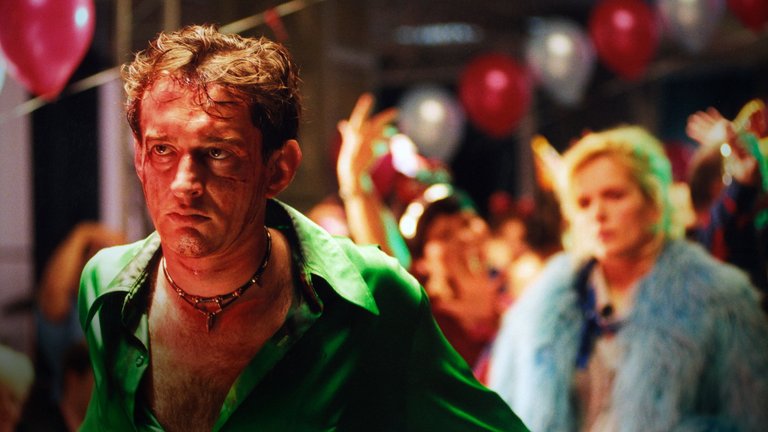
The plot proper returns to contemporary Moscow, with Anton now working as an instructor to Svetlana (Maria Poroshina), a powerfully talented Other with whom he is secretly in love. The fragile truce between the factions is jeopardised when Galina Rogova (Irina Yakovleva), a Dark Other and Yegor’s mentor, is murdered, with all evidence pointing to Anton. Geser (Vladimir Menhov), the leader of the Lights, decides to protect Anton by having him switch bodies with Olga (Galina Tyunina), the owl/human shapeshifter from the first film. This leads to all kinds of comical misunderstandings when ‘Olga’ (inhabited by Anton’s consciousness) meets Svetlana. Meanwhile, Zavulon (Victor Verzhbitsky), the petulant leader of the Darks, has his own agenda and seeks to eliminate Anton. All these threads culminate in a spectacular birthday party for Yegor at Moscow’s iconic Cosmos Hotel, which serves as the backdrop for the film’s chaotic third act.
As in the first film, Bekmambetov displays an enormous flair for visual spectacle. Helped by a larger budget and even more generous use of CGI effects, the film delivers a series of innovative and memorable scenes: cars driving up the sides of buildings, characters leaping through the ‘Gloom’ (the shadow dimension that Others can access), and a thrilling chase involving a flying carpet. Yet, also like its predecessor, this often manifests as an MTV-like dominance of style over substance. The plot remains at times difficult to comprehend, a whirlwind of magical rules, political machinations, and personal vendettas that threatens to overwhelm the viewer. It is only the spirited performances of the cast, particularly Khabensky’s world-weary Anton and Verzhbitsky’s sneering Zavulon, that manage to anchor the chaos and fill the gaps in the script. Bekmambetov does attempt to differentiate the sequel, most notably in its apocalyptic finale, which is truly impressive in its scale: the Ostankino television tower topples, a giant ferris wheel breaks loose and causes chaos on the streets of Moscow. It’s a bravura sequence of computer-generated mayhem that underscores the director’s commitment to sheer visual audacity.
What makes Day Watch a better film, however, is the simple fact that, since the first film—however poorly—established the origin story and painted the world in which the action takes place, the plot here seems a bit more focused. The core through-line of Anton’s framed murder and the body-switch scheme provides a clearer narrative engine than the first film’s scattered vortex-and-curse subplots. Some melodramatic elements remain distracting, such as the ultimately tragic romance between Zavulon’s second-in-command and lover, Alissa Donnikova (Zhanna Fiske), and a young vampire named Kostya Saushkin (Alexey Chadov). Yet, unlike Night Watch, which felt like an unfinished first act, Day Watch’s story doesn’t seem incomplete. It actually concludes with an interesting twist that resets the board, a logical, if cynical, narrative loop that brings everything back to the beginning.
Day Watch is also interesting for its references to history and contemporary Russian culture. Bekmambetov uses the opportunity to feature actors from his native Kazakhstan speaking Kazakh, and he weaves in urban legends about Tamerlane’s curse and its alleged connection to the Second World War. The film also makes extensive use of iconic Moscow landmarks, while paying homage to contemporary Russian cinema with a brief but noticeable poster for the 2005 war film 9th Company. Furthermore, the subplot involving the body switch between Olga and Anton allows for some ‘man in a woman’s body’ and alternative sexuality tropes, played almost entirely for comical effect—a levity that contrasts with the otherwise dour, rain-soaked atmosphere.
Day Watch received generally mixed reviews from critics, who continued to fault its narrative convolution and over-reliance on style. However, it was a commercial success in Russia and even won the MTV Russia Movie Award for Best Film. Bekmambetov initially intended to make a third film, Twilight Watch, but instead leveraged the franchise’s success to advance his career in Hollywood, directing the 2008 action film Wanted.
In the end, Day Watch is indeed a better film than Night Watch. It is more confident, more visually ambitious, and narratively somewhat more cohesive. Yet, it remains a film that can be best recommended only to those who have watched its predecessor. Without the context of the first film’s messy world-building and character introductions, much of Day Watch’s emotional stakes and mythological intricacies would be utterly impenetrable. It stands as a superior sequel to a deeply flawed original—a bigger, louder, and slightly more competent chapter in a saga that promised a great deal more than it ever ultimately delivered.
RATING: 5/10 (++)
==
Blog in Croatian https://draxblog.com
Blog in English https://draxreview.wordpress.com/
InLeo blog https://inleo.io/@drax.leo
InLeo: https://inleo.io/signup?referral=drax.leo
Leodex: https://leodex.io/?ref=drax
Hiveonboard: https://hiveonboard.com?ref=drax
Rising Star game: https://www.risingstargame.com?referrer=drax
1Inch: https://1inch.exchange/#/r/0x83823d8CCB74F828148258BB4457642124b1328e
BTC donations: 1EWxiMiP6iiG9rger3NuUSd6HByaxQWafG
ETH donations: 0xB305F144323b99e6f8b1d66f5D7DE78B498C32A7
BCH donations: qpvxw0jax79lhmvlgcldkzpqanf03r9cjv8y6gtmk9