Film Review: Grimm Love (Rohtenburg, 2006)

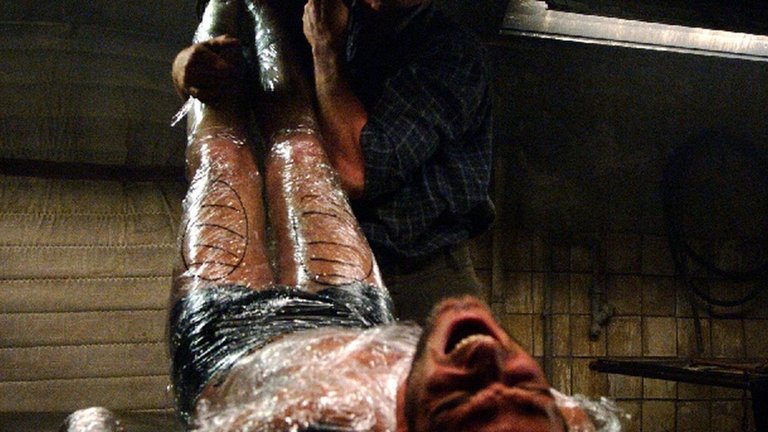
Popular perception, especially in recent decades, rarely associates German cinema with exploitation films. The country's cinematic output is more readily connected with serious artistic endeavours, from the Expressionist masterpieces of the Weimar era to the New German Cinema of Fassbinder, Herzog, and Wenders. Yet one of the more interesting examples to the contrary might be found in the 2006 horror drama Rohtenburg, better known under its English title Grimm Love. This problematic yet fascinating film exists at the uncomfortable intersection of true crime, psychological drama, and exploitation cinema, raising questions about the ethics of adapting real-life atrocities for entertainment purposes.
Rohtenburg is one of a number of films that were, in various degrees, inspired by the sensational case of Armin Meiwes, a German computer repairman who gained worldwide notoriety in 2002 after police found evidence linking him to the murder of Bernd Brandes, an engineer who, after being approached via an Internet advertisement, had agreed to be mutilated and eaten as part of fulfilling a joint sexual cannibalistic fantasy. The case horrified and fascinated the public in equal measure, not least because it presented unprecedented legal challenges: the victim had been a willing participant in his own slaughter. The title itself is a wordplay, a reference to the German word "roh" meaning "raw" and Rotenburg am Fulda, the town where the murder took place in 2001.
The plot presents a fictionalised version of these events, which changed some details, such as the names of participants and actual timing. The film employs a framing story of Katie Armstrong (played by Keri Russell), a young American woman who has come to Germany to study criminal psychology and has decided to take the case of Meiwes' fictional alter ego – Oliver Hartwin (played by Thomas Kretschmann), a notorious cannibalistic murderer. She begins to research the past of both Hartwin and his victim Simon Grombeck (played by Thomas Huber), and through flashbacks the plot describes both men's traumatic pasts and how those traumas might have led them to explore their strange fetishes. Hartwin meets various men who share part of his fantasy via the Internet, but those encounters end without any serious consequences when potential victims back away at the last moment. It is quite different with Grombeck, who goes through with their plan that, among other things, includes Hartwin cutting off and cooking his penis for both men to eat before Grombeck dies of bleeding and is later butchered by Hartwin for further consumption. The film ends with Katie discovering a snuff video of the whole event, which she destroys in disgust.
Rohtenburg, produced by Marco Weber, a former associate of Roland Emmerich who had some of his work in Hollywood, is in its essence an exploitation film. Director Martin Weisz, who began his career in music videos, tries to hide this in the first part, which plays out like some sort of serious psychological drama and gives the impression of trying to provide answers as to what led those two men to this fateful encounter. The script by T. S. Faull suggests that the reason might be feelings of loneliness, and that Hartwin and Grombeck bizarrely complemented each other, fulfilling each other's sick fantasies. The cinematography is dark and depressing, and the slow pacing and grim set-pieces contribute to the building of an overall uncanny atmosphere.
The film becomes more interesting later on, especially when the actual encounter is reconstructed. Despite most of the target audience, which was familiar with the Meiwes case, probably knowing what happens next, Weisz is a capable director who maintains the suspense, and Thomas Kretschmann and Thomas Huber play their characters very well. However, near the end, the film tries to speculate that the victim, being reminded of his gay lover, had some second thoughts and wanted to live, but was too drugged or weak to stop the killer's plan. This detail looks added only to prevent the victim from being held responsible and to make the film more palatable to "normies" and their sense of morality. It is a dishonest embellishment that undermines the genuinely disturbing nature of the actual case, where consent was unequivocally given throughout.
Weisz, much to his credit, is true to his approach and, despite a few disturbing scenes, is never too graphic in the depiction of actual violence. His direction is subtly creepy and he clearly does not aim for sensationalism in the conventional sense. There is a restraint here that distinguishes the film from the more lurid entries in the cannibal subgenre, and the film plays more like a drama than a horror movie or thriller, which is appropriate given it is based on a true case of voluntary cannibalism.
What ultimately ruins the film and makes it too exploitation-like is the presence of Katie Armstrong as both some sort of Greek chorus and a "normie" character with whom the audience can identify. While Russell delivers a capable performance, her presence looks too convenient, and her nationality clearly points out that the film was intended for the lucrative US market, trying to sensationalise and "spice up" an already difficult story. The film has clearly been made for English-language rather than German audiences – the actors speak in English, whilst the email exchanges and the phrases written on body parts are all in English. Yet all that only ruins the suspension of disbelief and deprives the film of having some sort of point or closure.
The English-language retitlings, Grimm Love and Butterfly: A Grimm Love Story, are also contrived – the phrase "Grimm Love" is unrelated to anything else in the film, except for one line where it is said they are close to a forest location of the Grimm Brothers, whilst there is nothing at all in the film about butterflies. One cannot help but feel that a more straightforward telling without the narrative wraparound would have helped Rohtenburg/Grimm Love to no end.
Ironically, the film became unavailable in Germany due to Meiwes, then serving a life sentence, taking legal action claiming that the film infringed on his personal rights; the ban, which was lifted in 2009, didn't prevent Grimm Love from being shown and even winning some awards at various horror film festivals, including Best Director, Best Actor for both Kretschmann and Huber, and Best Cinematography at the 2006 Festival de Cine de Sitges.Weisz used it as a way to continue his career in Hollywood with the 2007 film The Hills Have Eyes 2.
As it stands, the film is a curious but flawed artefact – too sensational for serious drama, too restrained for exploitation, and ultimately unsure of what it wants to be.
RATING: 4/10 (+)
==
Blog in Croatian https://draxblog.com
Blog in English https://draxreview.wordpress.com/
InLeo blog https://inleo.io/@drax.leo
InLeo: https://inleo.io/signup?referral=drax.leo
Leodex: https://leodex.io/?ref=drax
Hiveonboard: https://hiveonboard.com?ref=drax
Rising Star game: https://www.risingstargame.com?referrer=drax
1Inch: https://1inch.exchange/#/r/0x83823d8CCB74F828148258BB4457642124b1328e
BTC donations: 1EWxiMiP6iiG9rger3NuUSd6HByaxQWafG
ETH donations: 0xB305F144323b99e6f8b1d66f5D7DE78B498C32A7
BCH donations: qpvxw0jax79lhmvlgcldkzpqanf03r9cjv8y6gtmk9
⚠️⚠️⚠️ ALERT ⚠️⚠️⚠️
HIVE coin is currently at a critically low liquidity. It is strongly suggested to withdraw your funds while you still can.