Film Review: High Lane (Vertige, 2009)

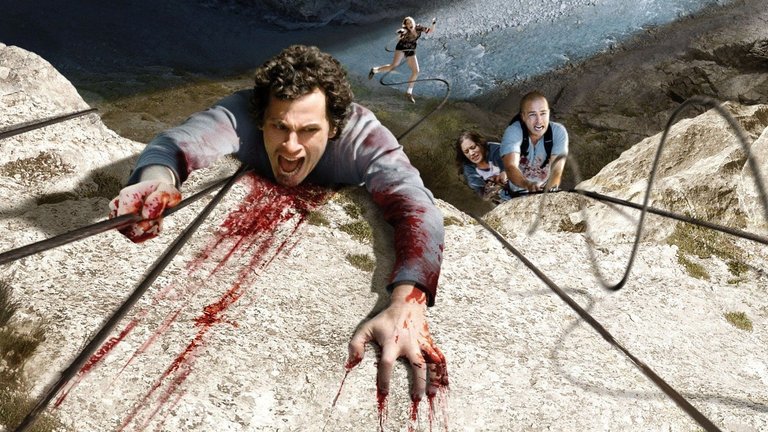
The cinematic landscape of the 21st century has seen relatively few films whose plots are squarely set in Croatia. Those that do exist are generally unlikely to win favour among Croatian tourism officials. Into this small, unflattering canon arrives High Lane (French title: Vertige), a 2009 French horror film directed by Abel Ferry. It follows in the dubious footsteps of works like Hostel in using Central and East European locales as a backdrop for primal fear and grotesque violence, ultimately reinforcing tiresome and damaging stereotypes about the region.
The choice of setting is the film’s first notable, if ultimately squandered, feature. By 2009, Croatia had firmly established itself as a premier destination for sun-seeking tourists, famed for its pristine Adriatic coast and historic Dalmatian cities. The protagonists of High Lane, however—five young, affluent French friends—pointedly reject this idyll. They are passionate mountaineers, seeking the rugged, sparsely populated interior, specifically the mountainous northwestern region near the Risnjak National Park. This is a place of breathtaking natural beauty, characterised by dense forests, limestone peaks, and sheer cliffs. The film initially leverages this setting effectively, establishing a mood of isolated grandeur that quickly curdles into unease. It is a promising setup, suggesting a conflict with nature itself.
Our ill-fated quintet comprises Fred (Nicolas Giraud), the confident, slightly reckless leader; his girlfriend Karine (Maud Wyler); their friend Chloé (Fanny Valette), a nurse grappling with guilt over a patient’s death; Chloé’s boyfriend Loïc (Johan Libéreau), who is fearful and inexperienced; and Guillaume (Raphaël Lenglet), who carries a torch for Chloé. Their dynamic is strained from the outset, fuelled by hidden tensions and Loïc’s anxiety, which proves justified. The planned hike becomes a series of perilous close calls, masterfully shot to induce vertigo. The real narrative rupture occurs when Fred, insisting on taking a closed-off trail, steps into a concealed bear trap. In the chaotic aftermath, before his friends can free him, he is violently snatched away by an unseen assailant. Karine is next, pierced by an arrow and dragged off. The surviving trio—Chloé, Loïc, and Guillaume—stumble upon a remote cabin, only to discover its owner, Anton (Justin Blanckaert), is a feral, cannibalistic killer. The film then abruptly pivots from a tense mountaineering survival tale into a relentless, brutal slasher, with Chloé emerging as the archetypal ‘Final Girl’ in a fight for her life.
Made on a relatively low budget and squarely aimed at the young adult slasher audience, High Lane is competently directed by Abel Ferry, with the mountaineering sequences being particularly visceral and well-executed. However, the film suffers from a fundamental structural flaw: it is essentially two different movies stitched uneasily together. The first half is a gripping adventure drama in the vein of Cliffhanger, pitting human frailty against indifferent, brutal nature. The second half is a by-the-numbers backwoods horror in the tradition of The Hills Have Eyes, complete with a degenerate antagonist and a grim cabin. The transition is jarring; the sophisticated natural threat of the cliffs is abandoned for a more mundane, human monster, feeling like a narrative bait-and-switch that diminishes both sections.
This structural issue is compounded by a pervasive predictability. Chloé’s role as the resilient, morally burdened nurse telegraphs her status as the Final Girl from the outset. The other characters are largely unsympathetic or underdeveloped, their interpersonal conflicts feeling like trivial filler before the carnage begins. Their decisions often skew toward irrational malice, most egregiously in Guillaume’s actions near the climax, which seem engineered solely to extend the runtime and reduce the survivor count. Even the film’s final, grim twist regarding Chloé’s fate feels like a foregone conclusion, lacking the impact of a genuine surprise.
One of the film’s few inspired touches is its ironic use of music. The 1995 Britpop hit “Alright” by Supergrass is employed twice as a diegetic soundtrack. First, the group sings it joyously in their car during the sun-drenched opening journey, full of anticipation. Later, they desperately hum and whisper the same song to herself as they walk through the dark woods, a haunting echo of lost innocence. This clever callback is a brief moment of stylistic coherence and thematic depth in an otherwise conventional genre piece.
Ultimately, the film’s most significant failure lies in its coda and its implicit worldview. The closing titles provide a ‘semi-official’ fate for the characters and make a vague reference to thousands of people mysteriously disappearing in the Balkans. This clumsy attempt to add gravitas instead reveals the film’s regressive core. It inadvertently plays into the oldest, most annoying stereotypes of Eastern Europe as a primitive, violent, and labyrinthine hinterland, a place where civilisation falters and barbarism reigns. This stands in stark contrast to the enlightened, ‘cool’ Western Europe represented by the attractive, cosmopolitan protagonists. In this regard, High Lane is a less graphic but equally cynical successor to Hostel, using a specific national context merely as exoticised set dressing for a reactionary fear of the ‘Other’.
Finally, for Croatian viewers or those familiar with the region, the inauthenticity is baked into the very landscape. Despite being set in Croatia, the film was primarily shot in the Alpine regions of the French Savoie. While this is a common logistical compromise, it means the specific, unique karst topography of the Croatian mountains is absent, replaced by generic, if beautiful, alpine vistas. The Risnjak region is thus rendered anonymous, stripped of its real identity to serve as a generic ‘dangerous foreign place’. In the end, High Lane is a moderately effective, if deeply flawed, genre exercise that fails its intriguing premise. It sacrifices potential originality for familiar horror beats and, in doing so, perpetuates a cultural caricature that its stunning real-world setting deserved far better than.
RATING: 5/10 (++)
Blog in Croatian https://draxblog.com
Blog in English https://draxreview.wordpress.com/
InLeo blog https://inleo.io/@drax.leo
InLeo: https://inleo.io/signup?referral=drax.leo
Leodex: https://leodex.io/?ref=drax
Hiveonboard: https://hiveonboard.com?ref=drax
Rising Star game: https://www.risingstargame.com?referrer=drax
1Inch: https://1inch.exchange/#/r/0x83823d8CCB74F828148258BB4457642124b1328e
BTC donations: 1EWxiMiP6iiG9rger3NuUSd6HByaxQWafG
ETH donations: 0xB305F144323b99e6f8b1d66f5D7DE78B498C32A7
BCH donations: qpvxw0jax79lhmvlgcldkzpqanf03r9cjv8y6gtmk9