Film Review: King Richard and the Crusaders (1954)

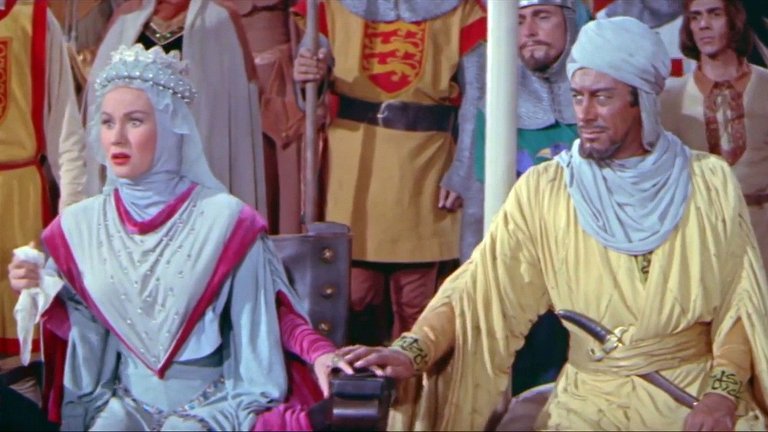
Of all the medieval conflicts, the Third Crusade remains arguably the most popular among Hollywood filmmakers. This fascination is partly due to the conflict’s thematic connection with the beloved legends of Robin Hood, a staple of adventure cinema, but it is also significantly because the two main protagonists—King Richard the Lionheart of England and Sultan Saladin—came to embody the noble ideals of chivalry in the popular perception. This romanticised view of the period is largely the product of centuries of European literature, which glossed over the brutality of the era in favour of tales of honour and courtly love. Chief among these literary influences is Sir Walter Scott’s 1825 novel, The Talisman. This romantic historical work served as the primary foundation for the 1954 Hollywood adaptation, King Richard and the Crusaders, a film directed by David Butler.
The narrative of the film is set in the year 1191, during the arduous campaign to liberate Jerusalem from the Saracens led by the formidable Saladin. King Richard (George Sanders), is leading the Crusader’s army, but the campaign is faring poorly. The primary impediment to success is not the enemy without, but the infighting and intrigues within the Crusader ranks. The film highlights the political manoeuvring of Duke Leopold of Austria (Wilton Graff), and King Philip II of France (Henry Corden), both of whom are vying for overall leadership of the forces. However, the most palpable danger to Richard emerges from Sir Giles Amaury (Robert Douglas). Amaury is the ambitious leader of the "Castleine" knights, an order Richard decreed would lead the army should he perish. Conspiring with Marquis Conrad of Montferrat (Michael Pate), Amaury schemes to accelerate this succession by dispatching a bowman to strike Richard with a poisoned Saracen arrow.
Richard survives this treacherous assassination attempt, though his condition remains grave and his life hangs in the balance. In her desperation, Queen Berengaria (Paula Raymond), journeys to a monastery to pray for her husband’s recovery. Recognising the perils of the terrain, Richard’s Scottish knight, Sir Kenneth of Huntington (Laurence Harvey), is tasked with scouting the path to ensure her safety. It is in the desert that Sir Kenneth encounters Emir Ilderim (Rex Harrison), a Muslim physician. Ilderim volunteers his expertise to the stricken King, and his unconventional methods prove effective, rallying Richard to health. During his stay in the Crusaders’ camp, Ilderim becomes captivated by Lady Edith of Plantaganet (Virginia Mayo). The Lady is the King’s cousin and is secretly in love with Sir Kenneth, setting the stage for a complex romantic entanglement. The plot thickens when it is revealed that the physician was actually sent by Saladin, who seeks to establish peace. This diplomatic overture threatens Sir Giles’ machinations; in response, he kills Saladin’s envoys, dons their attire, and kidnaps Lady Edith, hoping to frame Saladin for the crime. In a dramatic turn of events, Saladin is revealed to have been Ilderim all along. He thwarts the conspiracy, and Sir Kenneth ultimately kills Sir Giles, leading Richard to bless the union between the knight and Lady Edith.
Work on King Richard and the Crusaders began on the film shortly after the triumph of Ivanhoe, a historical spectacle set in exactly the same period and also based on a Walter Scott novel. In a twist of casting, George Sanders, who plays the hero King Richard in this film, had portrayed the villainous De Bois-Guilbert in Ivanhoe. Warner Bros., the studio backing the project, was eager to replicate the massive financial success of its predecessor. To entice audiences back to cinemas for another helping of medieval history, the studio employed the new Cinemascope picture format. This technological innovation was utilised as an extra attraction, a means to make the film appear even more spectacular and grandiose than the standard fare of the day.
Despite these commercial advantages, the ultimate result was hardly the success the studio had anticipated. The film was poorly received by contemporary critics and failed to recoup its substantial production costs at the box office. The reasons for this failure are manifold, but they largely rest on an uninspired direction by David Butler and an even less inspired script by John Twist. The dialogue burdens the actors with flowery, stilted lines that feel theatrical rather than cinematic. The only exception to this turgid prose is a line that has achieved a degree of infamy for its unintended hilarity. When Lady Edith chastises her royal cousin, she cries out, "War, war, war, is this all you think of, Dick Plantagenet?"—a moment of jarring anachronism that often elicits laughter rather than the intended solemnity.
While historians might traditionally be unhappy with Hollywood’s cavalier approach towards authenticity, the specific deviations in this film are particularly notable. John Twist was forced to invent the "Castleine" knights to serve as the villains. This invention was necessitated by the strictures of the MPAA Production Code, which forbade the negative portrayal of members of the clergy. In reality, the antagonists of this period would likely have been the Templars, but they shared their name with the Masonic Knights Templar—an organisation that allegedly counted some of Hollywood’s most influential people among its members.
Furthermore, modern audiences may find themselves put off by the portrayal of the Saracens, which is viewed through a distinct Orientalist lens. Rex Harrison, a classically English actor, is made up with a darker complexion to portray Saladin. The character is presented as somewhat effeminate, depicted in possession of a harem and even indulging in the spectacle of a scantily clad belly dancer within his tent. Despite these dated tropes, Harrison, who later described the film as "rotten", delivers a competent performance. Moreover, the film deserves credit for praising Saladin’s character as a man of peace who preferred diplomacy to fighting—a sentiment that likely resonated with audiences during the early stages of the Cold War.
Another significant issue plaguing the film is the terrible miscasting of Virginia Mayo. She completely lacks chemistry with the young Laurence Harvey, making their supposed romance feel forced and unconvincing. Furthermore, it requires a significant suspension of disbelief to accept her as the object of Saladin’s intense lust; her performance lacks the spark necessary to justify such high-stakes romantic rivalry.
What ultimately rescues this film from total obscurity is a series of effective action scenes, as well as a more than serviceable musical score by the legendary composer Max Steiner. Steiner’s music provides the emotional gravitas that the script occasionally lacks, sweeping the audience along in the narrative. Additionally, George Sanders seems to be having a thoroughly good time playing King Richard. He brings a certain roguish charm and authority to the role that elevates the material whenever he is on screen, reminding viewers why he was a staple of Hollywood’s Golden Age.
The legacy of King Richard and the Crusaders is a curious one. In 1978, the film achieved a dubious immortality by entering the infamous book The Fifty Worst Movies Ever Made. However, it also became the subject of film criticism by the esteemed director François Truffaut. Truffaut called the film "bad", but he used it to illustrate a broader point about cinema, arguing that "the bad American film is better than a bad French film". His reasoning was that even in failure, the American product possessed a level of glitz, glamour, and colour that European films of the time often lacked.
In conclusion, the audience today is more likely to agree with Truffaut’s more charitable assessment. King Richard and the Crusaders is undoubtedly a flawed picture, hampered by a weak script, questionable casting, and dated cultural sensibilities. However, despite these many faults, the film still provides a considerable amount of entertainment. It possesses a certain Classic Hollywood charm, a Technicolor vibrancy, and a swashbuckling energy that might win over more nostalgic cinephiles who are willing to overlook its historical inaccuracies and narrative shortcomings.
RATING: 5/10 (++)
==
Blog in Croatian https://draxblog.com
Blog in English https://draxreview.wordpress.com/
InLeo blog https://inleo.io/@drax.leo
InLeo: https://inleo.io/signup?referral=drax.leo
Leodex: https://leodex.io/?ref=drax
Hiveonboard: https://hiveonboard.com?ref=drax
Rising Star game: https://www.risingstargame.com?referrer=drax
1Inch: https://1inch.exchange/#/r/0x83823d8CCB74F828148258BB4457642124b1328e
BTC donations: 1EWxiMiP6iiG9rger3NuUSd6HByaxQWafG
ETH donations: 0xB305F144323b99e6f8b1d66f5D7DE78B498C32A7
BCH donations: qpvxw0jax79lhmvlgcldkzpqanf03r9cjv8y6gtmk9