Film Review: Lemony Snicket's A Series of Unfortunate Events (2004)

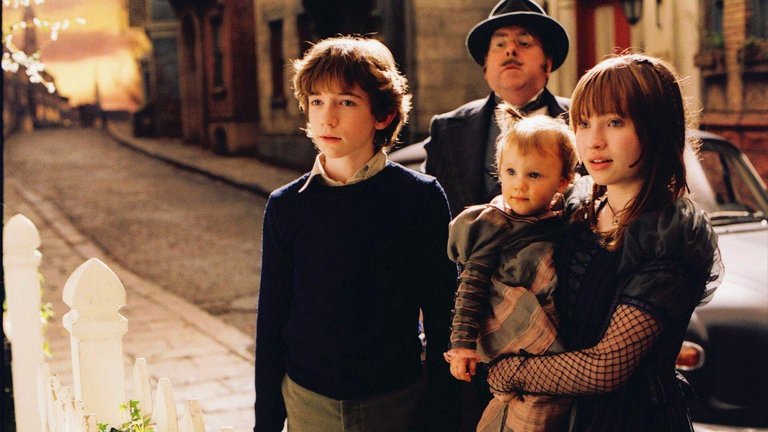
Early 21st century witnessed a seismic shift in Hollywood’s approach to children’s literature, largely driven by the monumental success of the Harry Potter film series. This cinematic triumph convinced studio executives that popular children's book series represented a new goldmine to be exploited. Consequently, a plethora of similar projects were launched at the start of the new millennium, ranging from instantaneous blockbusters to middling failures. Among this crowded field, Lemony Snicket's A Series of Unfortunate Events (2004), directed by Brad Silberling, stands out as one of the more interesting, albeit not commercially successful, attempts. While it failed to achieve the massive box office returns of its fantasy counterparts, it is a distinctive entry in the canon of children’s cinema, offering a darkly stylised alternative to the brighter horizons of Hogwarts.
The film is adapted from the cycle of thirteen children's novels written by American author Daniel Handler (who writes under the pseudonym Lemony Snicket), which were published from 1999 to 2006. The screenplay by Robert Gordon condenses the plot into an adaptation of the first three books of the cycle: The Bad Beginning, The Reptile House, and The Wide Window. The film introduces the children’s world through the perspective of the titular narrator, Lemony Snicket (voiced by Jude Law). Snicket is established not merely as a storyteller, but as an investigator and writer who guides the audience through the tragedy befalling the Baudelaire orphans.
The protagonists are the three Baudelaire children - Violet (Emily Browning), the 14-year-old eldest, a brilliant inventor who ties her hair up when she needs to think; Klaus (Liam Aiken), the 12-year-old bibliophile with a vast knowledge of obscure facts and a penchant for quoting literature and the youngest sibling, Sunny (played by twins Kara and Shelby Hoffman), is an infant whose vocabulary consists primarily of biting and single words. The plot trajectory is one of relentless misfortune. It begins when Violet and Klaus receive the devastating news that their parents have perished in a fire. Their family banker, Mr. Poe (Timothy Spall), while settling the family affairs, places all three siblings in the care of their distant relative, Count Olaf.
Count Olaf (Jim Carrey), is revealed to be a nefarious stage actor intent on getting his hands on the Baudelaire fortune, which is supposed to be inherited by Violet when she reaches eighteen years of age. Olaf treats the children with cruelty, ranging from demeaning chores to attempted murder; he famously tries to kill them by locking them in a car on a train track. The children manage to escape, and Mr. Poe, shaken by the attempt on their lives, removes Olaf's custody. He subsequently places the Baudelaires in the care of Dr. Montgomery "Uncle Monty" Montgomery (Billy Connolly), an eccentric herpetologist. However, Olaf resurfaces, disguising himself as Monty's assistant, "Stefano," and ensures Monty's demise. The Baudelaires are finally put in the care of their eccentric hermit Aunt Josephine (Meryl Streep), a woman terrified of water and obsessed with grammar. Olaf returns once more, this time disguising himself as "Captain Sham," a shallow man who marries Josephine off to him. After Josephine is pushed from a boat by Olaf, the children find themselves under his thumb once more, leading to the final act where Olaf stages a play to force Violet into a marriage she cannot legally sign.
The production history of the film is as unfortunate as the plot itself. Producer Scott Rudin and original director Barry Sonnenfeld abandoned the project over a budget dispute with Paramount Pictures. Sonnenfeld was arguably the right director for this material, given his previous work on The Addams Family and Addams Family Values, which possessed a similar blend of dark humour and gothic whimsy. Despite the change in leadership, Brad Silberling—who came in as a replacement—managed to do a solid job. His primary hurdle was making A Series of Unfortunate Events distinguishable from the Harry Potter films, a task he achieved through a concerted effort to provide the film with a much darker tone and a specific genre combination that mixes children's fiction with murder mystery, Gothic fiction, and dark comedy.
This differentiation was achieved not only through tone but through a distinct visual style. The film was entirely made in studios, utilising CGI, matte paintings, and intricate set designs to create a dark, almost monochromatic world. This aesthetic could have been England or America, or it could belong to our times or distant past; in any case, the result is a surreal atmosphere and a memorable visual look that sets it apart from its contemporaries. The film also benefits immensely from Jim Carrey, who takes the role of villain with gusto, playing not one but three different versions of the same character. The rest of the cast is equally good, including an almost unrecognisable Timothy Spall as Mr. Poe and Meryl Streep, who plays what is in essence a side character with great comedic timing. Emily Browning, the young Australian actress who plays Violet, handles her role with composure, and it is unsurprising that she maintained her career in subsequent years, just as Liam Aiken, who played her brother, did.
The result is a surreal but entertaining adventure that could be pleasing both for younger and more discerning adult viewers. However, it suffers a lot from the ending, which is deliberately left without proper closure in order to leave room for new sequels. The script sets up a clear trajectory for the orphans' misfortune, culminating in a cliffhanger that teases further adventures. Unfortunately, those sequels were never made because the film failed to have the box office impact that would be too convincing for Paramount executives. As time went by, the child actors grew out of their characters, making sequels impractical. Instead, the story of the Baudelaire orphans was eventually adapted into a television series by Netflix, originally streamed between 2017 and 2019, serving as the definitive conclusion to the saga that the 2004 film only teased.
RATING: 6/10 (++)
==
Blog in Croatian https://draxblog.com
Blog in English https://draxreview.wordpress.com/
InLeo blog https://inleo.io/@drax.leo
InLeo: https://inleo.io/signup?referral=drax.leo
Leodex: https://leodex.io/?ref=drax
Hiveonboard: https://hiveonboard.com?ref=drax
Rising Star game: https://www.risingstargame.com?referrer=drax
1Inch: https://1inch.exchange/#/r/0x83823d8CCB74F828148258BB4457642124b1328e
BTC donations: 1EWxiMiP6iiG9rger3NuUSd6HByaxQWafG
ETH donations: 0xB305F144323b99e6f8b1d66f5D7DE78B498C32A7
BCH donations: qpvxw0jax79lhmvlgcldkzpqanf03r9cjv8y6gtmk9
Uuuh ive watched this movie many years ago!! Thanks for the review must be a good time for a rewatch especially with my stepdaughter she haven't see it yet.