Film Review: Mary of Scotland (1936)

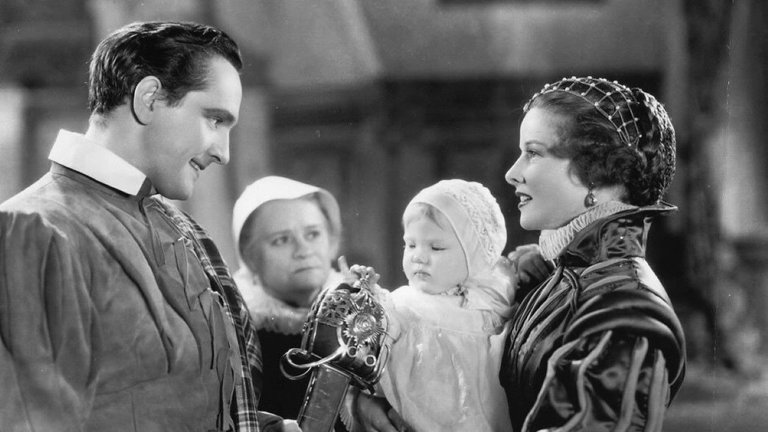
Katharine Hepburn is rightly remembered as one of the most regal and intellectually formidable stars of Classic Hollywood, an icon whose career spanned decades and earned her a record four Academy Awards for Best Actress. Yet, for much of the 1930s, Hepburn was notoriously labelled “box office poison” by skittish theatre owners, a tag that stemmed from a series of prestigious but commercially disappointing vehicles. Perhaps none did more to cement this unenviable status than her 1936 historical drama, Mary of Scotland. The film also occupies an awkward, often dismissed place in the formidable filmography of its legendary director, John Ford. While technically competent, the picture is a fascinating case study in miscasting, narrative overreach, and the perils of adapting stagy, verbose theatre into cinematic spectacle, resulting in a plodding and emotionally inert production that fails to do justice to its turbulent historical subject or its formidable leading lady.
The script, written by Dudley Nichols from Maxwell Anderson’s 1933 Broadway play, inherits both the strengths and weaknesses of its source. Anderson, a prolific playwright with a penchant for British history rendered in elevated, sometimes ponderous verse, provides a framework heavy on political intrigue but light on compelling personal drama. The plot follows the broad strokes of Mary Stuart’s tragic return to Scotland following the death of her first husband, Francis II of France. As a Catholic monarch arriving in a nation increasingly swayed by the fiery Protestantism of John Knox (a stern Moroni Olsen), she is immediately at odds with her illegitimate half-brother, the Earl of Moray (Ian Keith), who has served as regent. Her very existence poses a profound threat to her distant cousin, Queen Elizabeth I (Florence Eldridge), who views Mary’s superior claim to the English throne through the lens of her own perceived illegitimacy. Elizabeth thus dedicates herself to undermining Mary’s rule from afar.
Mary’s position, however, is perilous from the outset. Her faith alienates the powerful Protestant nobility, leaving her dependent on unlikely allies. The most significant of these is the Earl of Bothwell (Fredric March), a gruff Protestant lord whose loyalty is fuelled by a growing romantic passion. Counseled by her devoted secretary, David Rizzio (John Carradine), Mary seeks to secure her throne through a politically astute marriage, choosing her Catholic cousin, Lord Darnley (Douglas Walton). Darnley is soon revealed as an effete and spiteful drunkard, whose jealousy over Rizzio’s influence culminates in the secretary’s murder. The subsequent assassination of Darnley, Mary’s forced marriage to Bothwell, her defeat at the hands of Moray’s rebels, and her fateful flight to England—where she would spend nearly two decades in captivity before her execution—are all rendered with a dutiful, chronological haste that prioritises event over insight.
From a purely technical standpoint, there is little to fault in Mary of Scotland. John Ford, though far from his comfort zone of western landscapes and Irish-American camaraderie, directs with a solid hand. The production values are lush, the costumes and sets are detailed, and the cinematography is professional. The material would, in theory, have appealed to Ford’s well-documented Catholic sensibilities and his occasional anti-English streak, previously explored in The Informer. Here was a chance to portray Mary as a Catholic martyr and national heroine, crushed by the ruthless machinations of the English crown. Yet, the film curiously fails to make her its emotional core. Mary is more often a reactive figure, buffeted by the schemes of men and the decrees of history, rather than a driving force. She becomes a passive icon, not a tragic protagonist, leaving the intricate political machinations without a compelling human anchor.
This central void is exacerbated by the quality of the performances, which range from the valiantly mismatched to the outright poor. Katharine Hepburn strives to invest Mary with dignity, intelligence, and a stubborn pride, but she is fighting against the script’s limitations and a profound lack of chemistry with her leading man. Fredric March, a typically reliable and distinguished actor, is utterly miscast as Bothwell. His performance lurches into broad, unconvincing bluster, his declarations of love feeling shouted rather than felt. There is no spark of credible passion between them, fatally undermining the film’s central romantic through-line. In stark contrast, Florence Eldridge (March’s real-life wife) delivers the film’s most compelling work as Elizabeth. She captures the monarch’s brilliant, neurotic insecurity and calculating coldness with chilling precision, and she utterly dominates the film’s one great scene—a completely fictional confrontation between the two queens. This invented meeting, while ahistorical, provides the dramatic catharsis the rest of the film lacks. Douglas Walton also manages to make an impression as the petulant, weak Darnley, with one remarkably suggestive line implying the character’s homosexuality—a subtle subversion that somehow slipped past the prudish Hays Office censors.
Upon its release, Mary of Scotland received mixed reviews and proved a definitive box-office failure, further tarnishing Hepburn’s commercial appeal. Modern assessments tend to align with the general contemporary opinion: it is a handsome but dull misfire. This is a sentiment reportedly shared by John Ford himself, who held the film in particularly low regard. Numerous anecdotes from later productions suggest that crew members would deliberately mention Mary of Scotland to irritate the famously irascible director, knowing it was a guaranteed method of provoking his temper. Ultimately, the film demonstrates that even the combined talents of a great star, a legendary director, and a respected playwright cannot salvage a project where the central dramatic engine fails to ignite, leaving behind a beautifully mounted but emotionally barren historical pageant.
RATING: 5/10 (++)
Blog in Croatian https://draxblog.com
Blog in English https://draxreview.wordpress.com/
InLeo blog https://inleo.io/@drax.leo
InLeo: https://inleo.io/signup?referral=drax.leo
Leodex: https://leodex.io/?ref=drax
Hiveonboard: https://hiveonboard.com?ref=drax
Rising Star game: https://www.risingstargame.com?referrer=drax
1Inch: https://1inch.exchange/#/r/0x83823d8CCB74F828148258BB4457642124b1328e
BTC donations: 1EWxiMiP6iiG9rger3NuUSd6HByaxQWafG
ETH donations: 0xB305F144323b99e6f8b1d66f5D7DE78B498C32A7
BCH donations: qpvxw0jax79lhmvlgcldkzpqanf03r9cjv8y6gtmk9
Congratulations @drax! You have completed the following achievement on the Hive blockchain And have been rewarded with New badge(s)
You can view your badges on your board and compare yourself to others in the Ranking
If you no longer want to receive notifications, reply to this comment with the word
STOPCheck out our last posts: