Film Review: Mary Queen of Scots (2018)


American cultural imperialism manifests itself in, among other things, the fact that, for example, the average resident of Croatia probably has no idea who ruled their country in the second half of the 16th century, but will likely have some notion that the British Isles were ruled at the same time by Queen Elizabeth. The reason lies first and foremost in Hollywood having taken from its former colonial motherland not only acting, screenwriting, and other talents but also history as a rather grateful source of material for commercially or artistically ambitious costume dramas. And rarely has anyone been as grateful a figure as Elizabeth, probably the greatest of all rulers in the history of the Isles, who during her nearly half-century reign, often proclaimed a kind of ‘golden age’, accumulated not only numerous political, military, economic, and cultural achievements but also many enemies. Among them, Mary, Queen of neighbouring Scotland, whose biography was quite colourful, and in some details perhaps even more colourful than that of the Virgin Queen, probably stands out the most. This had been recognised by numerous artists, writers, and finally filmmakers, including Josie Rourke, under whose direction the biographical film Mary Queen of Scots was made in 2018.
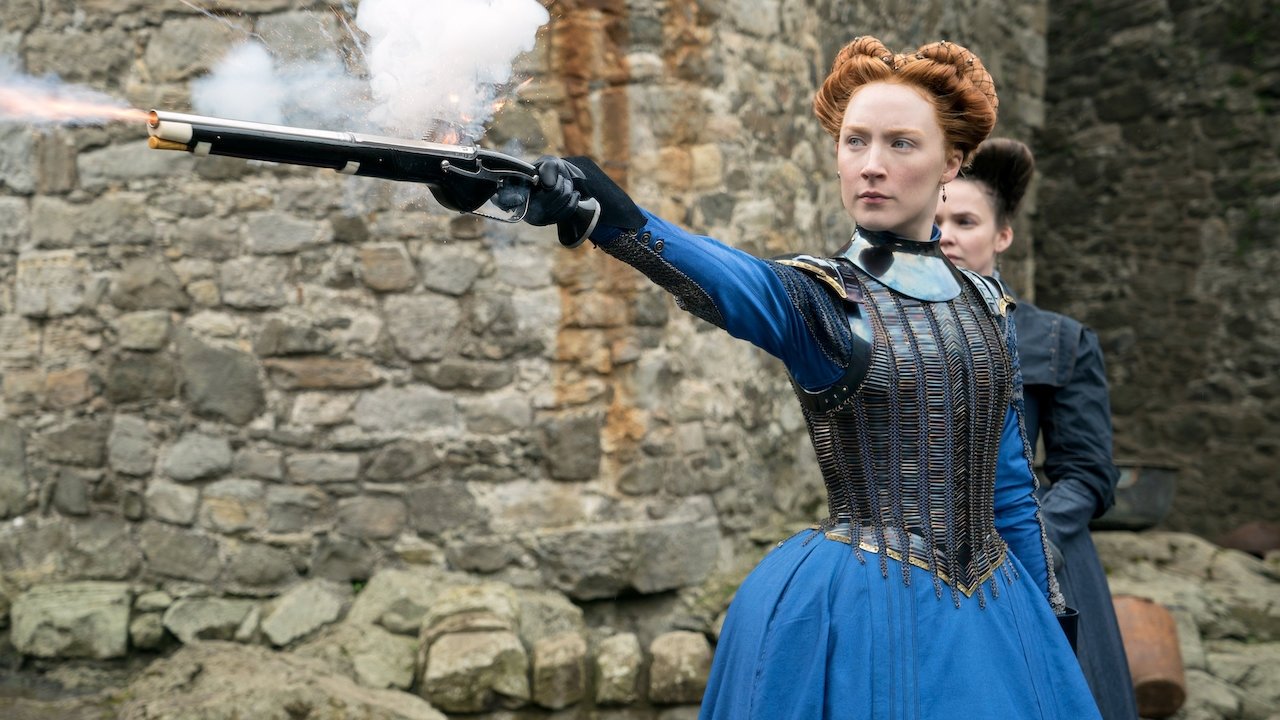
The plot begins in 1561 when the 19-year-old Mary (Saoirse Ronan), who had inherited the Scottish throne as a small baby, arrives in Scotland from France where she had grown up, been educated, and was for a time married to the French King Francis II. Her compatriots greet the young woman with little enthusiasm, including both her half-brother and regent Lord Moray (James McArdle) and the preacher John Knox (David Tennant), who in the meantime had carried out the Protestant Reformation in Scotland and cannot bear the idea of the state being taken over by a queen who remained faithful to the Catholic Church. Besides internal conflicts, Mary is also threatened by her distant cousin, the 29-year-old English Queen Elizabeth (Margot Robbie), who is unmarried and childless and seriously concerned that after her death, the throne of Protestant England could be inherited by the Catholic Mary. She tries to solve this problem by ‘arranging’ for Mary to marry her own lover, Lord Dudley (Jack Lowden), but neither Mary nor Dudley are thrilled with this plan, so Mary, to Dudley’s great relief, takes Dudley’s compatriot Lord Darnley (Joe Alwyn) as her future husband. However, the marriage turns out to be anything but happy; although Darnley gives her the long-desired child that should unite the thrones of the two countries, he is also unfaithful to her, both romantically and politically, so Mary’s throne and life come into danger.
Mary Queen of Scots appeared in American cinemas at the end of the year, leaving no doubt that the main purpose of this British-American production was to try and win as many ‘Oscars’ and other prestigious awards as possible. And, like many such projects, the concern for some more fundamental things like a coherent screenplay or a solid story was very often sacrificed to this goal. Thus, Mary’s character as a ‘serious’ or ‘art’ film was supposed to be given by its director Rourke, who before this had spent her entire career in theatre and had absolutely no experience behind film or television cameras. This, however, is not visible at first glance, as Rourke handles herself well in several scenes that take place in exteriors and which make very good use of the Scottish landscapes. When, however, the action moves to interiors, the contrived and ‘theatrical’ nature of this film becomes far more visible.
The impression is somewhat saved by a diverse and quite spirited cast. This applies first and foremost to the always reliable Saoirse Ronan, who could play much more complex roles than this one blindfolded and who without great problems outacts Margot Robbie, who as Elizabeth struggles with a thankless role, tones of makeup, and even more unfortunate comparisons with Cate Blanchett, who two decades ago portrayed the same character far more successfully in Kapur’s Elizabeth. However, not even the actors are able to completely overcome the screenplay’s limitations, primarily a lack of imagination and inspiration due to which Mary practically ends before the last episode in the character’s life, ignoring the plots and conspiracies against Elizabeth that would ultimately lead to her spectacular execution.
Where the screenwriters try to do something original, they do so at the expense of historical authenticity, which might not be a problem if that ‘originality’ weren’t a predictable interpretation of history in line with the canons of today’s salon leftism, which in the latest SJW era have been raised to the highest level. Thus, Mary tries to sell itself as an ultra-feminist film, so the relationship between the Scottish and English queens is portrayed as a deep friendship and respect between two women whose commonality was that as rulers they did a man’s job, surrounded by a bunch of malicious patriarchal male chauvinist pigs. Mary, of course, in that story must be the good one, so this must also be indicated by her, when faced with the effeminate lifestyle of her courtier David Rizzio (played by Ismael Cruz Cordova), explicitly expressing an attitude towards transgenderism that seems more appropriate to the tweets of Titania McGrath than to a conservative Catholic ruler from the mid-16th century.
However, even that is not enough for this film to be completely ‘woke,’ so Rourke made sure that several historical figures from Renaissance England are portrayed by black and Asian actors, whereby, according to the filmmaker’s own words, the main motivation was that she couldn’t stand the idea of making a film where all the actors had to be white. How justified the insistence on diversity was in this case can be debated, but because of this choice, the audience will find it far harder to perceive Mary as a serious historical film instead of an Oscar hunt via the righting the wrongs of English and Hollywood history.
(Note: The text in the original Croatian version is available here.)
Blog in Croatian https://draxblog.com
Blog in English https://draxreview.wordpress.com/
InLeo blog https://inleo.io/@drax.leo
LeoDex: https://leodex.io/?ref=drax
Hiveonboard: https://hiveonboard.com?ref=drax
InLeo: https://inleo.io/signup?referral=drax.leo
Rising Star game: https://www.risingstargame.com?referrer=drax
1Inch: https://1inch.exchange/#/r/0x83823d8CCB74F828148258BB4457642124b1328e
BTC donations: 1EWxiMiP6iiG9rger3NuUSd6HByaxQWafG
ETH donations: 0xB305F144323b99e6f8b1d66f5D7DE78B498C32A7
BCH donations: qpvxw0jax79lhmvlgcldkzpqanf03r9cjv8y6gtmk9
Congratulations @drax! You have completed the following achievement on the Hive blockchain And have been rewarded with New badge(s)
You can view your badges on your board and compare yourself to others in the Ranking
If you no longer want to receive notifications, reply to this comment with the word
STOPCheck out our last posts: