Film Review: Memories of Murder (2003)

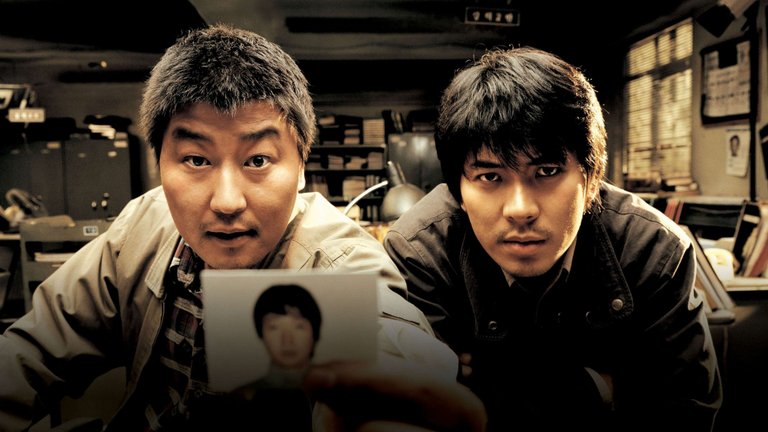
South Korea’s emergence as one of the most significant powerhouses of global pop culture is a remarkable phenomenon in which the nation’s cinema industry played a large part. Among the South Korean filmmakers that made their name in this period, one of the most celebrated is Bong Joon Ho, best known for his Oscar triumph with the 2019 drama Parasite. Before achieving that level of international acclaim, Bong Joon Ho came to the global stage with his 2003 crime drama Memories of Murder, a film that, apart from becoming a great domestic box office hit, also earned praise in international critics circles as one of the best films to be made in the 21st century. In fact, at the time of its release, it was the country’s box-office champion for 2003, attracting nearly two million admissions ahead of major Hollywood imports. Critics were at least as enthusiastic about it as general audiences, and it has gone on to triumph in all the domestic film-awards lists. This film stands as a testament to the creative ambitions of New Korean Cinema, which began to forge a new kind of genre-bending work without relying on worn-out templates.
The narrative foundation of the film is deeply rooted in historical reality, drawing from the 1996 play Come to See Me by Kim Kwang-lim. This play was itself inspired by the real-life story of the Hwaseong Serial Murders, a sequence of fourteen unsolved killings of women between 1986 and 1991 that rattled South Korean society and became the most notorious such events in the country's history. Bong Joon Ho has described this as “the first real case of serial murder in Korea”. The production crew took the story very seriously, as the family of the victims were still alive during filming, which meant shooting near the actual location of the incident had to be done with extreme care. This historical basis imbues the work with an almost documentary-like weight, creating a tense atmosphere that permeates every frame.
The script, co-written by Bong Joon Ho and Shim Sung-bo, begins in the autumn of 1986 in a small provincial town. Two women are found raped and murdered in the outskirts, and local police begin an investigation led by Park Doo-man (Song Kang-ho). Together with his partner Cho Yong-koo (Kim Roi-ha), he quickly finds out that he lacks the resources and experience to solve such a complex case. The investigation becomes chaotic, with no care for forensics, destroyed evidence, and crowds observing proceedings turning into a farce. Park and his colleagues try to solve the case the old-fashioned way, by rounding up the most likely suspects and trying to beat confessions out of them, reflecting the incompetence of the police force depicted as an inefficient and arrogant law enforcement political arm. Seo Tae-yoon (Kim Sang-kyung), a more experienced detective from Seoul, is sent to provide assistance and brings his own modern and rational methods of investigation, yet the efforts of the two men fail to stop new killings, although they appear to come tantalisingly close . Baek Kwang-ho (Park no-shik) is first viewed as a suspect only to be revealed as likely witness who saw how the real killer looked like. In the end, investigation focuses on Park Hyeon-gyu (Park Hae-il), but DNA analysis of semen samples made by FBI labourers in the USA fails to confirm his guilt, and the crime remains unsolved.
The narrative inspiration arrived in the form of a gift from critic Tony Rayns, who gave Bong a copy of From Hell, Alan Moore’s famous graphic novel dedicated to another infamous unsolved case of serial killings. Bong, who had been utterly disappointed with its awful 2001 Hollywood adaptation, shaped his film's narrative to cast a critical eye on South Korea’s military rule under President Chun Doo-hwan. Memories of Murder provides the audience with an unusual genre combination of police procedural, period drama, dark thriller and black comedy with even some sociopolitical commentary thrown to good measure . The film avoids Hollywood-style plot-driven crime dramas and looks more real than cinematic, setting the film on the backdrop of the Chun Doo-hwan dictatorship.
The film actually begins like dark comedy, with police led by Park and his colleague being shown as inept and incompetent like Keystone Kops. It is only later that the film becomes darker and darker, with most scenes taking place at night and not only women becoming targets but also innocent people being subjected to torture, having their lives ruined or in some cases ended . In the end, darkness even consumes Seo, the detective who was supposed to be embodiment of modernity and rationality, and in the famous tunnel scene near the end it is country yokel Park who has to be the voice of reason.
Bong Joon Ho has spent months painstakingly researching the case, and his strive to make the film as authentic as possible reflected in use of numerous different locations, which was unprecedented for South Korean cinema at the time . Film is visually very interesting, with locations playing large part both in establishing the story and in emotional epilogue taking part in 2003. The cinematography makes the most out of the scenery of everyday life on rural South Korea, with sepia colored lenses tinting the vastness of the grassland.
The film benefits a lot from excellent acting, with Song Kang-ho establishing his stellar presence with a character that transforms from semi-buffoon into something of a film’s moral anchor. Memories of Murder also benefits from simple but atmospheric music score by Japanese composer Taro Iwashiro. The music is poignant and aided by the creepy use of a Korean pop song that accompanies each murder, peppered with fabulous doses of comic relief. The cast's performances elevate the film to cinematic greatness, capturing a profound sense of futility and its iconic final sequence.
Memories of Murder is also interesting for going against the stereotypes of serial killer films made in Hollywood, or even those made in Nordic Noir style. The main difference is being set in different time and place; film begins at the very end of the period when South Korea was under right-wing military dictatorship and its police was more focused on maintaining it through physical violence rather than protecting its citizens. That, at least according to Bong Joon Ho, filmmaker known for his left-wing leanings, allowed killer to slip through the cracks. The story being set in late 1980s and 1990s also meant that DNA and similar kinds of forensic Wunderwaffe that had allowed instant crime solving in CSI-like TV shows was slow, primitive and inefficient.
Bong Joon Ho ended the film with protagonist looking at the camera, hoping that the actual killer would see this image. South Korean statute of limitations also meant that the killer would not prosecuted after 2006, yet in the end, it was revealed that such concerns were unfounded. The real killer, Lee Choon-jae, was in prison, serving life sentence for 1994 rape and murder of his sister-in-law, and his connection with other murders was finally established via DNA analysis in 2019.
The case continued to inspire numerous films and TV shows in South Korea, but with the actual mystery resolved, Memories of Murder did lose some of its original emotional punch . In a way, Bong Joon Ho used the film not to solve the mystery, but to immortalize the emotional toll of failure. It cemented Bong Joon Ho’s reputation long before he won the Academy Award for Parasite*. Ultimately, the film ensures its status as one of the finest South Korean films ever made, leaving a legacy that continues to resonate in 2026 .
At the end of day, Memories of Murder is a pivotal work that bridged the gap between Korean cinema and the global stage. It captures a nation transitioning from authoritarian rule, where the police force was clearly outmatched by the methodical evil of an invisible killer. The film dares us to figure out who we can hold accountable for a culture that accepts inequality and violence, even if accountability means looking in the mirror. Bong’s filmmaking is tremendous throughout, exploring human nature and societal failur The legacy of the film proves that some stories are not just about the crime, but about the failure of the system to prevent it ^9*. As such, it is a required viewing for any fan of the crime genre, not because it provides a neat solution, but because it perfectly captures the terror of no solution.
RATING: 8/10 (+++)
==
Blog in Croatian https://draxblog.com
Blog in English https://draxreview.wordpress.com/
InLeo blog https://inleo.io/@drax.leo
InLeo: https://inleo.io/signup?referral=drax.leo
Leodex: https://leodex.io/?ref=drax
Hiveonboard: https://hiveonboard.com?ref=drax
Rising Star game: https://www.risingstargame.com?referrer=drax
1Inch: https://1inch.exchange/#/r/0x83823d8CCB74F828148258BB4457642124b1328e
BTC donations: 1EWxiMiP6iiG9rger3NuUSd6HByaxQWafG
ETH donations: 0xB305F144323b99e6f8b1d66f5D7DE78B498C32A7
BCH donations: qpvxw0jax79lhmvlgcldkzpqanf03r9cjv8y6gtmk9