Film Review: Night Watch (Nochnoy dozor, 2004)

The most frustrating films are not those which are irredeemably awful; they are the ones which dangle the promise of greatness, yet somehow fail to cross that elusive, almost metaphysical boundary between genuine excellence and mere mediocrity. Timur Bekmambetov’s 2004 Russian fantasy action film Night Watch (Nochnoy dozor) stands as a prime specimen of this breed. It is a profound disappointment, a feeling amplified by its context as one of post-Soviet Russia’s first bona fide modern blockbusters and the purported launching pad for its director’s subsequent Hollywood career. Here was a film that seemed destined to announce the triumphant return of Russian genre cinema to the world stage, yet it ultimately staggers under the weight of its own ambition, collapsing into a visually arresting but narratively incoherent muddle.
The film is adapted from Sergei Lukyanenko’s 1998 novel of the same name, the inaugural entry in the ‘World of Watches’ series. The core premise is undeniably compelling, offering a rich mythology for a cinematic universe. It posits the existence of parallel levels of reality, chief among them being ‘the Gloom’, a shadowy dimension accessible only to ‘Others’—individuals born with extraordinary supernatural abilities. These Others are irrevocably split into two factions based on their inherent moral alignment: the forces of Light and the forces of Dark. This eternal struggle is given a uniquely bureaucratic, Muscovite twist, setting the stage for a potentially fascinating urban fantasy.
Bekmambetov’s film opens with a prologue set centuries in the past, depicting the final, cataclysmic battle between the Light Others, led by Geser (Vladimir Menshov), and the Dark Ones, commanded by Zavulon (Viktor Verzhbitsky). The conflict is so mutually destructive that a stalemate is forced upon them. To avoid total annihilation, they broker an uneasy Truce, a supernatural Cold War that permits each side to operate in the human world during their allotted time—Light by day, Dark by night. To police this accord, two opposing agencies are established: the Night Watch, which monitors the Dark Others, and the Day Watch, which keeps the Light in check. It’s a superb setup, blending high fantasy with the mundane mechanics of state surveillance.
The plot then leaps forward to 1992 Moscow, introducing us to the hapless protagonist, Anton Gorodetsky (Konstantin Khabensky). Reeling from his wife’s abandonment, a desperate Anton seeks out a witch, Daria (Rimma Markova), who offers to cast a love spell—a ritual requiring the death of her own unborn child. In a moment of weak complicity, Anton agrees. The ritual is violently interrupted by a trio in coveralls who subdue Daria. Their shock at Anton’s ability to see them reveals his latent status as an Other.
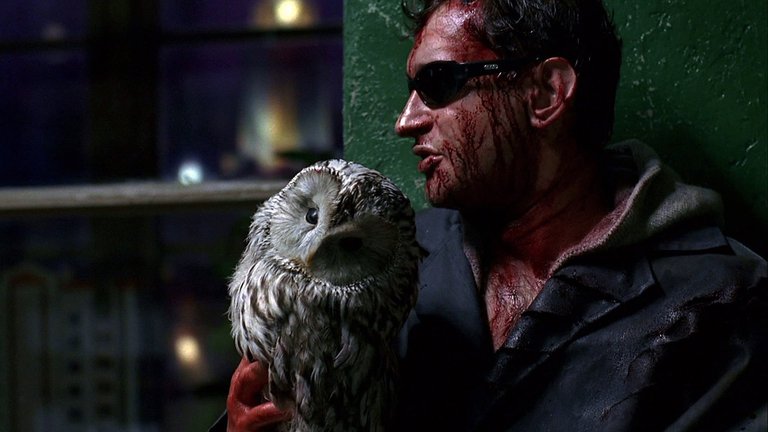
The narrative then jumps ahead twelve years. Anton, now a seer with the ability to glimpse future visions, is a field agent for the Night Watch. His duties involve tracking down unlicensed vampires, such as Andrei (Ilya Lagutenko). Using a 12-year-old boy, Yegor (Dmitry Martinov), as bait, Anton’s operation goes awry, resulting in Andrei’s accidental death and Yegor’s disappearance. This sparks a chain of events involving Andrei’s vengeful vampire girlfriend, Larissa (Anna Dubrovskaya), and draws the concern of Geser, who fears retaliatory action from Zavulon. Geser assigns Anton a bodyguard, the owl/human shapeshifter Olga (Galina Tyunina). Concurrently, Anton investigates a supernatural vortex threatening Moscow, tracing it to a powerful curse placed on a woman named Svetlana (Mariya Poroshina). The curse is lifted just in time, revealing Svetlana to be a potent Other in her own right. The film’s climax delivers its most poignant blow: Yegor is revealed to be Anton’s son, the very child he once consented to kill. When Zavulon cruelly informs the boy of this attempted filicide, Yegor, in his hurt and betrayal, renounces the Light and defects to the Day Watch.
The road to production was itself a saga. Efforts to adapt Lukyanenko’s novel began in 2000 but floundered until the script found a home at Russian state television’s Channel One. Initially conceived as a four-part mini-series, studio executives, recognising the story’s spectacular potential, gambled on a theatrical release. They entrusted the project to the Kazakh filmmaker Timur Bekmambetov, who took on dual roles as writer and director.
The film’s substantial budget is immediately and unequivocally apparent. If Night Watch’s primary mission was to demonstrate that Russian cinema had emerged from its post-Soviet creative and economic crisis, that it could compete with Hollywood on a purely visual level, then it was an unqualified triumph. The film is a torrent of arresting imagery, a playground where Bekmambetov’s visual imagination runs gloriously amok. The computer-generated effects, while occasionally rough by contemporary standards, were groundbreaking for the Russian industry in 2004. More impressive than the raw CGI are the film’s myriad creative flourishes. Bekmambetov injects the supernatural bureaucracy with wonderfully odd, distinctly Russian character details: Geser masquerades as a mid-level Moscow city bureaucrat, while his nemesis Zavulon is portrayed as a petulant video game enthusiast. One particularly unforgettable sequence features the Dark Other Alissa Donnikova (Zhanna Fiske) taunting the vampire Larissa by dangling a bottle of blood from a moving car—a moment of pure, stylised kineticism that feels lifted from a lost exploitation classic. The production design, from the grimy, neon-drenched Moscow apartments to the ethereal eeriness of the Gloom, creates a cohesive and compelling aesthetic world.
Yet, all this visual splendour cannot conceal the film’s fundamental, crippling flaw: Bekmambetov is a far more accomplished director than he is a screenwriter. So intoxicated is he by the prospect of delivering one stunning set-piece after another that he utterly neglects the connective tissue that binds a narrative together. The plot of Night Watch is not merely complex; it is utterly befuddling. Key concepts are explained in rushed, exposition-heavy dialogue rather than being organically revealed through action. The relationship between the vortex, Svetlana’s curse, Yegor’s significance, and the overarching political manoeuvring between the Watches feels haphazardly stitched together, leaving even attentive viewers scrambling to decipher the story’s internal logic. This narrative incoherence is compounded by Yuri Poteyenko’s disappointingly generic musical score.
Furthermore, the film possesses the distinct aura of an unfinished product. It does not so much conclude as simply stop, on a cliffhanger that baldly serves as a trailer for its sequel, 2006’s Day Watch. While franchise-building was undoubtedly the goal, it renders Night Watch an incomplete experience, a first act sold at feature-film price. The emotional resonance of Yegor’s defection is undermined because we have not had sufficient time to understand his character or his relationship with Anton; it feels like a plot twist for its own sake, a mechanical beat necessitated by the sequel’s requirements rather than a natural culmination of the story we have just witnessed.
Despite these considerable artistic shortcomings, Night Watch proved to be a monster box-office hit in Russia. Audiences, starved for a home-grown alternative to Hollywood fantasy spectacles, flocked to it in droves. Critical reception was mixed, but the film garnered influential admirers, most notably Quentin Tarantino, who championed its frenetic style. More consequentially, its commercial success became Bekmambetov’s passport to Hollywood, leading directly to his 2008 studio film Wanted (which also featured a supporting role for Konstantin Khabensky). In the final analysis, Night Watch remains a fascinating cultural artefact—a film of immense style and vision that tragically forgot to bring a coherent story along for the ride. It is the cinematic equivalent of a spectacularly decorated cake that is, upon tasting, revealed to be mostly empty inside. Its legacy is one of potent, unfulfilled promise, a dazzling proof of concept that never quite managed to become a satisfying film in its own right.
RATING: 4/10 (+)
==
Blog in Croatian https://draxblog.com
Blog in English https://draxreview.wordpress.com/
InLeo blog https://inleo.io/@drax.leo
InLeo: https://inleo.io/signup?referral=drax.leo
Leodex: https://leodex.io/?ref=drax
Hiveonboard: https://hiveonboard.com?ref=drax
Rising Star game: https://www.risingstargame.com?referrer=drax
1Inch: https://1inch.exchange/#/r/0x83823d8CCB74F828148258BB4457642124b1328e
BTC donations: 1EWxiMiP6iiG9rger3NuUSd6HByaxQWafG
ETH donations: 0xB305F144323b99e6f8b1d66f5D7DE78B498C32A7
BCH donations: qpvxw0jax79lhmvlgcldkzpqanf03r9cjv8y6gtmk9