Film Review: Sabotage (1936)

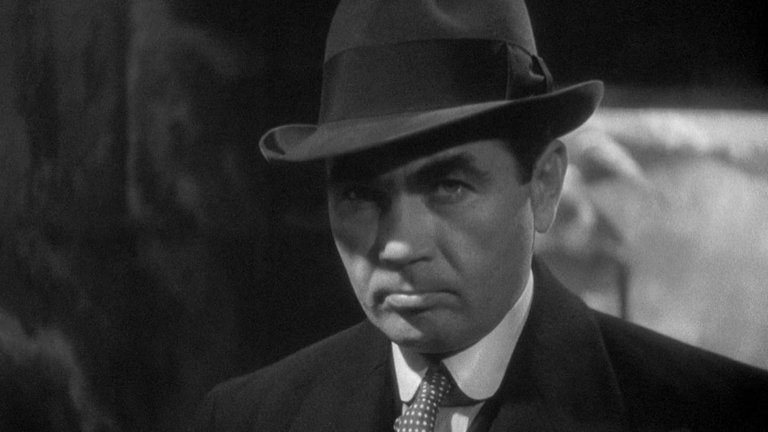
Alfred Hitchcock, the grand master of suspense, liked to describe his filmmaking technique by telling the right and the wrong way to make a scene featuring a bomb going off. Simply showing the bomb exploding was the wrong way, because it would be quick and, apart from shock value, would not be that effective in emotionally engaging the audience. The right way was to establish the bomb being set up and slowly ticking while its unsuspecting victims went about their business, thus creating emotional tension that would be released one way or another.
That particular scene was actually used by Hitchcock himself in his 1936 British thriller Sabotage. The film is based on The Secret Agent, a popular 1907 novel by Joseph Conrad. The plot begins one night in London when the entire city suffers a blackout because of sabotage conducted at a power station. This is the work of Karl Anton Verloc (played by Oscar Homolka), a cinema owner who supplements his income by providing clandestine services for representatives of an unknown foreign power. He is very good at hiding this from his young wife, Mrs. Verloc (played by Sylvia Sidney), and her young brother, Stevie (played by Desmond Tester). However, his employer is not actually pleased with the effects of the blackout on the British public and demands more shocking action in the form of a bombing attack on the London Underground. Verloc is not happy about it, but nevertheless proceeds with the scheme and obtains an explosive device from The Professor (played by William Dewhurst), an eccentric bomb maker who warns him that it is timed and that it will go off at a precise time during the Lord Mayor’s Show.Verloc’s mission is complicated by the presence of Ted Spencer (played by John Loder), a clerk from a nearby greengrocery who is actually an undercover Scotland Yard detective tasked with surveillance of potential saboteurs. He becomes interested in Verloc also because of the attraction he feels towards his young wife.
The script for Sabotage was written by Charles Bennett, a popular screenwriter who had worked with Hitchcock before. While retaining most of the plot of the original novel, he erased most of Conrad’s political context by having the plot set in contemporary Britain. With Tsarist Russia not being around, Bennett changed the main culprit into an unnamed “foreign power”; in subsequent years, some critics and scholars believed that the “foreign power” was Nazi Germany, which would go to war with Britain a few years after the premiere. This is, however, very unlikely because Bennett even changed the name of Verloc from “Adolf” (in the original novel) to “Karl” for the sole purpose of severing any association with German leader Adolf Hitler. Furthermore, the radical revolutionary underground of Edwardian-era London was, with the exception of The Professor, reduced to criminals of a more generic variety.
Setting the film in the 1930s also allowed Hitchcock the opportunity to modernise the plot and characters; Verloc was changed from a bookshop owner to a cinema owner, and the films in his theatre (including parts of Disney’s animated short Who Killed Cock Robin?) served as a sort of Greek chorus to the events in the film. Hitchcock, however, remained faithful to Conrad’s novel in using the most shocking and disturbing event from its text – the actual explosion of the bomb. In the film, just like in the novel, it claims the life of an innocent child (and in the film it is even worse, because he happens to be on a crowded bus). This makes Sabotage one of the more disturbing films in Hitchcock’s filmography, and the director even had to publicly apologise to more sensitive parts of the audience. It is even more disturbing because this scene is made in perfect Hitchcockian manner – the audience knows what is going to happen, while the victim, who carries the bomb, does not; what was supposed to be a simple plan gets complicated by a series of coincidences and even some comical events that actually seal the victim’s fate. When the tragedy happens, it has a profound effect not only on the viewers, but also on the characters, making the last segment of the film, despite violence and high emotions, more realistic than melodramatic.
Much of the credit for the success of the film should be given to the cast. Oscar Homolka, an Austrian actor who would later make a career playing Communist spies and Soviet officials, plays a character who is supposed to be a villain, but who even manages to evoke some of the audience’s sympathy by trying to justify his unforgivable act. American actress Sylvia Sidney (known to younger audiences for her supporting role in Beetlejuice half a century later) delivers an emotional performance which, although on the edge of hamming it up, is quite strong and rather fitting for this tragic story. Hitchcock, however, did not have that much luck with John Loder in the role of Spencer. He originally wanted Robert Donat, with whom he worked very well in The 39 Steps, but the actor was unavailable. While Loder is adequate, he lacks proper chemistry with Sidney, especially near the end when the script adds a romantic subplot. More cynical or jaded viewers would criticise this addition for succumbing to clichés and commercial demands of 1930s cinema, but, on the other hand, it works in the context of Depression-era audiences which needed at least glimpses of a happy ending to this otherwise intolerably cruel story.
Sabotage in the end works as one of the finer Hitchcock works and can even be recommended to modern viewers who care little about film history or the Master of Suspense.
(Note: Hitchcock’s previous film, which had nothing to do with Conrad’s novel, was titled Secret Agent. In order to prevent confusion, the adaptation was titled Sabotage. This, however, created a little confusion among some cinephiles later on, because only a few years later in Hollywood Hitchcock directed a similarly titled Saboteur.)
RATING: 8/10 (+++)
Blog in Croatian https://draxblog.com
Blog in English https://draxreview.wordpress.com/
Leofinance blog https://leofinance.io/@drax.leo
Unstoppable Domains: https://unstoppabledomains.com/?ref=3fc23fc42c1b417
Hiveonboard: https://hiveonboard.com?ref=drax
Bitcoin Lightning HIVE donations: https://v4v.app/v1/lnurlp/qrcode/drax
Rising Star game: https://www.risingstargame.com?referrer=drax
1Inch: https://1inch.exchange/#/r/0x83823d8CCB74F828148258BB4457642124b1328e
BTC donations: 1EWxiMiP6iiG9rger3NuUSd6HByaxQWafG
ETH donations: 0xB305F144323b99e6f8b1d66f5D7DE78B498C32A7

Congratulations @drax! You have completed the following achievement on the Hive blockchain And have been rewarded with New badge(s)
Your next target is to reach 130000 upvotes.
You can view your badges on your board and compare yourself to others in the Ranking
If you no longer want to receive notifications, reply to this comment with the word
STOPTo support your work, I also upvoted your post!
Check out our last posts: