Film Review: Sherlock Jr. (1924)

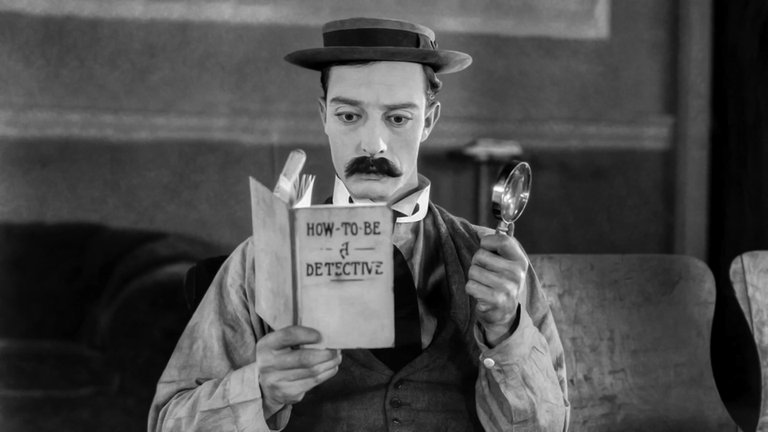
Sir Charles Chaplin remains the most iconic figure amongst the pantheon of silent Hollywood comedians, his image instantly recognisable to the general public even a century after his prime. Yet, for the more hardcore, and some would dare say more snobbish, cinephiles, the title of the finest silent Hollywood era comedian belongs unequivocally to Buster Keaton. Known not merely as an accomplished actor, Keaton was an innovative director who stood at the forefront of those exploring the possibilities of the new medium of cinema. Before his celebrated 1926 film The General, his best-known and arguably one of his more influential works was the 1924 film Sherlock Jr., a picture that remains a testament to his technical ingenuity and physical prowess.
In the film, Keaton appears playing the unnamed character of the Projectionist, a young man making his ends meet working in a huge cinema theatre. His dream is to become a famous detective, an ambition he doggedly pursues by studying a detective handbook. The skills he obtains from this text he is forced to apply in real life when his attempt to win the favour of the Girl, played with charm by Kathryn McGuire, crosses paths with a rival, known as the "local Sheik" and played with oily menace by Ward Crane. The Sheik steals a pocket watch from the Girl’s Father, portrayed by Keaton’s own father, Joe Keaton, and pawns it to buy chocolates for the Girl. When the Projectionist volunteers to find the thief, the Sheik slips the pawn ticket into his pocket, thus making him look like the culprit. As a result, he is banished from the Girl’s house, humiliated and wronged. Nevertheless, using the instructions from his textbook, the Projectionist shadows every move by the Sheik, though it is ultimately the Girl who learns the truth, visiting the pawnshop and having its clerk recognise the Sheik as the person who pawned the watch.
In the meantime, the Projectionist must return to his duties, whilst the cinema theatre shows a film titled "Hearts and Pearls", a melodrama with a plot revolving around the theft of a pearl necklace. Tired, bored, and heartbroken, the Projectionist falls asleep and dreams a vivid fantasy in which he goes inside the screen and transforms into the film's protagonist, the famous detective "Sherlock Jr." In this dream logic, the characters in the film are transformed into the real-life counterparts: the Sheik, the Girl, and the Girl's Father. Sherlock Jr. arrives to solve the mystery, but the Sheik is determined to take him out with the help of the Butler, played by Erwin Connelly. The antagonist attempts to poison the detective, set up deadly booby traps, and finally plants an explosive inside a billiard ball. Sherlock manages to survive all of this, unmask the villain, and escapes through an insane chase that ends with him in a lake alongside the Girl. He awakens from his dream to find the Girl has arrived to explain that he has been exonerated, and their romantic actions mimic those performed by the actors in the film.
Like with many silent films, an ordinary audience from today's perspective might initially question what the fuss was about, but for the actual standards of 1920s Hollywood, Sherlock Jr. was a notable technical achievement. It was a great feat for Keaton, who had to invent or improvise the special effects and other techniques that feature the film's most memorable detail – the Projectionist trying to enter the film, being kicked out of it, and finally settling in as the background changes in an almost dreamlike state. This sequence required exacting precision and timing, sometimes described as "clockwork machine of craftsmanship" that bewildered contemporary cinematographers who viewed the film repeatedly to try and devise how certain scenes were accomplished.
Sherlock Jr. is known as one of the first films to use the "film within a film" narrative concept, and as such, it has been copied and paid homage to in countless other films or television shows. Woody Allen’s The Purple Rose of Cairo is a direct descendant of this concept, where a character walks out of a movie and into real life. The latter medium, television, until the most recent times, was perhaps more suitable for repeating Keaton's original feat of blending reality with the cinematic world, yet the original purity of Keaton’s vision remains unmatched. The film predates most self-referential postmodern films by nearly a century, showcasing a level of meta-humor that would not become mainstream for decades.
Yet, despite its innovative approach and recognising the dreamlike quality of silent cinema, Sherlock Jr. is still an easily recognisable piece of Hollywood silent comedy, and as such, it depends heavily on slapstick and physical action. This reliance provided Keaton with the opportunity to display some of his stuntwork skills, performed with his famous "deadpan" stoicism. However, this dedication to realism came at a high personal cost; the film was responsible for a spinal injury discovered only decades after production. During a stunt where he was hanging off a ladder connected to a huge water basin, the water poured out and washed him onto the railroad track, fracturing his neck nearly to the point of breaking it. This injury was responsible for Keaton's severe migraines and other health issues in the decades that followed, a heavy toll for the sake of his art.
Keaton, whose recovering alcoholic father Joe appears in the role of the Girl's father, originally wanted this film to be directed by his old friend and mentor Roscoe Arbuckle. Arbuckle was once a popular film comedian whose career was practically over due to his involvement in the infamous 1921 scandal surrounding actress Virginia Rappe. Although Arbuckle was acquitted at criminal trial, he was a pariah in Hollywood, and Keaton tried to jumpstart his career as a director under the pseudonym "William Goodrich". The attempt failed, and Keaton had to direct by himself. This proved to be fortunate, for his skill and talent for innovation was undoubted; this film served as his first sole directorial venture, showcasing the cinephilia and attention to detail he developed by dismantling and reassembling cameras to understand their mechanics.
Contemporaries, on the other hand, were not nearly as impressed as modern critics. Sherlock Jr. had only modest box office success, and critics, at least in America, were not particularly favourable. Many complaints revolved around the film not being particularly funny, and Keaton, after some test screenings, decided to shorten the film to a mere 45 minutes. Yet, in Europe, some snobbish critics recognised the film as a reflection of the then-emerging Surrealist movement, feeling that it made later efforts by Dalí, Buñuel, and Cocteau look pedestrian and timid. As such, it planted the seed of Keaton's work being hailed as an ambitious work of the Seventh Art, earning praise for its "primitive American surrealism".
That short running time, which was a result of the editing to address contemporary criticisms, makes the film more accessible for today's audience. It allows for enjoyment with some impressive action and physical comedy, especially in the second part of the film where the dream sequence takes flight. The film is praised for its physical comedy and inventive plot, standing as one of Buster Keaton's best films, and possibly his greatest. While there is endless debate as to which is the funniest of Keaton’s 1920s features, there is little doubt as to which is the cleverest.
At the end of the day, Sherlock Jr., despite not perhaps looking like the best film of the era to the uninitiated eye, truly deserves its status as a silent cinema classic and one of the most influential works of early Hollywood. It is a breathtakingly virtuosic display of every silent comedy technique imaginable, from Keaton's own formidable physical skills to some then-groundbreaking camera trickery. It captures the majesty of our cinema dream-life and offers a masterclass in the core principles of silent story-telling. Few films are as philosophically eloquent or technically daring, securing its place not just as a comedy, but as a profound statement on the medium itself.
RATING: 7/10 (+++)
==
Blog in Croatian https://draxblog.com
Blog in English https://draxreview.wordpress.com/
InLeo blog https://inleo.io/@drax.leo
InLeo: https://inleo.io/signup?referral=drax.leo
Leodex: https://leodex.io/?ref=drax
Hiveonboard: https://hiveonboard.com?ref=drax
Rising Star game: https://www.risingstargame.com?referrer=drax
1Inch: https://1inch.exchange/#/r/0x83823d8CCB74F828148258BB4457642124b1328e
BTC donations: 1EWxiMiP6iiG9rger3NuUSd6HByaxQWafG
ETH donations: 0xB305F144323b99e6f8b1d66f5D7DE78B498C32A7
BCH donations: qpvxw0jax79lhmvlgcldkzpqanf03r9cjv8y6gtmk9