Film Review: Super Size Me (2004)

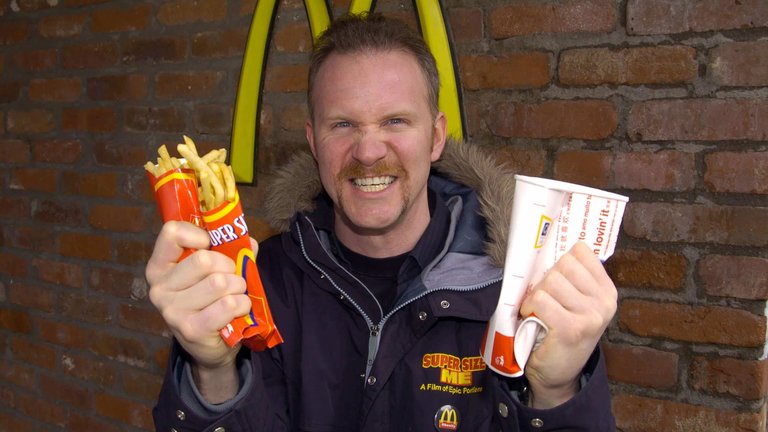
The first decade of the 21st century can be described as the golden age of documentaries, at least in America, where they were celebrated as potent tools for political and cultural change. The year 2004 represented the zenith of this movement, though its fervour had as much to do with Hollywood seeing the form as a clever, Oscar-friendly vehicle to help remove George W. Bush from the White House as with any pure cinematic artistry. This trend culminated in Michael Moore’s blistering, Palme d’Or-winning Fahrenheit 9/11. Riding this wave, though not dealing in politics directly, was a young and relatively unknown filmmaker named Morgan Spurlock. That his documentary Super Size Me, released in the very same pivotal year, became both beloved by critics and, more importantly, a staggering box-office success, is inextricably linked to that cultural moment. This very success, however, only made the film’s subsequent fall from grace and the controversies that engulfed it in later years appear all the more spectacular.
Spurlock took as his subject something which was, and sadly still is, a major pathology in American society: the obesity epidemic, with its particularly grim implications for children and the young. Finding inspiration in his then-girlfriend, the vegan chef Alexandra Jamieson, Spurlock aimed to explore the fast-food industry as the most likely culprit. McDonald’s, the global fast-food giant and a potent symbol of American business and cultural hegemony, presented the most obvious target. Its products, marketing, and pervasive ‘Happy Meal’ ethos seemed engineered to capture the young, making it the perfect antagonist for a muckraking documentary.
To test this case, Spurlock engaged in a bizarre, dangerous, and—as would later become clear—deeply controversial experiment. His premise was simple: for 30 days, he would consume every meal exclusively from McDonald’s, accepting the ‘Super Size’ upgrade whenever it was offered. After initial medical check-ups established him as a healthy 33-year-old male, he began recording his experiences and the effects of this mono-diet on his body. The on-screen results appeared devastating. Spurlock gained significant weight, suffered mood swings, complained of depression and sexual dysfunction, and, most alarmingly, presented liver enzyme readings so elevated that his doctors warned he was risking acute hepatitis. The experiment concluded with Spurlock being nursed back to health via a ‘vegan detox diet’ administered by Jamieson.
The film’s impact was immediate and substantial. It garnered attention not only for its brazen premise but for Spurlock’s obvious sense of humour and his ability to present a dire public health warning in an accessible, even entertaining way. It won numerous awards and, famously, was credited with forcing McDonald’s—its stock price taking notable hits—to quietly retire the ‘Super Size’ option from its menus and begin promoting healthier choices like salads and apple slices. Spurlock himself rode this wave to a successful career as a documentary filmmaker, producing a series of similar stylised, personal-investigation films.
Yet, almost from the outset, the film attracted pointed criticism regarding the veracity of its claims. Detractors argued that Spurlock’s numbers simply did not add up; to gain the weight he claimed while consuming only McDonald’s food, he would have had to ingest a calorific surplus far beyond what was shown, all while abandoning his previously active lifestyle. This scepticism spawned a series of response documentaries, the most notable being comedian Tom Naughton’s 2009 film Fat Head. Naughton and others undertook similar month-long fast-food diets, often with strict calorie control, and bafflingly (to fans of the original) experienced weight loss and improved cholesterol, directly contradicting Spurlock’s central narrative.
However, the most devastating blow to Spurlock and his film’s legacy arrived in 2017, borne on the tide of the ‘Me Too’ movement. In a shocking pre-emptive attempt to head off impending exposés, Spurlock published a lengthy confession detailing his history of sexual misconduct. Even more damaging to the integrity of Super Size Me was his admission that he had been a functioning alcoholic since the age of 13. He confessed he had not been sober during his famed experiment. This revelation fundamentally reframed the film’s most alarming medical finding—the severe liver damage. Critics and doctors alike were swift to point out that such hepatic distress was far more likely the result of chronic alcohol abuse than of a 30-day diet of Big Macs, however excessive. The documentary’s scientific cornerstone crumbled overnight.
Consequently, the reputation of Super Size Me was permanently, and perhaps irreparably, damaged. It stands today not as a flawed but noble truth-telling endeavour, but as a cleverly constructed piece of advocacy journalism built on a foundation of personal deceit and methodological sleight of hand. Yet, to dismiss it as completely worthless would be to misunderstand its cultural impact. It did force a corporate giant to recalibrate its public relations strategy and spurred a mainstream debate about nutrition, corporate responsibility, and personal health choices that continues to this day. Ironically, that debate has largely migrated to the realm of social media and influencers, many of whom now peddle health advice while being demonstrably more dysfunctional and arguably less honest than the late Morgan Spurlock ever was.
RATING: 6/10 (++)
==
Blog in Croatian https://draxblog.com
Blog in English https://draxreview.wordpress.com/
InLeo blog https://inleo.io/@drax.leo
InLeo: https://inleo.io/signup?referral=drax.leo
Leodex: https://leodex.io/?ref=drax
Hiveonboard: https://hiveonboard.com?ref=drax
Rising Star game: https://www.risingstargame.com?referrer=drax
1Inch: https://1inch.exchange/#/r/0x83823d8CCB74F828148258BB4457642124b1328e
BTC donations: 1EWxiMiP6iiG9rger3NuUSd6HByaxQWafG
ETH donations: 0xB305F144323b99e6f8b1d66f5D7DE78B498C32A7
BCH donations: qpvxw0jax79lhmvlgcldkzpqanf03r9cjv8y6gtmk9