Film Review: The Grapes of Wrath (1940)

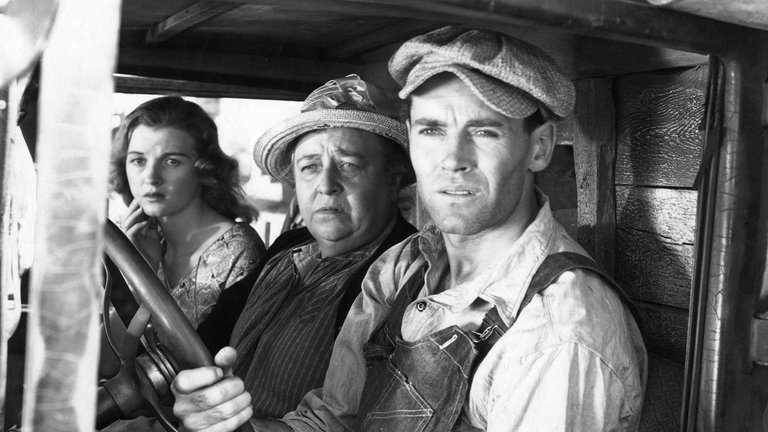
To say that the Great Depression had a huge impact on the history of Hollywood would be an understatement. Poverty and despair among the American and world’s masses created a need for film studios to deliver a steady diet of escapist entertainment, while also turning the political beliefs of its creators leftwards and, sometimes consciously, sometimes unconsciously, finding a way to affect the content of Hollywood films. Yet, the period was stuck between the spectacular excesses of the Jazz Age and the noble struggle of the Second World War and, as such, produced fewer great films in comparison. Unsurprisingly, the greatest film dealing with the Great Depression was made while the Great Depression was still going on. It was The Grapes of Wrath, a 1940 drama directed by John Ford. The film is based on the popular 1939 novel by John Steinbeck, which won the Pulitzer Prize and later brought its author the Nobel Prize for Literature.
The plot begins in Oklahoma where the protagonist, a young man named Tom Joad (played by Henry Fonda), is paroled after serving four years for manslaughter. When he returns to the farm which his family of sharecroppers had worked for generations, he finds it abandoned. A half-mad neighbour, Muley (played by John Qualen), and a former preacher, John Casy (played by John Carradine), explain that, while he was incarcerated, a series of droughts and dust storms had devastated the area. The Joads, like so many people around them, lost their livelihood and were ultimately forced to seek a better life somewhere else.
Tom manages to reunite with his family, led by Ma Joad (played by Jane Darwell), just before they are about to start the long journey to California. The Joads hope that they will manage to find jobs picking fruit there, but when they arrive, it turns out that it isn’t the end of their troubles. The local population doesn’t like newcomers, their employers brutally exploit them and, when they complain, they use paid thugs to keep them in line.
The Grapes of Wrath is considered to be one of the finest works in the career of John Ford. It was recognised as such immediately, resulting in him receiving his second Oscar for Best Director and thus cementing his reputation as one of the greatest film-makers of the Classic Hollywood era. Ford indeed showed great skill in directing this film, making a story with a seemingly unappealing and depressive subject look attractive and intriguing to the audience. A lot of credit for that should go to Gregg Toland, whose black-and-white cinematography introduced some innovative lighting techniques, allowing some of the most important and memorable scenes to take place at night and look realistic. As with many of his famous Westerns, a lot of scenes were directed on location, including the famous Route 66 which the Joads used to get from Oklahoma to California.
Ford was also helped by the experienced scriptwriter Nunnally Johnson, who handled the difficult task of faithfully adapting Steinbeck’s novel while doing it in a manner not to cause the enmity of the censors of the Hays Office. Composer Alfred Newman delivered a good soundtrack, written around the popular folk song “Red River Valley”, which is at one point sung by Henry Fonda. Even producer Darryl F. Zanuck, known for his clashes with famous directors, gave a constructive contribution to the film by suggesting the effective use of sound during the night scenes.
The most memorable contribution, at least where the general audience is concerned, was given by the cast. Henry Fonda, a relatively young actor at the time, fought tooth and nail for the role of Tom Joad, correctly assuming that it would help confirm his status as a genuine star. He delivered one of his finest and most celebrated performances. The protagonist is a man with a violent temper who makes mistakes, but at the same time he is a loyal family member and displays common sense, thus becoming someone the audience could identify with. Jane Darwell, who won the Oscar for Best Supporting Actress, is great in the role of the matriarch who desperately tries to keep her family alive. But the character actor John Carradine almost steals the show with his brilliant portrayal of a former preacher who lost his faith but nevertheless kept some of the wisdom that would help steer the protagonist to make the right decisions.
The Grapes of Wrath can be easily described as an “anti-escapist” film and one of the rare Classic Hollywood films that wore its social (and implicitly political) message on its sleeve. It very realistically and rather explicitly for the standards of the era reminds audiences of the sorry state of America at the time. Ordinary people are, through no fault of their own, deprived of their livelihood, memories, dignity, and some of them even literally starve to death. All this isn’t the work of a few rotten apples or corrupt individuals, but the capitalist system itself, which is rather impersonal and first strikes at the Joads and other Oklahoma farmers as a faceless Behemoth-like monster and later opportunistically exploits their misery in the California orchards. Through the angry words of Tom Joad near the end, the authors expressed their outrage over such injustice and espoused views that can be easily seen as socialist.
Somewhat ironically, John Ford later developed a reputation as one of the few right-wingers in a predominantly left-wing Hollywood, and this might have saved him from trouble during the McCarthy era. The reputation of the film was saved by an ending that was much happier than in Steinbeck’s novel and even more by the Second World War, which actually brought the end of the Great Depression and provided a proper happy ending for the Joads. This, however, doesn’t mean that The Grapes of Wrath has lost relevance. On the contrary, what happened during the Great Depression is beginning to happen again in somewhat different ways, and John Ford’s classic could serve as a lesson to all those who have forgotten some important lessons from history.
RATING: 8/10 (+++)
Blog in Croatian https://draxblog.com
Blog in English https://draxreview.wordpress.com/
Leofinance blog https://leofinance.io/@drax.leo
Unstoppable Domains: https://unstoppabledomains.com/?ref=3fc23fc42c1b417
Hiveonboard: https://hiveonboard.com?ref=drax y
Bitcoin Lightning HIVE donations: https://v4v.app/v1/lnurlp/qrcode/drax
Rising Star game: https://www.risingstargame.com?referrer=drax
1Inch: https://1inch.exchange/#/r/0x83823d8CCB74F828148258BB4457642124b1328e
BTC donations: 1EWxiMiP6iiG9rger3NuUSd6HByaxQWafG
ETH donations: 0xB305F144323b99e6f8b1d66f5D7DE78B498C32A7

Congratulations @drax! You have completed the following achievement on the Hive blockchain And have been rewarded with New badge(s)
You can view your badges on your board and compare yourself to others in the Ranking
If you no longer want to receive notifications, reply to this comment with the word
STOPCheck out our last posts: