Film Review: The Informer (1935)

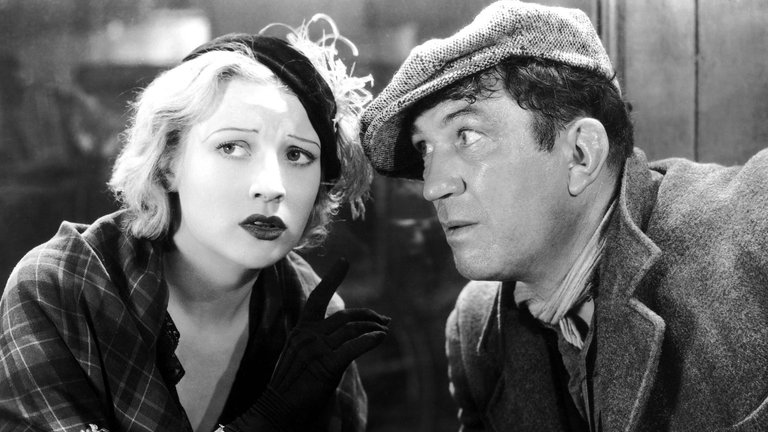
The Irish struggle for independence has always enjoyed a great deal of sympathy in the United States. This is hardly surprising, since both countries have won their independence from the British. Those sympathies extended to the American film industry and the person most associated with it was the Irish American director John Ford who, despite being mostly associated with the genre of the western, had some of his best known films deal with Ireland. This included The Informer, the 1935 drama which represents one of the earliest and the best films about the Irish War of Independence.
The film is based on the eponymous novel by Irish writer Liam O'Flaherty, which had been previously adapted as a part-silent, part-sound 1929 British film. The new version is set in 1922 Dublin, at a time when Irish freedom fighters from the Irish Republican Army (IRA) are waging a guerrilla campaign against British authorities and their Black and Tan paramilitaries. The protagonist is Gypo Nolan (played by Victor McLaglen), a former IRA member who was kicked out of the organisation after taking pity on a captured Black and Tan and failing to carry out his execution. Nowadays he roams the streets without a penny in his pocket while his girlfriend Katie Madden (played by Margot Grahame) is forced to support herself through prostitution. Gypo dreams of taking Katie to America and starting a new life, but the price of ship tickets is too steep. An opportunity for that dream to come true arrives with Frankie McPhillip (played by Wallace Ford), Gypo's old friend and IRA member who came to Dublin from hiding in order to visit family. The British have set a £20 reward for information leading to his capture and this is exactly the sum Gypo needs. He gives up Frankie to the British who later kill him in front of his mother and sister. Burdened by a guilty conscience, Gypo tries to drown his sorrow in alcohol and, as a result, begins to spend all that money on people he meets, drawing attention to himself. Dan Gallagher (played by Preston Foster), the IRA commander, is determined to find the informer who gave up Frankie at all costs and Gypo with his odd behaviour becomes the prime suspect.
The Informer is a simple film about a simple man who makes wrong choices, but John Ford's direction makes it look like something much grander. There is actually very little spectacle in the film, although Ford uses the studio sets to create the foggy streets of Dublin and create the atmosphere that resembles German Expressionist films. Although clearly inspired by silent classics, the film also uses the benefits of sound by providing the audience with lively and inspired dialogues delivered by great and dependable actors. Victor McLaglen, whose brother Cedric had played the same role in the 1929 version, delivers a great performance, creating a great deal of sympathy for the character who is not the sharpest tool in the shed, who is often pathetic and whose actions might be unforgivable, but who is deep inside a decent human being who tried and failed to do the right thing. McLaglen, who won the Oscar for his performance, is helped by a supporting cast which includes the ever-reliable Una O'Connor as Frankie's mother and Donald Meek as Mulligan, the harmless tailor whom Gypo falsely accuses of his own crime in a pathetic attempt to save himself from the IRA. The script by Dudley Nichols, which also received the Oscar (initially rejected because Nichols supported labour unions in a dispute with Hollywood studios), is very good and also quite imaginative in the ways to work around the heavy censorship of the MPAA Production Code, like with suggestions to the nature of Katie's profession or the brothel the drunken Gypo visits later in the film. Another Oscar was won by composer Max Steiner for his musical score, which adds a lot to the film, although it isn't among the most recognisable in Steiner's career.
The Informer is a very good film, but it is far from a masterpiece. The reason might be found in the commercial consideration which burdened the otherwise perfect story with a romantic subplot between Gallagher and Frankie's sister Mary (played by Heather Angel). The finale, that takes place in a church, is overly melodramatic and it wouldn't work on today's more jaded audiences. However, The Informer is still a strong and inspiring piece of cinema. In 1968 it was remade by Jules Dassin as Uptight, a film with setting changed to the milieu of radical African American activists during race riots in Cleveland.
RATING: 7/10 (+++)
Blog in Croatian https://draxblog.com
Blog in English https://draxreview.wordpress.com/
Leofinance blog https://leofinance.io/@drax.leo
Unstoppable Domains: https://unstoppabledomains.com/?ref=3fc23fc42c1b417
Hiveonboard: https://hiveonboard.com?ref=drax
Bitcoin Lightning HIVE donations: https://v4v.app/v1/lnurlp/qrcode/drax
Rising Star game: https://www.risingstargame.com?referrer=drax
1Inch: https://1inch.exchange/#/r/0x83823d8CCB74F828148258BB4457642124b1328e
BTC donations: 1EWxiMiP6iiG9rger3NuUSd6HByaxQWafG
ETH donations: 0xB305F144323b99e6f8b1d66f5D7DE78B498C32A7

Hey @killerwot check this out.
This sounds interesting, I've never heard of this one before but it sounds like it would be worth a watch. As you say, the melodrama might be lost on the more modern and jaded audiance, but then again, sometimes it's nice to go back to older films.