Film Review: The Tunnel (Le Tunnel, 1933)

Arrival of sound technology brought serious problems for film makers, at least those targeting foreign markets. Inability of audiences to understand dialogue in foreign languages meant that the commercial prospects of such films would be severely limited. With still relatively poor quality of sound, dubbing was impractical and subtitles even more so, making it more sensible to instantly remake a film, or, more precisely, to produce different versions of a film for different language markets. Some of the classics of the early sound era were subjected to such treatment, most notably Dracula, which, apart from the English-language version, received instant remakes in French and Spanish. In 1933, Germany The Tunnel (“Der Tunnel”), a science fiction film directed by Curtis Bernhardt, was instantly remade into an eponymous French-language version (“Le Tunnel”), also directed by Bernhardt.
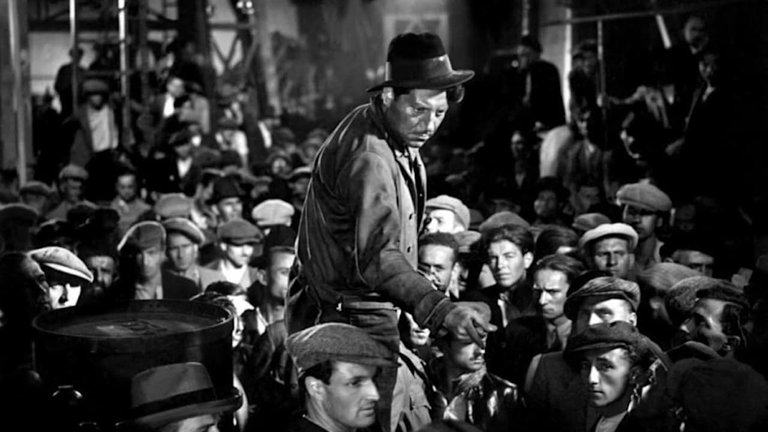
The film is based on the 1913 best-selling novel by German writer Bernhard Kellerman, which had been first adapted in 1915 as silent feature film. The plot of the 1933 French version begins in New York City where the protagonist, famed engineer Mac Allan (played by Jean Gabin), arrives at the terrace of a luxury hotel to present his construction project to a group of wealthy investors. It is the tunnel that is to be dug under the Atlantic Ocean and provide railway communication between North America and Europe. Investors agree to finance the project with billion-dollar funds and the work is supposed to bring millions of jobs and last for fifteen years. Mac Allan is completely dedicated to his work and neglects his wife Mary (played by Madeleine Renaud), but the project in its first years has unexpectedly fast progress. Things change when accidents, like flooding and explosions, begin to happen and claim hundreds of lives. The investors become jittery and Mac Allan soon begins to suspect deliberate sabotage. His suspicions prove to be correct when Woolf (played by Gustaf Gründgens), one of the heads of the Tunnel Syndicate, turns out to be speculating with shipping companies’ stock, which would rise with the collapse of Mac Allan’s projects. Mac Allan now has to deal not only with technical issues, but also with a labour force that is increasingly displeased with gruelling work conditions and risks it has to take on a daily basis.
Production of The Tunnel was likely inspired by the success of F.P.1 Doesn’t Answer, another German science fiction film that dealt with futuristic alternatives to trans-Atlantic travel (which was, like The Tunnel, also made in three different language versions). While the film was made, Nazis took power in Germany and Bernhardt, as a Jew, left the country; he was nevertheless given special permission to briefly return and finish the production. The German and French versions are nearly identical, with similar script, sets, costumes, and props, with the only difference being the language and the cast. Gustaf Gründgens, an actor whose best-known role was gang boss in Fritz Lang’s M (and who would later be immortalised as inspiration for the character of conformist Nazi-era actor in Mephisto), plays the character of villainous Woolf in both films. The French version is slightly better known, because it lacked the baggage of being associated with the Nazi regime and the main star Jean Gabin, who, unlike Paul Hartmann in the German version, succeeded in becoming an icon of French and European cinema.
The Tunnel has an idea which might look preposterous, but it is nevertheless intriguing and, with sufficiently imaginative director or scriptwriter, could have resulted in interesting speculation about the development of technology in the near future. Unfortunately, this version doesn’t deal much with any technical issues and instead tries to bring audience attention through rather weak thriller plot, which is mixed with even more disappointing melodrama related to Mac Allan’s family life. Even the scenes that take place underground, in the tunnel itself, are disappointing. Bernhardt makes those scenes look too dark and confusing and also shows a lack of imagination – the tunnel, which is supposed to be a technical marvel of the 20th Century, is built not with machines but with thousands of manual labourers. Bernhardt, apparently unable to use any kind of serious special effects, often had to rely on stock footage of real-life tunnel construction projects, which is even mentioned in the opening credits. Jean Gabin in the main role tries his best, but he is poorly served by an uninspired script, and Madeline Renaud, who plays his long-suffering wife, fares even worse. As a co-production between Nazi Germany and democratic France, The Tunnel is inoculated against any political context, although those seeking might find some sympathies for the working class and labour movement in a few scenes. Only a relatively short running time prevents The Tunnel from becoming a complete waste of time. Only two years later, Kellerman’s novel was adapted again in Britain, in a version sometimes titled Transatlantic Tunnel and which is also considered a slightly more successful and more imaginative attempt to deal with the subject.
RATING: 3/10 (+)
Blog in Croatian https://draxblog.com
Blog in English https://draxreview.wordpress.com/
Leofinance blog https://leofinance.io/@drax.leo
Unstoppable Domains: https://unstoppabledomains.com/?ref=3fc23fc42c1b417
Hiveonboard: https://hiveonboard.com?ref=drax
Bitcoin Lightning HIVE donations: https://v4v.app/v1/lnurlp/qrcode/drax
Rising Star game: https://www.risingstargame.com?referrer=drax
1Inch: https://1inch.exchange/#/r/0x83823d8CCB74F828148258BB4457642124b1328e
BTC donations: 1EWxiMiP6iiG9rger3NuUSd6HByaxQWafG
ETH donations: 0xB305F144323b99e6f8b1d66f5D7DE78B498C32A7
