Film Review: Vampyr (1932)

It is a commonplace among horror film aficionados that the main tropes and clichés of the genre, at least in its supernatural guise, were cemented in the 1930s by Hollywood’s Universal Studios. The iconic images of Bela Lugosi’s Dracula, Boris Karloff’s Frankenstein’s Monster, and Claude Rains’s Invisible Man seem to define the cinematic language of terror for the popular audience. Yet, this prevailing narrative overlooks a crucial debt: the recognisable form of horror cinema was arguably established elsewhere, in the shadow-drenched studios of Weimar Germany. The Expressionist classics—The Cabinet of Dr. Caligari (1920), Nosferatu (1922), Waxworks (1924)—forged a visual and psychological template from which Hollywood would liberally borrow. This fertile period, however, came to an abrupt end with the arrival of synchronised sound, a technological revolution that presented immense creative and financial challenges. While Hollywood, with its robust studio system, adapted and ultimately thrived, European cinema faltered, struggling to reconcile its artistic heritage with the new demands for dialogue and auditory realism. The scope and consequence of these challenges are perhaps nowhere more starkly visible than in Vampyr, the 1932 Franco-German production directed by the grand Danish filmmaker Carl Theodor Dreyer. Hailed by later generations as a classic of mood and atmosphere, the film nevertheless pales in comparison to the more robust genre works of its era, fundamentally hampered by the very technological transition it sought to go through. It stands as a fascinating, deeply flawed artefact of a cinema in crisis—a work whose immense ambition is constantly undermined by its confused execution.
The film’s narrative foundations are intriguing yet immediately signal a dilution of potent source material. The script, co-written by Dreyer and Christen Jul, represents a loose adaptation of Carmilla (1872), Joseph Sheridan Le Fanu’s foundational novella of vampire fiction which preceded Bram Stoker’s Dracula by a quarter of a century. Le Fanu’s work is notable not only for its atmospheric power but for establishing the enduring and provocative trope of the “lesbian vampire,” a theme of seductive corruption and homoerotic desire. Dreyer and Jul systematically excise this element, replacing it with a more generic, albeit eerie, Gothic mystery. This decision, perhaps motivated by contemporary censorship or a desire for broader appeal, drains the story of a specific psychosexual charge, leaving a plot that feels both archaic and oddly vacant.
The resulting story follows Allan Gray (played by French socialite and the film’s producer, Nicolas de Gunzburg, credited under the pseudonym “Julian West”), a young man who travels the countryside studying occult phenomena. Arriving at the village of Courtempierre, he is given a mysterious package by an old man (Maurice Schutz) with instructions to open it after the donor’s death. Following phantom shadows, Gray arrives at a manor house just as the old man—revealed to be the lord of the manor—is shot. The estate’s servant (Albert Bras) invites Gray to stay until the police arrive, as the lord’s daughter, Léone (Sybille Schmitz), is gravely ill, and her younger sister, Giséle (Rena Mandel), tends to her. The village doctor (Jan Hieronimko) persuades a weakened Gray to provide a blood transfusion for Léone. While Gray recuperates, the servant reads an occult treatise, a section on vampirism mirroring Léone’s plight: she is preyed upon by a vampire, the ancient Marguerite Chopin (Henriette Gérard), who enthralls local helpers. The doctor is revealed to be one such acolyte, ultimately kidnapping Giséle. The plot, while serviceable as a skeleton for set-pieces, is rendered confusing and emotionally remote. Character motivations are opaque, relationships undefined, and the logic of the vampire’s curse feels arbitrary, leaving the audience more perplexed than terrified.
This narrative muddle is inextricably linked to the film’s fraught production history, a direct consequence of the sound revolution. Dreyer, fresh from the monumental success of The Passion of Joan of Arc (1928)—one of the last great masterpieces of silent cinema—originally conceived Vampyr as a silent film. It was shot as such on authentic locations in 1930, with cinematographer Rudolph Maté conjuring a world of palpable unease. However, by the time post-production began, the audience’s appetite for “talkies” was insatiable. Reluctant but pragmatic, Dreyer was forced to retrofit sound onto his creation in the Berlin UFA studios. The film’s final form bears the scars of this compromise: dialogue is sparse and functional, with extensive intertitles carrying the expository weight, creating a jarring hybrid that belongs wholly to neither era. Like many early sound films, including Universal’s Dracula (1931), the language barrier was addressed by shooting multiple versions—reportedly French, German, and English—though only the French and German cuts survive as the basis for modern restorations. This practice further fragmented the film’s artistic unity, making it a product of commercial calculation as much as creative vision.
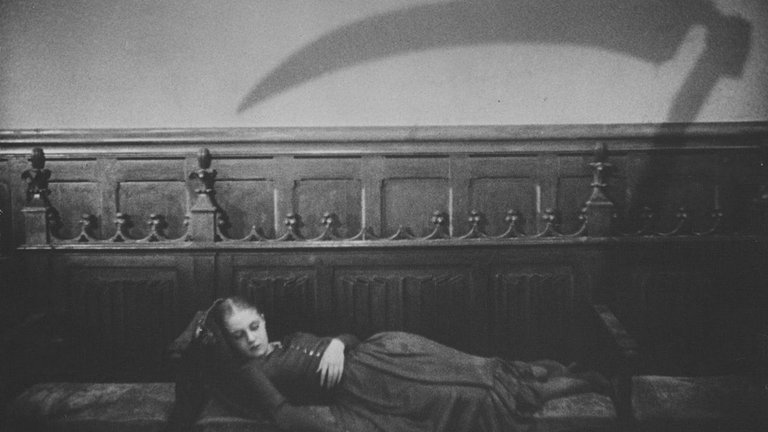
The casting choices further reflect Dreyer’s uncertain footing in the new cinematic landscape. He employed a largely non-professional cast, with de Gunzburg’s performance as Gray being particularly stiff and inexpressive, his aristocratic demeanour failing to convey the required sense of dread or curiosity. The notable exceptions are Maurice Schutz, who brings a genuine pathos to his brief role, and especially Sybille Schmitz as the afflicted Léone. Schmitz, who would later become a tragic star of mid-century German cinema, delivers the film’s most compelling performance. Her face, hauntingly used in promotional posters, conveys a profound, soul-sick languor and a terrifying, blank-eyed possession that speaks volumes where the script falls silent.
Where Vampyr unquestionably succeeds, and why it retains its stature among cinephiles, is in its visual and atmospheric construction. Dreyer, aided immeasurably by Maté’s virtuoso cinematography, creates a film that is less a narrative and more a waking nightmare. Heavily influenced by German Expressionism, the film employs shadows not merely as absence of light but as active, malevolent entities. They move independently, stretch unnaturally, and form shapes that guide and entrap the characters. This creates an overpowering, eerie atmosphere of pervasive unease, a world where the very laws of physics are subordinate to supernatural malice. Two sequences stand out as masterful. The first is Gray’s nightmare, a bravura piece of subjective filmmaking where he envisions his own death, watching his corpse being sealed in a coffin through a glass window in the lid, the camera adopting his buried-alive perspective. It is a chilling evocation of primal fear. The second is the climax, in which the villainous doctor meets his end, trapped and slowly crushed by the cascading grain of a mill—a poetic, visually striking comeuppance that lingers in the memory.
However, this strong visual storytelling ultimately cannot compensate for the foundational weaknesses in the script and Dreyer’s then-unadapted directorial approach to sound. The film’s pacing is often funereal, and the lack of clear narrative cause-and-effect leaves audiences adrift. Dreyer, still thinking like a silent filmmaker, relies on imagery to carry meaning, but in the sound era, audiences expected a more integrated and coherent narrative drive. Furthermore, some of the special effects, such as the notoriously limp vanquishing of the vampire with an iron stake, appear dated and unconvincing, breaking the carefully built spell of dread.
The contemporary reception of Vampyr was disastrous, particularly when measured against its Hollywood counterpart. Universal’s Dracula, itself adapted from a popular stage play, proved vastly superior in engaging a mass audience. While Dracula “has at least two major displays of extraordinary talent”—the Expressionist-inspired cinematography of Karl Freund and the iconic, genre-defining performance of Bela Lugosi—it also suffered from static shots and uninspired direction by Tod Browning. Yet, it possessed a narrative clarity and a charismatic central performance that Vampyr sorely lacked. UFA, the German distributor, deliberately postponed Vampyr’s release, hoping to capitalise on the publicity surrounding Dracula. The strategy backfired spectacularly; inevitable comparisons only highlighted Vampyr’s obscurity and narrative deficiencies. The film was rejected by critics and audiences alike, with reports of cinema patrons rioting to demand their money back. The failure was so profound it sent Dreyer into a nervous breakdown, requiring a period of hospitalisation. For years, Vampyr was considered the nadir of his illustrious career.
Yet, as with many films ahead of their time, Vampyr’s reputation underwent a gradual rehabilitation. Among arthouse and auteurist cinephiles, its virtues—the hypnotic imagery, the oppressive atmosphere, its status as a doomed artefact of cinematic transition—began to outweigh its flaws. It gained a cult status, recognised not as a successful horror film in the conventional sense, but as an important and deeply personal work of European Gothic. It is a film that speaks in a whisper where others shout, a haunting and often frustrating experience that reflects the anxieties of an art form losing its silent voice and struggling to find a new one. Vampyr is less a classic of horror and more a classic of cinematic melancholy—a beautiful, bewildering ghost of a film, forever caught between two worlds.
RATING: 6/10 (++)
==
Blog in Croatian https://draxblog.com
Blog in English https://draxreview.wordpress.com/
InLeo blog https://inleo.io/@drax.leo
InLeo: https://inleo.io/signup?referral=drax.leo
Leodex: https://leodex.io/?ref=drax
Hiveonboard: https://hiveonboard.com?ref=drax
Rising Star game: https://www.risingstargame.com?referrer=drax
1Inch: https://1inch.exchange/#/r/0x83823d8CCB74F828148258BB4457642124b1328e
BTC donations: 1EWxiMiP6iiG9rger3NuUSd6HByaxQWafG
ETH donations: 0xB305F144323b99e6f8b1d66f5D7DE78B498C32A7
BCH donations: qpvxw0jax79lhmvlgcldkzpqanf03r9cjv8y6gtmk9