Film Review: White Oleander (2002)

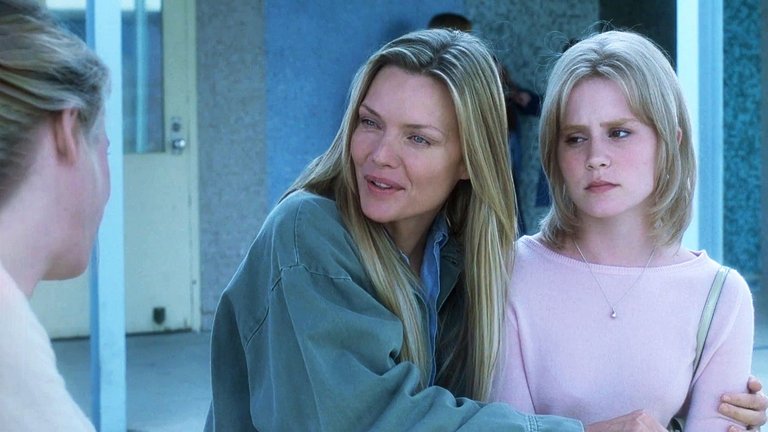
Decades ago, Oprah Winfrey cemented her status as one of the most powerful figures in the world. Her Book Club was a stamp of approval that could turn obscure novels into bestsellers overnight. One such success was the 1999 novel White Oleander by Janet Fitch. Translating the novel's lyrical and dark prose to the screen proved to be a significant challenge, which director Peter Kosminsky attempted in 2002 with the eponymous drama film. The narrative centres on the volatile relationship between a mother and daughter, told through the experiences of the protagonist, Astrid Magnussen.
Astrid, portrayed by Alison Lohman, is a teenage girl whose life is upended when her mother, the free-spirited Los Angeles artist Ingrid Magnussen (Michele Pfeiffer), commits a cold-blooded crime. Ingrid, consumed by jealousy, has her longtime boyfriend, Barry Kolker (Billy Connolly), poisoned with white oleander. Upon being arrested and sentenced to life in prison, Astrid is thrust into the foster care system. Her journey is defined by a series of mismatched foster homes that serve as microcosms for different aspects of the American experience.
Astrid's first placement is with Starr Thomas (Robin Wright Penn), a former stripper and born-again Christian who struggles to maintain sobriety while navigating a life filled with questionable men. One of these men, her boyfriend Uncle Ray (Cole Hauser), develops an inappropriate interest in Astrid. In a fit of jealousy, Starr shoots Astrid, leaving her to recover at the McKinney Children's Center. It is here that Astrid bonds with Paul Trout (Paul Fugit), a teenage boy who shares her artistic sensibilities. Her next stop is the home of Claire Richards (Renée Zellweger), a Hollywood actress unable to conceive with her always-absent screenwriter husband, Mark (Noah Wyle). Claire proves to be deeply insecure and, after making the mistake of communicating with manipulative Ingrid in prison, is unable to cope with the impending divorce, leading to her suicide. Astrid is then taken in by Rena Gruschenka (Svetlana Efremova), a shrewd Russian immigrant who runs a street-selling operation with other foster children. The narrative arc reaches a climax when Ingrid contacts Astrid and demands she lie during her appeals trial; Astrid reluctantly complies, only for Ingrid to ultimately decide to remain in prison. The film concludes with Astrid reuniting with Paul and launching an artistic career in New York City.
Visually, White Oleander boasts an impressive, predominantly female cast that includes some of the most notable actresses of the era. However, the weight of the film rests heavily on the shoulders of Alison Lohman, for whom this role was a starring debut. Lohman is exceptional in a demanding part that required her to play the same character through different periods of her life. Her performance is marked not only by physical changes in costumes and hairstyles but also by a profound evolution in attitude and emotional depth.
Michelle Pfeiffer is equally compelling, though she plays a character that is arguably the most unsympathetic of her career. She brings her trademark icy beauty to Ingrid, a woman who is destructive, manipulative, and selfish. Ingrid proves to be toxic to everyone around her, including her own daughter, making her a fascinating but deeply flawed antagonist. Renée Zellweger offers an interesting portrayal of Claire as a vulnerable B-movie actress. The film cleverly includes a clip from Zellweger's major debut in 1994's The Return of the Texas Chainsaw Massacre as a "film within a film," highlighting her evolution from horror icon to dramatic lead.
On the other hand, the supporting performances often feel like forced caricatures rather than organic characterisations. Robin Wright Penn is almost unrecognisable in her segment, where she plays a character that mixes Bible-thumping with "white trash" stereotypes in rather unpleasant ways. Similarly, the character of Rena is depicted as a ruthless post-Communist "New Russian" capitalist. These elements, combined with the Starr Thomas storyline, make these sections feel less like part of an organic narrative and more like a collection of illustrative cliches.
Director Peter Kosminsky, who would later make a significant mark on television with series like Wolf Hall, attempts to make the film visually interesting through a distinct use of costumes and hairstyles. However, the camerawork is sometimes confusing and disjointed. Even with Astrid's narration guiding the audience, the film often forces viewers to fill in the blanks themselves to get the narrative right, which can be frustrating rather than immersive.
Ultimately, the ending of White Oleander is rather predictable. It follows a familiar trajectory where the mother and daughter finally attain some sort of closure, and the heroine predictably finds happiness in the arms of a suitable man within the cool bohemian surroundings of New York City. While the film is impressive in parts—particularly the central performances of Lohman and Pfeiffer—it ultimately fails as a coherent narrative. It suffers from a lack of narrative cohesion, pacing issues, and reliance on stereotypes. Consequently, White Oleander can be recommended only to fans of Alison Lohman and those looking for a superficial exploration of the foster care system rather than a deep, character-driven drama.
RATING: 4/10 (+)
==
Blog in Croatian https://draxblog.com
Blog in English https://draxreview.wordpress.com/
InLeo blog https://inleo.io/@drax.leo
InLeo: https://inleo.io/signup?referral=drax.leo
Leodex: https://leodex.io/?ref=drax
Hiveonboard: https://hiveonboard.com?ref=drax
Rising Star game: https://www.risingstargame.com?referrer=drax
1Inch: https://1inch.exchange/#/r/0x83823d8CCB74F828148258BB4457642124b1328e
BTC donations: 1EWxiMiP6iiG9rger3NuUSd6HByaxQWafG
ETH donations: 0xB305F144323b99e6f8b1d66f5D7DE78B498C32A7
BCH donations: qpvxw0jax79lhmvlgcldkzpqanf03r9cjv8y6gtmk9