Television Review: Across the Sea (Lost, S6X15, 2010)

Across the Sea (S6X15)
Airdate: 11 May 2010
Written by: Carlton Cuse & Damon Lindelof
Directed by: Tucker Gates
Running Time: 43 minutes
As Lost approached its cataclysmic finale in 2010, there was palpably little time for its creators to put their sprawling mythological affairs in order. The narrative architecture built over nearly six seasons was so fiendishly complex that delivering sensible, final answers to the legion of fan questions seemed a Herculean—perhaps impossible—task. With only three episodes remaining (or four, if the two-part finale is counted separately), it therefore required considerable bravery—or foolhardiness—to devote an entire instalment to depicting the ancient past of the Island and providing origin stories for the iconic, supernatural uber-protagonists introduced in Season Six. Across the Sea, written by showrunners Carlton Cuse and Damon Lindelof, did exactly that. Yet, for all its ambition and singular focus, the episode ultimately is a fascinating but deeply flawed endeavour, one that exemplifies both the creative audacity and the narrative frustrations that defined Lost’s final act.
Where the previous flashback episode Ab Aeterno ventured 140 years into the past, “Across the Sea” plunges the viewer millennia back, into a primordial era. The plot begins with a pregnant, Latin-speaking woman, Claudia (Lela Loren), washing ashore. She is found and aided by another woman (Allison Janney), a mysterious being simply credited as “Mother”, who helps deliver her twins. Upon seeing the two boys—Jacob and his unnamed brother—Mother callously murders Claudia and adopts the infants as her own. This stark, mythic prologue immediately establishes a tone of biblical fatalism and moral ambiguity that the episode never relinquishes.
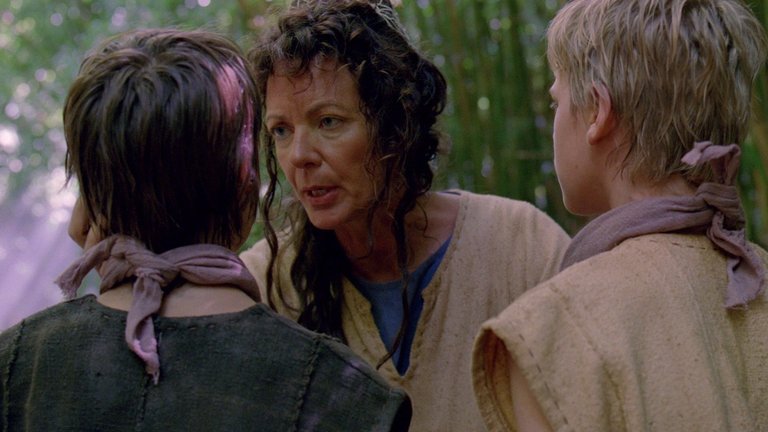
Thirteen years later, the young Jacob (Kenton Duty) and his twin, the “Boy in Black” (Ryan Bradford), live in insular innocence, taught by Mother that the Island is all that exists. Their world fractures upon encountering a trio of hunters from a newly arrived group of settlers. After the Boy in Black receives a vision of his slain birth mother, Claudia, who claims the newcomers are “their people” who came “across the sea”, the fundamental schism between the brothers is born. The Boy in Black becomes determined to leave with these people, while the more obedient Jacob resolves to stay with Mother. This choice sets in motion the eternal conflict, with Mother’s warning that the newcomers are not “good people” serving as a bleak prophecy.
Thirty years further on, the now-adult Man in Black remains superficially cordial with Jacob but has fully embraced the settlers. Despite learning of their corrupt nature, he has used their labour to engineer an escape route: a well designed to tap into the mysterious, luminous source of energy at the Island’s heart. When Mother discovers his plan, she beats him unconscious in a shocking act of violence. She then anoints Jacob as the new protector of the light—the source’s guardian—before seemingly exterminating the entire settler community. Awakening to this genocide, the enraged Man in Black murders Mother. In retribution, a grief-stricken Jacob throws his brother into the stream of light, an act that transforms him into the malevolent Smoke Monster. The episode concludes with Jacob solemnly burying Mother and his brother’s physical form in the cave that would, millennia later, be discovered by the set of survivors.
A brief epilogue, set in 2004, directly connects this ancient tragedy to the series’ earliest mystery. It shows Jack and Kate discovering the two skeletons that John Locke would later, in the Season One episode House of the Rising Sun, poetically dub the Island’s “Adam and Eve”. This moment of explicit, if somewhat clunky, linkage underscores the episode’s central purpose: to provide foundational myth.
Across the Sea remains one of Lost’s most divisive hours, polarising both fans and critics. It is not counted among the series’ finest dramatic achievements—lacking the emotional punch of The Constant or the taut suspense of The Pilot. Its uniqueness, however, is undeniable. The narrative structure is refreshingly linear, a stark contrast to the show’s typical temporal gymnastics, and its plot is deceptively simple, focusing intensely on just three central characters. This simplicity grants it a fable-like quality rarely seen in the series.
What makes the episode particularly unusual is that, while it adds crucial pieces to Lost’s mythological puzzle, it is arguably the only instalment that could function as a standalone piece of television—a self-contained ancient myth suitable for an anthology series like The Twilight Zone. Its connection to the main narrative is largely associative, relying on the viewer’s foreknowledge of Jacob and the Man in Black’s future roles. The epilogue, splicing in archival footage from Season One, feels like a somewhat unconvincing attempt to tether this esoteric fable back to the present-day storyline, reminding the audience that, yes, this is still Lost.
The episode is wonderfully acted, particularly by Allison Janney, who imbues Mother with a formidable, inscrutable, and morally ambiguous presence. Yet, for many fans, Across the Sea proved profoundly frustrating. By this penultimate stage, it was clear that countless mysteries would remain unresolved. Ironically, this episode itself introduces fresh enigmas—most notably, the origin and full nature of Mother herself—that it pointedly refuses to address. It does, however, provide monumental answers: it crystallises the conflict between Jacob and his brother as a timeless, almost biblical sibling rivalry and depicts the literal birth of the Smoke Monster, explaining its origin as a corrupted human soul cast into the Island’s life force.
In a clever, meta-textual wink, the scriptwriters seem to anticipate criticism about obfuscation. Mother tells Claudia, “Every question I answer will simply lead to another question.” This line functions as both an in-universe philosophy and a tacit defence of Lost’s entire narrative approach. It suggests that the pursuit of absolute answers is futile, and that the true essence of the story lies in the cyclical conflicts and moral choices of its characters.
Across the Sea is an intriguing, artistically bold, yet ultimately problematic piece of television. Its greatest weakness is one of timing. Coming so late in the series, its revelations feel like foundational lore that should have been woven into the narrative fabric much earlier. Had audiences understood the primal, mythic stakes of the Jacob-Man in Black conflict in, say, Season Four or Five, the final season’s thematic weight might have been immeasurably greater. As it stands, this episode, while beautifully shot and compelling in its stark simplicity, cannot help but feel like a last-minute, albeit brave, attempt to shore up a mythology that had already spiralled beyond concise explanation. It is a fascinating footnote and a rare glimpse into Lost’s primordial heart, but it ultimately arrives too late to save the finale from the burden of unanswered questions, making this unique chapter appear a worse narrative misstep than it truly deserves.
RATING: 6/10 (++)
==
Blog in Croatian https://draxblog.com
Blog in English https://draxreview.wordpress.com/
InLeo blog https://inleo.io/@drax.leo
LeoDex: https://leodex.io/?ref=drax
InLeo: https://inleo.io/signup?referral=drax.leo
Hiveonboard: https://hiveonboard.com?ref=drax
Rising Star game: https://www.risingstargame.com?referrer=drax
1Inch: https://1inch.exchange/#/r/0x83823d8CCB74F828148258BB4457642124b1328e
BTC donations: 1EWxiMiP6iiG9rger3NuUSd6HByaxQWafG
ETH donations: 0xB305F144323b99e6f8b1d66f5D7DE78B498C32A7
BCH donations: qpvxw0jax79lhmvlgcldkzpqanf03r9cjv8y6gtmk9