Television Review: Baelor (Game of Thrones, S1X09, 2011)

Baelor (S01E09)
Airdate: 12 June 2011
Written by: David Benioff & D.B. Weiss
Directed by: Alan Taylor
Running Time: 58 minutes
From its very inception, Game of Thrones announced itself as a television series fundamentally different from the established norms of fantasy adaptation, and indeed from much of television drama itself. Where genre aficionados had become accustomed to predictable narrative arcs—where the noble hero, once established, would inevitably triumph—this series offered a colder, more ruthless calculus. Even within its first season, long before the Red Wedding, Game of Thrones taught its audience, particularly those unfamiliar with George R.R. Martin’s literary source, to expect the unexpected. It trained viewers in a new kind of narrative anxiety, where moral certainty was a liability and survival was never guaranteed. The first truly defining moment of this brutal pedagogy arrives with Baelor, the penultimate episode of Season 1. It is here that the series executes not just a central character, but the conventional television contract itself, replacing it with something far more perilous and compelling.
The episode’s title refers to the Great Sept of Baelor, the central temple of the Faith of the Seven in King’s Landing, whose public square hosts the realm’s most consequential ceremonies. It is the stage for the resolution of Eddard Stark’s fate, a process that begins in the gloom of the Red Keep’s dungeons. Imprisoned and charged with treason, Ned is subjected to repeated visits from the Master of Whisperers, Varys. In these superb scenes, the Spider weaves a pragmatic argument, attempting to pierce Ned’s uncompromising Northern honour. Varys’s persuasion is in a chillingly rational appeal to the greater good: Ned’s stubbornness will not only condemn his daughter Sansa but will ignite a civil war costing countless more deaths. It is a masterful depiction of realpolitik confronting idealism, and Sean Bean’s performance captures the profound erosion of a man who must betray his own identity to, as he believes, save his family and the realm. This interior drama is counterpointed by the exterior chaos of King’s Landing, where his younger daughter Arya, disguised as a boy, scavenges to survive. Her journey through the city culminates at the Sept of Baelor, where she becomes an unwilling witness to the great event her father has been coerced into enabling.
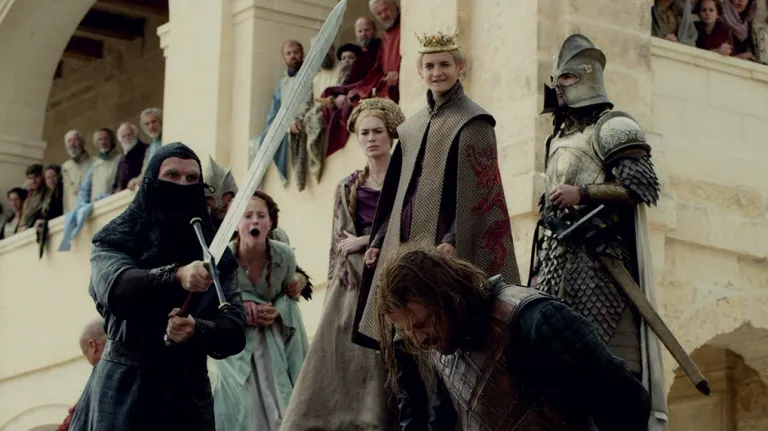
That event is grand example of dramatic irony and cruel spectacle. Ned is brought before the crowd, and as Varys instructed, he publicly confesses his crimes and recognises Joffrey Baratheon as the one true king. Grand Maester Pycelle extols the king’s mercy, and for a moment, the narrative teases a reprieve. Sansa’s pleas and Cersei’s counsel have seemingly prevailed; Joffrey declares that Ned may take the black and live out his days on the Wall. Then, with the petulant sadism that defines him, the boy-king shatters the illusion. “Women are soft,” he sneers, declaring that treason must never go unpunished. The order to Ser Ilyn Payne (Wilko Johnson) is given in an instant. The horror that floods Cersei’s face—a mother realising she cannot control the monster she created—is palpable, but it is too late. The mute executioner’s sword falls, and the head of the series’ moral centre rolls. The direction, focusing on Arya’s stunned perspective from the crowd, is brutally effective. She is saved from rushing to her doom only by the quick intervention of Yoren of the Night’s Watch, who recognises her and begins her transformation from noble daughter to faceless weapon. This sequence is not merely shocking; it is a foundational act of narrative destruction. By the conventions of genre television, Ned Stark, the honourable protagonist, was supposed to survive, or at least die a martyr’s death. Instead, he is removed in the most capricious manner possible, a victim not of a grand villainous plot but of a spoiled child’s whim. The message is unequivocal: in this world, no one is safe, and good intentions offer no protection. This principle would become the series’ narrative engine for years to come.
While the axe falls in King’s Landing, the civil war escalates elsewhere. Robb Stark, marching to relieve his besieged Tully kin at Riverrun, faces the strategic bottleneck of the Twins, the heavily fortified crossing held by the nonagenarian opportunist Walder Frey (David Bradley). In a portentous deal, Robb secures passage and additional troops by promising marriages to Frey children—a pact whose tragic consequences will reverberate catastrophically later. Robb’s campaign, however, is marked by cunning. In a strategic feint, he sends a smaller force to engage Tywin Lannister at the Green Fork. This battle is witnessed through the disorienting, comedic perspective of Tyrion Lannister, who is knocked unconscious almost immediately after it begins. He awakes to Bronn’s report of a Lannister victory, but with the puzzling note that the Northern force was far smaller than expected. The revelation follows: the main Northern host, under Robb’s personal command, has ambushed and crushed Jaime Lannister’s army in the Whispering Woods, capturing the Kingslayer himself. This victory, presented through Catelyn’s proud but anxious gaze as Jaime is paraded before her, establishes Robb as a formidable battle commander. Yet his sober reminder that “the war is far from over” underscores the episode’s theme: a single triumph, however dazzling, does not guarantee ultimate success.
Tyrion’s subplot provides a rare moment of lightness amidst the gathering darkness. Bronn procures for him a prostitute named Shae (Sibel Kekili). Her exotic manner and sharp wit immediately captivate Tyrion, forging an attachment that feels more genuine than transactional. This relationship, born on the eve of battle, becomes a crucial emotional anchor for the character in seasons to come.
Meanwhile, across the Narrow Sea, Daenerys Targaryen faces a crisis of a different nature. Her husband, Khal Drogo, is dying from a festering wound received in a duel. The formidable Dothraki khalasar grinds to a halt as its leader weakens. Ser Jorah Mormont, ever the pragmatic advisor, urges Daenerys to flee, warning that her status will evaporate with Drogo’s last breath. But Daenerys, displaying the stubborn will that will define her reign, chooses a riskier path. She summons Mirri Maz Duur, a captive maegi, to perform a blood magic ritual. The sacrifice of Drogo’s horse and the forbidden nature of the magic provoke the bloodrider Qotho (Dar Salim) to violence, leading to a fierce duel with Jorah that ends in Qotho’s death. In the chaotic aftermath, Daenerys goes into premature labour, and Jorah, desperate, carries her into the ritual tent despite Duur’s explicit warnings. This sequence masterfully intertwines personal tragedy with supernatural dread, setting the stage for the cataclysmic events of the season finale.
At the far northern edge of the story, Jon Snow’s journey continues on a quieter, though significant, note. As a reward for saving his life, Lord Commander Jeor Mormont presents Jon with Longclaw, a Valyrian steel sword—a tangible symbol of his acceptance and rising status within the Night’s Watch. In a poignant scene, he also learns the secret of Maester Aemon: the frail, blind old man is Aemon Targaryen, uncle to the Mad King, who chose the Watch’s neutral obscurity over the perils of royal blood. This revelation quietly expands the series’ historical depth, linking the Wall’s present to the Targaryen past in a way that foreshadows Jon’s own obscured lineage.
Director Alan Taylor, an HBO veteran, deserves considerable credit for the episode’s taut execution. Baelor juggles no fewer than six distinct narrative threads across four geographical locations, yet it never feels disjointed or rushed. Taylor maintains an optimal balance between propulsive plot advancement and essential character exposition. The pacing is deliberate, allowing the dread surrounding Ned’s fate to build inexorably, while the cross-cutting between King’s Landing, the war camps, Essos, and the Wall creates a compelling tapestry of simultaneous crisis. The episode is a model of efficient, multi-stranded television storytelling.
A notable character introduction is Shae, a role that represented a breakout for actress Sibel Kekili. Her casting, insisted upon by George R.R. Martin himself, involved a significant adaptation from the books: Shae’s Westerosi background was rewritten to make her a foreigner, thereby accommodating Kekili’s distinctive German-Turkish accent. This change proved fortuitous, adding an extra layer of outsider mystery to the character. Kekili, whose previous work included roles in the adult film industry—a fact that sparked some controversy at the time—brings a combination of vulnerability, charm, and shrewdness to the role that makes Shae instantly intriguing. She is neither a simple romantic interest nor a mere plot device, but a complex figure whose motivations remain opaque.
For all its strengths, Baelor is not without a significant point of critique, one rooted in the practical realities of television production. The episode features two major military engagements—the Battle of the Green Fork and the Battle of the Whispering Woods—yet the audience sees almost nothing of the actual combat. We experience the Green Fork through Tyrion’s concussion-induced blackout and the Whispering Woods through Catelyn’s anxious waiting and the aftermath. While this can be justified as a deliberate narrative choice, foregrounding the personal over the panoramic, the more obvious explanation is budgetary constraint. Much like HBO’s earlier series Rome, which notoriously relegated the epochal Battle of Actium to a few lines of dialogue, Game of Thrones here had to cut corners. This economising, however frustrating for viewers craving spectacle, had a strategic purpose. It conserved resources for the later seasons, helping to secure the show’s future and ultimately enabling the vast, cinematic battles that would become its hallmark. In hindsight, this limitation forced a focus on character and consequence that arguably strengthened the episode’s emotional impact.
Baelor is a pivotal work of television, the moment Game of Thrones truly announced its ruthless narrative philosophy. It is a brilliantly constructed episode that balances intimate character tragedy with sprawling political intrigue, all while delivering a landmark twist that irrevocably altered audience expectations. By sacrificing its most apparent hero not in a blaze of glory but in a squalid political murder, the series demonstrated a commitment to unpredictable, often brutal storytelling that would define its golden age. The off-screen battles, while a concession to budget, do not detract from the episode’s profound dramatic power. Instead, they focus the lens precisely where it matters most: on the human cost of the game, and the terrifying truth that in Westeros, honour is not a shield, but a target.
RATING: 8/10 (+++)
Blog in Croatian https://draxblog.com
Blog in English https://draxreview.wordpress.com/
InLeo blog https://inleo.io/@drax.leo
LeoDex: https://leodex.io/?ref=drax
InLeo: https://inleo.io/signup?referral=drax.leo
Hiveonboard: https://hiveonboard.com?ref=drax
Rising Star game: https://www.risingstargame.com?referrer=drax
1Inch: https://1inch.exchange/#/r/0x83823d8CCB74F828148258BB4457642124b1328e
BTC donations: 1EWxiMiP6iiG9rger3NuUSd6HByaxQWafG
ETH donations: 0xB305F144323b99e6f8b1d66f5D7DE78B498C32A7
BCH donations: qpvxw0jax79lhmvlgcldkzpqanf03r9cjv8y6gtmk9