Television Review: Bang (The Shield, S4X03, 2005)

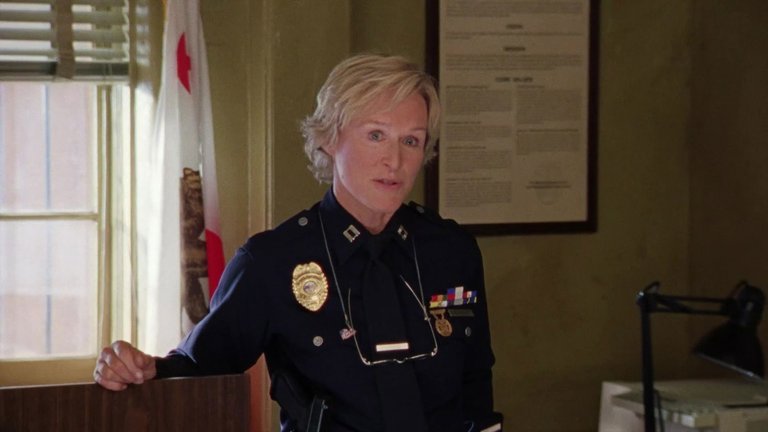
Bang (S04E03)
Airdate: March 29th 2005
Written by: Scott Rosenbaum
Directed by: Guy Ferland
Running Time: 44 minutes
The third episode of The Shield’s fourth season, Bang, represents a significant improvement over its predecessor, Grave. This elevation stems less from a dramatic shift in writing or directing quality and more from a refined, economical approach to storytelling. Where the previous episode felt cluttered with competing narratives, Bang pares back the subplots, allowing the audience to engage more deeply with the grim, morally ambiguous streets of Farmington. The result is a tightly wound, brutal hour of television that efficiently advances the season’s central conflict: the corrosive impact of Captain Monica Rawling’s uncompromising new regime.
The episode’s primary narrative thrust begins with Rawling (Glenn Close) formally taking command of the Farmington Precinct. In a speech to her officers, she outlines a radical departure from former Captain Aceveda’s policies, placing criminal asset forfeiture at the centre of her strategy. She argues that seizing ill-gotten gains can solve budgetary woes, fund overtime, purchase new equipment, and even return resources to the community. The rank-and-file react with enthusiasm, smelling opportunity. However, detectives Claudette Wyms and Dutch Wagenbach are less thrilled, particularly upon learning that the ethically compromised Vic Mackey will lead the new anti-gang unit. Rawling’s philosophy is immediately put to a severe test when a fatal drive-by shooting ignites a vicious gang war between the black gangs, the Spookstreet Souljahs and the One-Niners. Retaliatory killings escalate rapidly, culminating in the brazen assassination of a Souljah member in his hospital bed at Mission Cross.
Pressed to halt the spiralling violence, Vic seeks the catalyst for the conflict. A key witness emerges in Aloicious “Choppa” Jenkins (Six Reasons), a Souljah who survived the initial attack. Vic tracks him to a house owned by his mother, Chenille (Leontine Guillard), and takes him into custody. A more concrete clue surfaces from an unexpected source: Shane Vendrell, who has obtained a rap pornography video featuring Choppa engaged in a sexual act with a woman bearing One-Niner tattoos. The video’s producer, Terence Ross (Ronnie Warner), identifies the woman as “Bounce” (Tanya Alexander). When brought in for questioning, visibly beaten, she reveals her assailant as Peter “Puppethead” (Kamil Beale), the father of her child and a One-Niner. The tragic, trivial origin of the gang war becomes clear: Puppethead’s attempt to murder Choppa over this liaison sparked the cycle of retaliation. Choppa, when interrogated by Vic, expresses a perverse delight in the carnage, seeing it as invaluable “street cred” for his rap career, and steadfastly refuses to give up Puppethead.
Rawling, embodying her ruthless new doctrine, decides to force Choppa’s hand by striking at his family. Knowing Chenille’s home was purchased with drug money, she exercises asset forfeiture, evicting Chenille and her young children. This calculated, cruel act is rendered almost instantly pointless by the behind-the-scenes machinations of gang lord Antwan Mitchell, who brokers a brutal peace by delivering Puppethead to the Souljahs for a gruesome execution. The immediate thirst for vengeance is quenched, but Rawling’s punitive measure remains. Vic suggests returning the house to Chenille on humanitarian grounds, but Rawling refuses, coldly stating that such kindness would send the wrong message and undermine her deterrent strategy. This moment crystallises her tragic arc: in her zeal to avoid the compromised, ends-justify-the-means territory of a Vic Mackey, she adopts a different but equally dehumanising form of absolutism.
The episode’s subplots are mercifully streamlined. Dutch and Claudette continue to suffer unofficial reprisals for Claudette’s principled stand in the case of drugged public defender. This forces Dutch to plead with Assistant District Attorney Beth Encardi (Maria Horsford) for clemency, promising “extra” favours in return—a small but telling corruption of his own integrity. Meanwhile, a visit by Vic to Shane’s home to see his newborn son and the depressed Mara hints at a potential reconciliation and Mackey’s return to the Barn, a prospect Shane considers with wary ambivalence.
Written by Scott Rosenbaum and directed by Guy Ferland, Bang uses its outlandish central device—the gangsta rap porn video—to brilliantly illustrate the distorted values and profound distrust of authority within the community it portrays. Both Choppa and Bounce display a shocking pride in the bloodshed their actions precipitated, viewing human life as cheap currency for notoriety. The episode benefits enormously from Glenn Close’s masterful performance. In a standout scene, Rawling is confronted and scolded by the evicted Chenille. Close portrays Rawling’s visible discomfort and flicker of guilt with subtlety, yet she hardens her resolve, recognising that any concession to compassion might start her on a slippery slope toward the moral quagmire inhabited by Vic.
However, the episode is not without flaws. A secondary subplot involving Dutch investigating a series of coffee shop robberies feels underdeveloped and tonally awkward. Dutch’s Islamophobic remark to one victim is jarring and serves little narrative purpose beyond underscoring his occasional insensitivity. Similarly, a brief scene where Vic confronts a paediatrician (Deborah Van Valkenburgh) who attempts to dissuade the Mackey family from a vaccine injury lawsuit is a wasted opportunity. It functions as mere filler, doing little to advance character or plot and offering the veteran actress a role with negligible impact.
Despite these minor missteps, Bang succeeds as a powerful, focused instalment. It compellingly establishes the harsh new order under Monica Rawling, explores the cyclical, petty origins of gang violence, and delivers a scathing critique of policies where punitive legalism overrides basic humanity. The episode demonstrates that whilst the mean streets of Farmington are as treacherous as ever, a clearer narrative focus allows their moral complexities to resonate with far greater force.
RATING: 7/10 (+++)
Blog in Croatian https://draxblog.com
Blog in English https://draxreview.wordpress.com/
InLeo blog https://inleo.io/@drax.leo
InLeo: https://inleo.io/signup?referral=drax.leo
Leodex: https://leodex.io/?ref=drax
Hiveonboard: https://hiveonboard.com?ref=drax
Rising Star game: https://www.risingstargame.com?referrer=drax
1Inch: https://1inch.exchange/#/r/0x83823d8CCB74F828148258BB4457642124b1328e
BTC donations: 1EWxiMiP6iiG9rger3NuUSd6HByaxQWafG
ETH donations: 0xB305F144323b99e6f8b1d66f5D7DE78B498C32A7
BCH donations: qpvxw0jax79lhmvlgcldkzpqanf03r9cjv8y6gtmk9