Television Review: Cambridge Spies (2003)

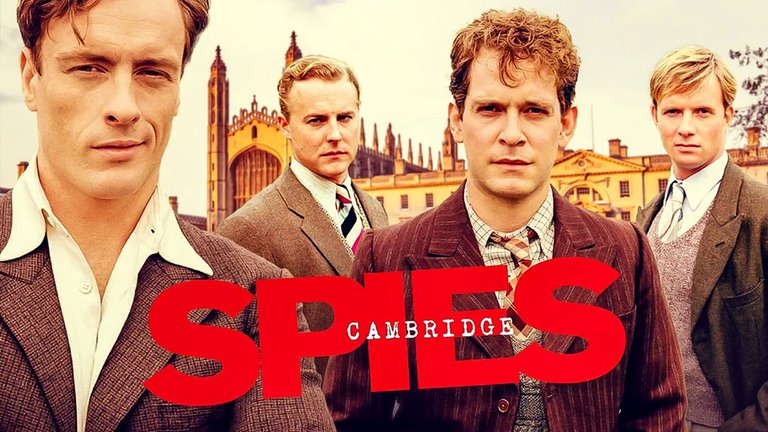
In the grand sweep of 20th-century history, the West ultimately emerged victorious in the Cold War, yet this triumph was not without its significant and often stinging defeats. Among the most spectacular and embarrassing of these setbacks was the defection of Kim Philby, a man who held the position of head of the British MI5 section dedicated to counterintelligence against the Soviets, only to be revealed as a deep-penetration Soviet mole. This seismic event did more than just shatter the reputations of the British intelligence services; it abruptly ended the real-life spy career of John le Carré, forcing him to channel his experiences into becoming one of the most successful and respected authors of spy fiction in literary history. The affair turned into one of the most infamous spy scandals of the century, with ripples that reverberated through the decades, fundamentally altering how the public viewed the intelligence establishment. Naturally, such a dramatic story of betrayal, ideology, and deceit has inspired numerous works of literature, films, and television shows, many attempting to reconstruct the labyrinthine aspects of the plot. However, the most comprehensive attempt to cover the saga in its entirety remains Cambridge Spies, a BBC four-part miniseries originally aired in 2003 that sought to dramatise the full arc of the Cambridge Five.
Written by Peter Moffat and directed by Tim Fywell, the miniseries commences its narrative at Cambridge University in 1934, where the audience is introduced to the four protagonists: Guy Burgess (played by Tom Hollander), Kim Philby (played by Toby Stephens), Anthony Blunt (played by Samuel West), and Donald Maclean (played by Rupert Penry-Jones). These men are depicted as close friends who share a privileged upper-class background, although they possess vastly different character traits and sexual orientations. Despite their personal differences, the most vital common trait binding them together is a profound fondness for Marxism. This political leaning was rather fashionable among the intellectual elite during the interwar years, largely as a reaction to the rise of Fascism across Europe. This political fervour is recognised and exploited by Arnold Deutsch, also known as Otto (played by Marcel Iures), an Austrian Communist who successfully recruits all four young men to work for Soviet intelligence. He instructs them to cease supporting Communism in public and instead to feign political sympathies turning in a different direction. The strategy is to win the favour of important members of the British business, military, and political elite who do not hide their own sympathies for Hitler and Nazism. The calculated idea is to win the trust of the Establishment, thereby allowing the four men to infiltrate the top echelons of government.
As the narrative progresses, this duplicity proves to be agonisingly painful for the protagonists when the Spanish Civil War erupts. Burgess, the most flamboyant and extroverted of the group, is forced to shun his lover, Julian Bell (played by Patrick Kennedy), who goes to fight on the side of the Republic and ultimately dies in the conflict. Meanwhile, Philby takes a job as a war correspondent for The Times and is compelled to write apologetically about the Nationalists, denying the help they received from the Nazis and even covering up atrocities such as the infamous bombing of Guernica. These personal and moral sacrifices, however, are not in vain, as all four men—belonging to "good families" with their Communist past viewed merely as a passing youthful fad—are successfully recruited into elite institutions like the BBC, the Foreign Office, MI5, or MI6. Blunt appears to fare the best of them all, securing a position as an assistant to the Royal family, granting him unparalleled access.
The outbreak of the Second World War, however, renders their position incredibly precarious. Due to the Hitler-Stalin pact, the men are technically aiding the ally of their country's enemy, creating a moral and professional minefield. In Paris, shortly before the city falls in June 1940, Maclean meets and marries an American woman named Melinda (played by Anna-Louise Plowman). He brings her back to England and eventually admits his true allegiance to her. The four men manage to keep their secret even after the UK and USSR become allies following the German invasion of Russia. Yet, after the end of the war, the rivalry between the Soviet Union and the West is reignited, with the USA holding a monopoly on nuclear weapons. The Soviets are desperate to obtain American nuclear secrets, and Maclean, posted in Washington, becomes a key asset, having established contact with the physicist and Manhattan Project participant Klaus Fuchs (played by Garrick Hagon). When the Soviets conduct their first nuclear test in 1949—years sooner than predicted—it convinces James Jesus Angleton (played by John Light), the head of counterintelligence in the newly created CIA, that there must be a leak. He identifies the source within the British embassy in Washington. Lord Halifax (played by James Fox), the ambassador, and Kim Philby are placed in charge of the investigation. Despite the incompetence of the former and the active sabotage by the latter, the list of suspects begins to narrow relentlessly toward Maclean. Realising that he can no longer protect his friend, and with the Soviets suggesting he sacrifice Maclean in order to preserve himself as a more valuable asset, Philby reluctantly helps Maclean escape. Maclean is escorted to safety by Burgess, and both men defect to the USSR in 1951.
Arguably one of the more ambitious BBC productions of its time, Cambridge Spies is a textbook example of why the British public broadcaster used to be regarded as the gold standard of high-quality television production. The miniseries boasts an excellent cast, featuring many notable names such as Tom Hollander, as well as actors like Toby Stephens, who would later go on to shine in major television shows like Black Sails. Filmed on location in England and Spain, the production displays great care for period details, accurately capturing the essence of the era through its fashion, set design, and music.
The ambitious task of covering two decades of tumultuous events in a mere four hours is also completed in a mostly satisfactory manner. The characters age gradually and realistically, aided by make-up and performance, allowing the audience to track the physical and psychological toll of their double lives. Furthermore, there is sufficient exposition provided for the many notable historical characters that appear in small roles, ensuring that the narrative remains accessible without becoming bogged down in historical minutiae.
Moffat’s script also generally avoids moral grandstanding. Instead of lecturing the audience, the drama reduces the characters' treason to few words in the opening credits and generally tries very hard to show the human rationale behind why four men chose such a treacherous path. It explores their motivations partly stemming from a genuine belief in the Communist cause, partly from a profound disgust over the hypocrisy of the British establishment, and partly from the guilt felt over their own privileged position. As the years pass and fatigue sets in, what keeps them going is portrayed not as patriotism or ideology, but a deep sense of loyalty and friendship that proves more important to them than any flag or political theory.
However, while generally succeeding in giving a comprehensive account of this infamous quartet, Cambridge Spies does have some issues regarding minor historical inaccuracies, a messed-up chronology, and a tendency towards spicing up the rather banal realities of spycraft with fiction. The most egregious error is the reconstruction of the infamous bombing of Guernica via a single biplane with German insignia. This move was clearly forced by budgetary constraints, but it adds an unnecessary layer of melodrama that undermines the historical gravity of the event.
These same constraints seemingly forced the authors to end the miniseries with Burgess and Maclean's 1951 defection. Consequently, Philby’s own defection in 1963, as well as the unmasking of Blunt as a spy, are merely mentioned in the end credits. This abrupt truncation leaves the viewer feeling somewhat short-changed, particularly regarding the conclusion of Philby’s story, which is central to the group's infamy.
Furthermore, the series, being made at a time when the BBC was trying to rebrand itself as "hip" and "edgy", also features a significant amount of nudity—both male and female. The former is represented in shots, repeated somewhat tiresomely in flashbacks, of the protagonists taking impromptu skinny-dipping session in front of hundreds of their fellow Cambridge students. While intended to showcase the reckless abandon of their youth, these scenes often feel like a gratuitous attempt to modernise the period drama.
At the end of the day, Cambridge Spies might not achieve all of its ambitions, particularly regarding its historical accuracy and narrative scope, but it nevertheless represents a solid and entertaining reconstruction of a fascinating episode of history. It offers a compelling glimpse into the minds of men who betrayed their country for what they believed was a greater good. However, those interested in a more nuanced, accurate, and comprehensive account would likely be better served by documentaries, which can deal with the complex realities of the Cambridge spy ring without the pressures of dramatic licence or runtime constraints.
RATING: 6/10 (++)
Blog in Croatian https://draxblog.com
Blog in English https://draxreview.wordpress.com/
InLeo blog https://inleo.io/@drax.leo
InLeo: https://inleo.io/signup?referral=drax.leo
Leodex: https://leodex.io/?ref=drax
Hiveonboard: https://hiveonboard.com?ref=drax
Rising Star game: https://www.risingstargame.com?referrer=drax
1Inch: https://1inch.exchange/#/r/0x83823d8CCB74F828148258BB4457642124b1328e
BTC donations: 1EWxiMiP6iiG9rger3NuUSd6HByaxQWafG
ETH donations: 0xB305F144323b99e6f8b1d66f5D7DE78B498C32A7
BCH donations: qpvxw0jax79lhmvlgcldkzpqanf03r9cjv8y6gtmk9