Television Review: Cripples, Bastards, and Broken Things (Game of Thrones, S1X04, 2011)

Cripples, Bastards, and Broken Things (S01E04)
Airdate: 8 May 2011
Written by: Bryan Cogman
Directed by: Brian Kirk
Running Time: 55 minutes
For the fourth episode of its inaugural season, Game of Thrones’ creators David Benioff and D.B. Weiss handed the scripting duties to their assistant, Bryan Cogman – until that point the series’ unofficial “keeper of the mythos”. The result, Cripples, Bastards, and Broken Things, is a notable pivot: the first episode not written by the showrunners, the first to feature a dream sequence (Bran’s vision of the three‑eyed raven), and the introduction of one of the series’ most enduringly popular characters. Cogman’s approach is less about propelling the central plot than about deepening the texture of George R.R. Martin’s world, a task he executes with a scholar’s care and a dramatist’s eye for the marginalised. While the episode may feel like a narrative deceleration, it compensates with rich character work and expository set‑pieces that would become hallmarks of the series.
The title derives from Tyrion Lannister’s explanation of his own unexpected kindness. Returning south from the Wall, he visits Winterfell and is taken to see Bran, now paralysed after his fall. Tyrion offers the boy designs for a special saddle that would allow him to ride again. When asked why he would bother, he replies with the episode’s defining phrase: “I have a tender spot in my heart for cripples, bastards and broken things.” It is a moment of genuine humanity from a character otherwise defined by cynicism, yet it is met with Robb Stark’s cold courtesy and open hostility from Theon Greyjoy (Alfie Allen). Theon, the hostage‑ward of Ned Stark following his father Balon’s failed rebellion, seizes the chance to perform loyalty to the Starks, his aggression underscoring his own precarious status – a “broken thing” in all but name. The scene establishes Tyrion’s moral complexity, but also the suspicion that greets Lannister goodwill in the North.
This affinity for society’s rejects is mirrored at Castle Black, where Jon Snow notices the brutal hazing of new recruit Samwell Tarly (John Bradley). Sam, the bookish, overweight, and physically inept son of Lord Randyll Tarly, is utterly unsuited to the Night’s Watch. Jon intervenes, ends the bullying, and befriends him, learning that Sam was forced to take the black by a father disgusted with his un‑warlike heir. Their burgeoning friendship is the episode’s emotional core, offering a straightforward bond of loyalty in a world otherwise devoid of such comforts. Sam’s introduction is a highlight of the episode; he is the series’ first outright “nerd”, a figure with whom a modern audience can immediately sympathise, and his presence instantly softens Jon’s stoic isolation.
In King’s Landing, Ned Stark’s investigation into Jon Arryn’s death inches forward. He discovers his predecessor was studying a massive lineage book, and visits a smithy where he takes an interest in a young apprentice, Gendry (Joe Dempsie) – a hint at the bastardy theme. Meanwhile, the Hand’s tournament provides visceral action: Ser Hugh of the Vale, Arryn’s former squire recently knighted, is killed in a joust by Ser Gregor ‘The Mountain’ Clegane (Conan Stevens). The death is both a spectacle and a blunt reminder of Lannister power, but it feels somewhat detached from Ned’s sleuthing, a set‑piece that highlights the show’s capacity for sudden violence without greatly advancing the conspiracy plot.
Across the Narrow Sea, the rift between Viserys and Daenerys widens. Viserys grows increasingly furious as the Dothraki horde moves east, away from his coveted Westeros, and as Daenerys’s influence over them grows. Jorah Mormont (Iain Glen) dryly observes that Viserys lacks the aptitude to rule, a verdict the episode thoroughly validates. This strand is functional but thin, serving mainly to chart Daenerys’s emerging authority and her brother’s descent into impotent rage.
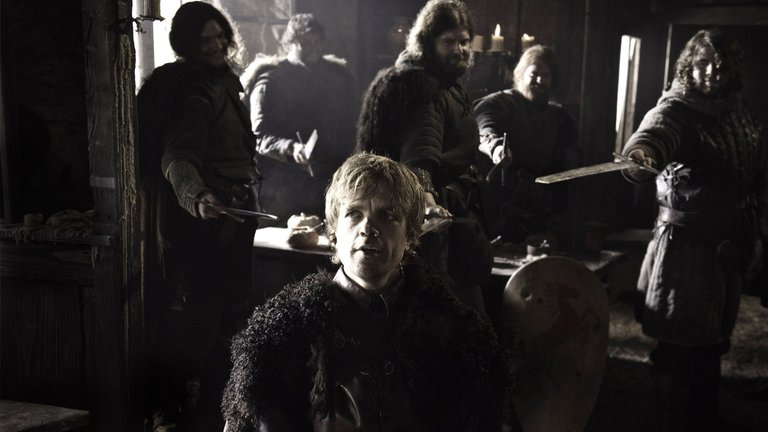
The episode’s climax arrives at the Inn at the Crossroads. Catelyn Stark, travelling discreetly back to Winterfell with master‑at‑arms Rodrik Cassel (Ron Donachie), is recognised by Tyrion, who is fortuitously present. To Catelyn, this seems divine providence; the inn is filled with knights loyal to her father’s House Tully. In a swift exercise of feudal authority, she accuses Tyrion of attempting Bran’s murder and orders his arrest to await the king’s justice. The scene is a superb cliffhanger, demonstrating how personal vendetta and inherited power can ignite continent‑spanning conflict. It also introduces, almost incidentally, a laconic sellsword named Bronn (Jerome Flynn) – a character whose sardonic presence would become one of the series’ great pleasures.
Cogman’s script is steeped in exposition, but he delivers it with considerable ingenuity. The past is woven into dialogue: Viserys recounts the extinction of dragons to Doreah while they have sex in a bathtub – the series’ first full‑blown “sexposition” scene, a technique that would be much employed (and criticised) in later seasons. The mention of the Greyjoy rebellion and the destruction of entire fleets adds layers to Westeros’s violent history. Yet the most potent exposition comes from Owen Teale’s Ser Alliser Thorne. Lecturing Jon and Sam on the horrors beyond the Wall, he tells a harrowing tale of a winter‑trapped patrol resorting to eating horses then to cannibalism. Delivered with grim relish, the monologue is rightly compared to Quint’s Jaws speech – a masterclass in building dread through anecdote.
Where the episode stumbles is in its pacing. The plot advances minimally: Ned gathers clues, Daenerys consolidates, Catelyn makes a fateful decision. The tournament aside, there is little action. Yet this deliberate slowdown allows for essential characterisation. Sam and Bronn are introduced seamlessly, and Tyrion’s multifaceted nature is further shaded. Cogman seems less interested in events than in people – specifically, the people on the edges. In doing so, he reinforces the series’ central theme: that the struggle for power often overlooks those it crushes, and that those “cripples, bastards and broken things” may yet shape the outcome.
Cripples, Bastards and Broken Things is a transitional episode, a breath before the storm. It lacks the dramatic punch of its predecessor or the shocks that would follow, but it provides the detailed world‑building and character depth that would sustain the series through its epic run. Cogman proves a capable steward of Martin’s mythos, delivering an instalment that is talky, sometimes meandering, but richly atmospheric. It may not be the most thrilling entry, but by focusing on the misfits, it ensures we care deeply about the world they inhabit – a crucial foundation for all that is to come.
RATING: 7/10 (+++)
Blog in Croatian https://draxblog.com
Blog in English https://draxreview.wordpress.com/
InLeo blog https://inleo.io/@drax.leo
LeoDex: https://leodex.io/?ref=drax
InLeo: https://inleo.io/signup?referral=drax.leo
Hiveonboard: https://hiveonboard.com?ref=drax
Rising Star game: https://www.risingstargame.com?referrer=drax
1Inch: https://1inch.exchange/#/r/0x83823d8CCB74F828148258BB4457642124b1328e
BTC donations: 1EWxiMiP6iiG9rger3NuUSd6HByaxQWafG
ETH donations: 0xB305F144323b99e6f8b1d66f5D7DE78B498C32A7
BCH donations: qpvxw0jax79lhmvlgcldkzpqanf03r9cjv8y6gtmk9