Television Review: Disaster (Star Trek: The Next Generation, S5X05, 1991)

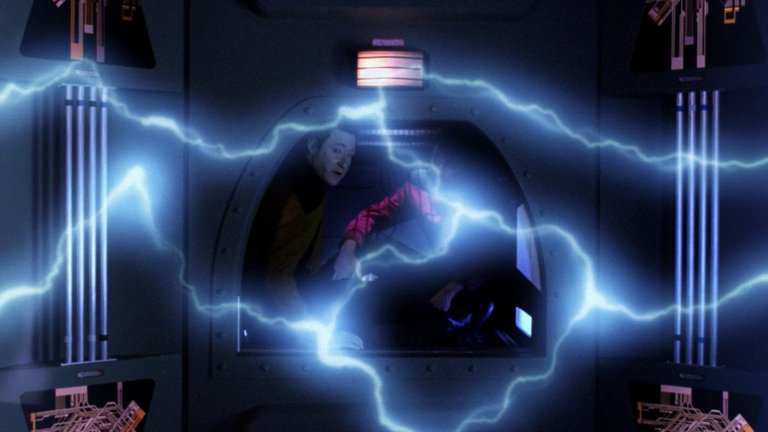
Disaster (S05E05)
Airdate: 21 October 1991
Written by: Ronald D. Moore
Directed by: Gabrielle Beaumont
Running Time: 46 minutes
Throughout its illustrious run, the creators of Star Trek: The Next Generation have demonstrated a remarkable versatility, frequently oscillating between hard science fiction, political allegory, and high-concept drama. Throughout its seven-year run, the series paid homage to its classic lineage in subtle ways, yet nowhere is this tribute more overt than in the fifth season episode aptly titled Disaster. This entry stands as a singular moment where the show fully embraced the grand tradition of disaster genre, transforming the Enterprise into a perilous arena for its characters. It serves as a stark reminder that behind the polished production values and cerebral dialogue, Star Trek has always retained a pulp sensibility that thrives on chaos.
The plot starts with the USS Enterprise-D returning from a mission, bathed in the glow of routine everyday events that serve as a deceptive calm before the storm. Captain Jean-Luc Picard is seen greeting a trio of young children—Marissa Flores (Erika Flores), Jay Gordon Graas (John Christian Graas), and Paterson Supra (Max Supera)—who have won a primary school science contest and are treated to a tour of the starship. This scene establishes a sense of normalcy and provides a human face to the starship's operations. In the leisure area of Ten Forward, Miles O'Brien and Keiko O'Brien are engaged in the domestic squabble of naming their unborn child. Simultaneously, in the cargo bay, Dr. Beverly Crusher and Geordi LaForge are supervising the loading of supplies.
Suddenly, the tranquility is shattered as the USS Enterprise is struck by a quantum filament, a phenomenon that precipitates catastrophic failure across the ship's vital systems. Life support, power generation, communications, and transport mechanisms all grind to a halt, plunging the vessel into darkness and panic. Isolation procedures are immediately initiated, effectively severing the ship into disconnected sections where crew members can no longer communicate or reach one another. On the bridge, a moment of bureaucratic confusion arises as Ensign Ro Laren attempts to assume command, only to be swiftly reminded by Miles O'Brien that Lieutenant Commander Deanna Troi technically outranks her due to her higher rank.
Captain Picard finds himself trapped in a turbolift with the three children, a situation that forces him to deal with both the physical labyrinth of the ship and the emotional challenges of childcare. He must find a method to rescue them while simultaneously lifting their spirits amidst the existential dread of the situation, a task that contrasts sharply with his usual command demeanor. In Ten Forward, which has been converted into a makeshift hospital, Commander Riker and Data venture out to attempt contact with the rest of the ship. During their journey, Riker is compelled to remove Data’s head to use his positronic brain, using its superior computing power to make repairs. Meanwhile, Dr. Crusher and Geordi face a desperate dilemma in the cargo bay: preventing a catastrophic exposure of radioactive plasma fire to quartaur barrels. Their solution requires a dangerous and drastic move of exposing the cargo bay to the vacuum of space, showcasing the extreme measures necessary to survive a ship-wide disaster.
In the social lounge, Keiko O'Brien goes into labour, placing the burden of delivery squarely on Worf’s shoulders, a role that elicits considerable discomfort to the stoic Klingon. As the crisis deepens, Ensign Ro suggests that due to the imminent danger of a warp breach, the saucer separation is the only logical course of action. However, this pragmatic suggestion is overruled by Deanna Troi, who, despite her lack of command experience, insists on the possibility that people might still be alive in the stardrive section of the ship. In the end, the crisis is averted as repairs are effected and systems are brought back online, culminating in the birth of a girl to Keiko.
The episode was crafted by Ronald D. Moore, one of Star Trek’s most celebrated authors. Moore, however, has been candid in his admission that he merely polished material pitched to him, often derived from a collection of strange ideas thrown together during production meetings. This collaborative process, however, did not detract from the episode’s general quality. Moore later acknowledged the contributions of Brannon Braga, a great fan of 1970s classic disaster films, noting that the plot represents a distinct homage to them, particularly The Poseidon Adventure, which employs a very similar scenario of a ship capsized by disaster.
Moore deserves significant praise for the structural integrity of the script. The plot divides the regular cast into distinct groups trapped in separate sections of the ship, yet ensures every group possesses something unique and vital to contribute to the resolution. The episode functions for most of its runtime as a collection of converging storylines that merge at the climax. In doing so, it provides Star Trek: The Next Generation with a well-utilised opportunity to experiment with novel concepts. This includes the until-that-time-unexplored pairing of Dr. Crusher and Geordi LaForge as a team, Data literally losing his head, and Captain Picard—who notoriously expressed his discomfort with children—being forced to take care for them. Furthermore, Troi is elevated to the position of de facto captain, allowing Marina Sirtis to portray Troi as a tough commander while simultaneously struggling with her own doubts, while Ensign Ro is introduced as a sensible officer who, in this particular instance, proves herself wrong regarding the necessary course of action.
The episode enjoyed immense popularity, largely because it brought back Miles and Keiko O'Brien, arguably the most beloved Star Trek couple. The presence of a pregnant Keiko added emotional weight, and Worf being forced to act as a midwife provided the audience with ample humour. The birth scene, though criticised for adhering to television tropes where heavily pregnant characters invariably go into labour during crisis situations, was handled with considerable care by Rosalind Chao. This motif would eventually be revisited in Deep Space Nine.
Although "Disaster" is not considered an undisputed classic, it is widely regarded as one of the more popular and memorable episodes of Star Trek: The Next Generation in its latter seasons. It is, regrettably, a poignant piece of trivia that this episode was the very last piece of Star Trek released before the death of its creator, Gene Roddenberry, on 24 October 1991.
RATING: 8/10 (+++)
Blog in Croatian https://draxblog.com
Blog in English https://draxreview.wordpress.com/
InLeo blog https://inleo.io/@drax.leo
LeoDex: https://leodex.io/?ref=drax
InLeo: https://inleo.io/signup?referral=drax.leo
Hiveonboard: https://hiveonboard.com?ref=drax
Rising Star game: https://www.risingstargame.com?referrer=drax
1Inch: https://1inch.exchange/#/r/0x83823d8CCB74F828148258BB4457642124b1328e
BTC donations: 1EWxiMiP6iiG9rger3NuUSd6HByaxQWafG
ETH donations: 0xB305F144323b99e6f8b1d66f5D7DE78B498C32A7
BCH donations: qpvxw0jax79lhmvlgcldkzpqanf03r9cjv8y6gtmk9