Television Review: Down Will Come (True Detective, S2x04, 2015)

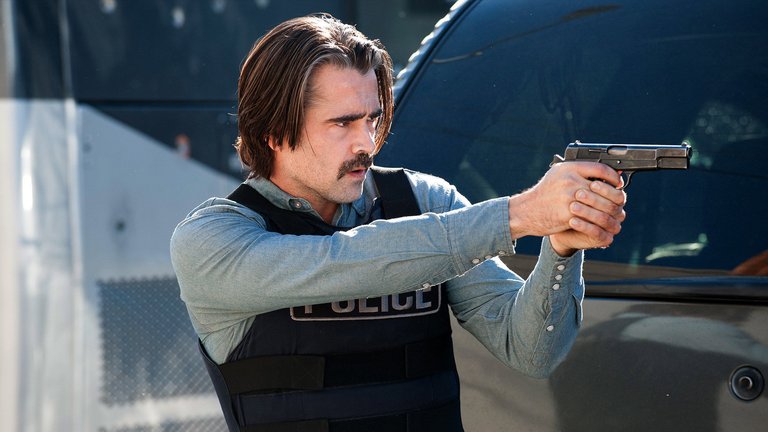
Down Will Come (S2x04)
Airdate: 12 July 2015
Written by: Nic Pizzolatto
Directed by: Jeremy Podeswa
Running Time: 55 minutes
By the midpoint of True Detective's second season, Down Will Come comes as a frustrating confirmation of what critics and audiences had already suspected: this installment would not merely fall short of Season 1's brilliance, but risk becoming one of HBO's most prestigious misfires. Written by series creator Nic Pizzolatto (sharing credit for the first time with Scott Lasser), this episode spends its first thirty minutes recycling virtually every flaw that plagued the preceding three—only to conclude with a bloodbath so nihilistic it plays like desperate compensation for the narrative inertia that preceded it.
The episode's most damning revelation is how thoroughly Pizzolatto's expanded cast has succumbed to "soap opera-isation." Where Season 1's Cohle-Hart dynamic thrived on psychological depth and philosophical tension, Season 2's quartet drowns in an almost parodic accumulation of personal crises that would strain credulity in a daytime melodrama.
Paul Woodrugh's storyline exemplifies this collapse most egregiously. In a single episode, the war veteran turned highway patrol officer: wakes beside his former army buddy (dispelling audience doubts about his sexuality with all the subtlety of a sledgehammer), has his motorcycle stolen, faces an ambush of journalists accusing him of war crimes, and receives news from his pregnant ex-girlfriend that prompts an enthusiastic marriage proposal. The implication—that establishing a "heteronormative" family represents Paul's only path to normalcy—reduces the character to a bundle of reductive tropes rather than a coherent human being.
Ani Bezzerides fares little better. We learn she faces a sexual harassment lawsuit from a former boyfriend/colleague, harbours gambling debts, and carries guilt for her police partner's dissolved marriage. Her father, leader of a New Age hippie commune, maintains decades-old ties to the Chessani clan running Vinci. In Pizzolatto's California, a state of nearly 40 million people has improbably shrunk to Peyton Place proportions—everyone connected to everyone, every private trauma intersecting with the central investigation in ways that strain coincidence to breaking point.
For three-quarters of its runtime, "Down Will Come" continues Season 2's most inexplicable failure: an investigation that barely advances. The detectives' inquiry into city manager Ben Caspere's murder remains mired in atmospheric posturing—endless aerial shots of California highways, dimly lit bar scenes where Frank Semyon trades monotone dialogue with Ray Velcoro, and a palpable sense that the narrative is killing time rather than building momentum.
This stagnation stems from a fundamental miscalculation. Pizzolatto attempted to differentiate Season 2 from its predecessor through quantity—four protagonists instead of two, twice the runtime's worth of conspiracy and corruption—without acknowledging that what worked with Cohle and Hart cannot simply be multiplied. The result is fragmentation rather than enrichment, with each character receiving insufficient development while the central mystery grows increasingly diffuse.
Then comes the final act—the shootout that critics would remember as the episode's sole memorable element, and perhaps its most troubling. When the detectives finally locate their suspect—a violent criminal with an extensive record—their approach ignores basic procedure. Rather than deploying SWAT, they initiate a "routine" arrest that transforms a methamphetamine laboratory into a war zone.
The sequence unfolds with deliberate anti-heroism. Gangsters armed to the teeth exchange fire with police just as local activists stage a demonstration outside, ensuring maximum civilian exposure. Bystanders fall like"sheep under a hail of bullets—some killed by criminal fire, others by police rounds fired in self-defense. The criminals briefly escape only to collide with a city bus, creating additional casualties before their execution. The protagonists stand amid corpses and blood pools, surrounded by the consequences of their incompetence.
Film enthusiasts will recognise the debt to Sam Peckinpah's The Wild Bunch—specifically its opening scene of indiscriminate massacre where innocents perish with realistic brutality. But where Peckinpah used such violence to interrogate codes of masculinity and loyalty, Pizzolatto deploys it as tonal differentiation. Cohle and Hart, even when breaking rules or arresting wrong suspects, demonstrated professional competence and emerged as flawed heroes. Velcoro, Bezzerides, and Woodrugh achieve no such redemption. Their "victory" is a fiasco of surreal proportions, leaving only bodies and institutional damage.
It is possible to imagine that critical hostility toward Season 2 reflects Pizzolatto's violation of Hollywood's unspoken political conventions. Where Season 1 located evil in rural Louisiana—Christian fundamentalism, white racism, Republican voting blocs, all acceptable targets for progressive critique—Season 2 relocates corruption to progressive California itself. The "eco-friendly" high-speed rail project serves kleptocratic elites; New Age spiritualists maintain incestuous ties to power; Latino gangsters perpetrate the bloodshed; and the potentially gay protagonist harbours psychological problems that render him suspect. Whether this subversion justifies the season's narrative failures remains debatable, but it provides context for the particular intensity of critical rejection.
The episode's conclusion sets up the season's remaining installments: political fallout from the massacre, superiors "suggesting" the bloodbath serve as an "elegant" pretext to close the investigation, and Frank Semyon—excluded from the shootout—positioned as perhaps the only real detective in a compromised system. Yet these narrative threads cannot overcome the structural damage evident in Down Will Come. Too many subplots remain unexplored, too many characters remain defined by cliché rather than complexity, and the dialogue—often atrocious throughout Season 2—fails to redeem these deficiencies.
The shootout provides a jolt of visceral intensity, but intensity without purpose merely numbs. By episode's end, True Detective Season 2 has established itself as a cautionary tale about overreach: the dangers of expanding scope without deepening substance, of mistaking darkness for depth, and of assuming that atmosphere alone can sustain a mystery that viewers increasingly struggle to care about solving.
RATING: 4/10 (+)
(Note: The text in the original Croatian version is available here.)
Blog in Croatian https://draxblog.com
Blog in English https://draxreview.wordpress.com/
InLeo blog https://inleo.io/@drax.leo
Substack https://draxster.substack.com/
LeoDex: https://leodex.io/?ref=drax
Hiveonboard: https://hiveonboard.com?ref=drax
InLeo: https://inleo.io/signup?referral=drax.leo
1Inch: https://1inch.exchange/#/r/0x83823d8CCB74F828148258BB4457642124b1328e
BTC donations: 1EWxiMiP6iiG9rger3NuUSd6HByaxQWafG
ETH donations: 0xB305F144323b99e6f8b1d66f5D7DE78B498C32A7
BCH donations: qpvxw0jax79lhmvlgcldkzpqanf03r9cjv8y6gtmk9