Television Review: Family Meeting (The Shield, S7X13, 2008)

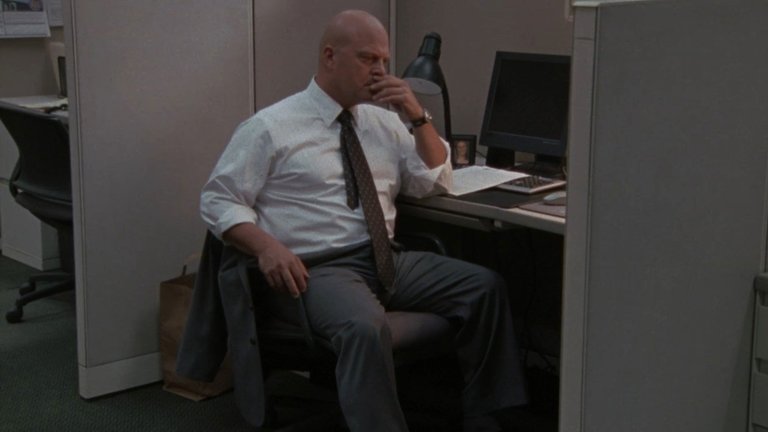
Family Meeting (S07E13)
Airdate: 25 November 2008
Written by: Shawn Ryan
Directed by: Clark Johnson
Running Time: 72 minutes
When The Wire concluded its five-year run on 9 March 2008, it was widely considered among the greatest, if not the absolute finest, piece of US scripted television produced at that time. The series set a new gold standard, establishing a level of narrative complexity and moral ambiguity that numerous subsequent shows would aspire to reach in the years that followed. Yet, the television drama most frequently compared to The Wire was another programme that aired nearly simultaneously, sharing the same gritty premise of morally compromised policemen navigating the hellscapes of urban America. When that rival show, The Shield, finally ended with its series finale Family Meeting, the comparisons proved apt not only between the two series as a whole but also regarding their respective final episodes, as both were directed by the acclaimed Clark Johnson.
"Family Meeting", the thirteenth and final episode of the seventh season, served as the culmination of a narrative journey that spanned eight years. The episode brought about the conclusion that was hinted at from the very beginning, referencing the shocking first episode where main character LAPD Detective Vic Mackey, the head of the Strike Team in the troubled Farmington Division, killed his new partner, Detective Terry Crowley, to cover his corrupt dealings. That initial act of betrayal could realistically only lead to one of three fates for Vic: getting killed, going to prison, or being kicked out of the force. In a masterful twist, Family Meeting delivers on all three possibilities, albeit assigned to different characters. The episode sees the last three surviving members of the Strike Team, which had recently been dissolved, face their ultimate reckonings in stark contrast to one another.
The member who meets his death is Shane Vendrell. Vic's former partner and best friend, transformed into his worst enemy, is now a pathetic wreck, a fugitive wanted by the LAPD. Stripped of his badge, his money, and any realistic possibility of caring for his beloved pregnant wife, Mara, the situation becomes untenable. The spouses begin to deliberate their grim future, one in which they would both end up in prison for the rest of their lives, and even worse, have their children taken away and put into foster care. This is a reality Shane cannot accept. When he learns that Vic’s deal with the federal government has rendered any of his own potential deals irrelevant, he makes his final decision. He returns to his home, and when his former colleagues come to seek him, he blows his own brain out, leaving behind a half-finished note and the bodies of Mara and their two-year-old son, Jackson, whom he had poisoned before taking his own life. This horrific act was inspired by the real-life tragedy of Chris Benoit, a detail that underscores the dark realism of the finale.
The character who goes to prison is Ronnie Gardocki, and his fate is particularly tragic for viewers who had grown to love his relative decency. Ronnie was arguably the most responsible and level-headed of the trio, and at the start of the final episode, he looked the most optimistic. Unaware that Vic had sold him out to the feds, he enthusiastically takes part in a sting operation against the Beltran and Black gangsters. It is an effort in which he displays significant street-level skills, and one which ultimately succeeds, bringing a large stash of drugs to the federal agents. Ronnie feels triumphant when he returns to the Barn, witnessing the happiness among federal agents and Captain Aceveda exploiting the success of the drug bust to cement his own mayoral campaign. Yet, upon return to the Barn, the devastating truth is gradually revealed. Ronnie breaks down in tears after being informed about the tragic fate of the Vendrells. Then, Claudette brings Vic to the interrogation room to confront him not only about the Vendrells' deaths but also to have him witness Ronnie's arrest, a moment where Vic's own treachery makes Ronnie's ruin possible.
Even before the episode began, Vic had already been effectively out of the LAPD. Yet the deal he made involved getting a job in a federal law enforcement agency, and Vic deludes himself that he will again roam the streets as a "superhero". However, Agent Olivia Massey, who felt personally humiliated by the confessions of the crimes for which Vic had won full immunity, turns the tables on him. She brings him to reality, revealing he would not only never see his wife Corrine again, now safely brought into a federal protection programme, but the deal stipulates work that actually looks more like indentured servitude. Instead of field work, he is to serve as a mere clerk, bound to a desk, forced to wear a suit and tie, deliver regular bureaucratic reports and sit in a corporate cubicle. For Vic, the faceless, sterile federal building begins to look like a prison, a punishment that feels fitting for a man too clever to get caught but too damned to escape his demons. The series ends ambiguously, with Vic taking a gun and leaving the office, presumably to seek the old excitement from his Strike Team days, though the likelihood of him returning to that life is slim.
In the final episode, showrunner Shawn Ryan remains true to the formula of the main series, where the narrative goes hand-in-hand with side storylines. The most obvious of these could serve as some form of sociopolitical commentary involving Robert Huggins. A comic bookstore owner and neighbourhood activist, Huggins reappears as a rival candidate to Aceveda's mayoral run and gets into all kinds of trouble, complaining about threats from drug-dealing gangs and disrupting Aceveda's events. Near the end, he gets shot and dies in an ambulance while talking to Officer Tina Hanlon, leaving his political arc largely unresolved. This plot point adds to the feeling that not every thread is neatly tied, reflecting the chaos of real life.
A storyline from previous episodes is also left open-ended regarding Dutch Wagenbach and Lloyd Denton. Dutch sees that someone tried to burn women's clothes in his driveway, and when Lloyd Denton reports the disappearance of his mother, both Dutch and Claudette know that the young psychopath murdered her and tried to pin crime on Dutch. Denton is advancing, just as Dutch had predicted, to become a serial killer. Yet they can't prove it, although Claudette is convinced that he would make a mistake and get caught sooner or later. Furthermore, Claudette admits to Dutch that her lupus is getting worse, that the medicine doesn't work any more, and that she will eventually die from the disease, adding a personal tragedy to the professional one.
There are also subplots involving Billings and the Barn. Billings is still involved in the lawsuit against the Barn, and his lawyer Ellen Carmichael, played by Julia Campbell, real-life wife of Jay Karnes, approaches Dutch with the intention of making him change his statements. She also uses the opportunity to slip him her phone number with obvious romantic attention, a nice little detail that adds a levity to otherwise grim tale.
Director Clark Johnson, who appears in a cameo role as a US Marshal helping Corrine and her children start a new life in Rockford, Illinois, did a good job as director. His direction captures the gravity of the moment, yet he could not fully compensate for some deficiencies in the script. While the ambiguous, open-ended scene works well as an ironic punishment for Vic, the episode lacks the proper closure of The Wire''s -30-, which provided a definitive sense of finality. Some storylines, like Huggins', seem redundant and few important characters from the early seasons, such as Julian and Danny, are reduced to cameos or left without full closure. Despite this, the finale remains a critical favourite.
At the end of the day, Family Meeting serves as a testament to the show's commitment to its gritty realism. It delivers a harsh, unflinching look at the consequences of a life lived in crime. Vic's fate, in particular, serves as a fitting end for a character who sought to be untouchable. While it may not match the definitive closure of The Wire, it succeeds in leaving a lasting impression on the audience, marking the end of an era in television drama. The legacy of the show remains strong, with the finale often cited in discussions regarding the best series finales in the medium's history. The performance of the cast, particularly Michael Chiklis and Walton Goggins, ensured that the emotional weight of the story was felt by millions. Ultimately, the series ended not with a whimper, but with a bang, leaving viewers to contemplate the moral costs of shortcuts in pursuing justice.
RATING: 7/10 (+++)
==
Blog in Croatian https://draxblog.com
Blog in English https://draxreview.wordpress.com/
InLeo blog https://inleo.io/@drax.leo
InLeo: https://inleo.io/signup?referral=drax.leo
Leodex: https://leodex.io/?ref=drax
Hiveonboard: https://hiveonboard.com?ref=drax
Rising Star game: https://www.risingstargame.com?referrer=drax
1Inch: https://1inch.exchange/#/r/0x83823d8CCB74F828148258BB4457642124b1328e
BTC donations: 1EWxiMiP6iiG9rger3NuUSd6HByaxQWafG
ETH donations: 0xB305F144323b99e6f8b1d66f5D7DE78B498C32A7
BCH donations: qpvxw0jax79lhmvlgcldkzpqanf03r9cjv8y6gtmk9