Television Review: First of His Name (Game of Thrones, S4X05, 2014)

First of His Name (S4x05)
Airdate: 4 May 2014
Written by: David Benioff & D.B. Weiss
Directed by: Michelle MacLaren
Running Time: 53 minutes
By the midpoint of its fourth season, Game of Thrones had reached a critical juncture. The sprawling, labyrinthine world of Westeros and Essos had been meticulously established for a global television audience, its complex web of families, allegiances, and historical grievances laid bare. The showrunners, David Benioff and D.B. Weiss, evidently concluded that this foundational work was complete; the audience, particularly the broad viewership HBO coveted, was now sufficiently versed in the rules of the game. The narrative imperative thus shifted from posing ever-more intricate questions to beginning the process of providing answers. First of His Name (S4, E05) is a deliberate and pivotal episode in this transition, offering a crucial resolution to one of the series’ oldest and most consequential mysteries: the precise catalyst for the War of the Five Kings. It is an instalment dedicated to the sobering business of governance and consequence, where the thrill of conquest gives way to the grind of rule, and long-hidden truths are finally prised into the light.
The episode’s most significant revelation arrives in the haunting, mist-shrouded heights of the Eyrie. After a season of cryptic manoeuvring, Petyr Baelish finally delivers Sansa Stark to her destination, revealing her aunt Lysa Arryn as his co-conspirator. In a masterful sequence of dialogue, Lysa’s unhinged exuberance unveils the truth: her torrid affair with Littlefinger led her to poison her husband, Jon Arryn, and then, at Baelish’s behest, send a letter falsely implicating the Lannisters, a deception that prompted Catelyn Stark to seize Tyrion and ignite the conflict. This is the answered mystery—the poisoned seed from which the chaos grew. Baelish’s gamble in harbouring a fugitive is instantly mitigated by Lysa’s desperate passion, culminating in their immediate, impulsive marriage. Yet, director Michelle MacLaren subtly foreshadows the instability of this new alliance. Lysa’s joy curdles into paranoid jealousy as she compares herself to the youthful, beautiful Sansa, establishing a toxic dynamic that replaces political safety with a new, intimate danger. The scene brilliantly reframes years of narrative as the product of one man’s ambition and one woman’s manipulated lust, providing a satisfying, if sinister, point of origin.
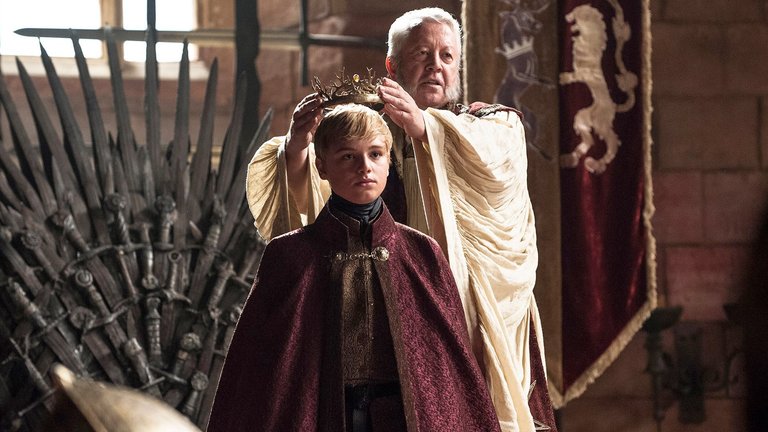
In King’s Landing, the episode explores the façade of stability that follows turmoil. The coronation of Tommen Baratheon is a pageant of relief; the realm collectively exhales, believing any monarch must be an improvement upon the sadistic Joffrey. This fleeting unity even prompts a temporary, frosty détente between Margaery Tyrell and Cersei Lannister. However, the episode swiftly undercuts this optimism with a stark piece of economic realism. In a private meeting, Tywin Lannister informs Cersei that the legendary gold mines of Casterly Rock have been barren for three years. The Lannister wealth, the very foundation of their power, is a myth; they are deeply indebted to the Iron Bank of Braavos. Tywin’s solution is brutally pragmatic: the debt can only be serviced through an alliance with the vastly wealthier Tyrells. This revelation, a significant deviation from George R.R. Martin’s books where the mines merely slow, serves as good political commentary. It reduces Cersei’s proud defiance to a matter of ledgers and liquidity, forcing her to acquiesce to political marriages she despises. The scene transforms the game of thrones from a romantic pursuit of power into a grim exercise in corporate debt management, echoing post-2008 financial anxieties and the fiscal decay of empires like Rome.
Across the Narrow Sea, Daenerys Targaryen confronts the universal lesson of empire-building: conquest is ephemeral without consolidation. News reaches her in Meereen of Joffrey’s death and the capture of the Meereenese navy, presenting a seemingly perfect opportunity to sail for Westeros. Yet, she simultaneously learns that Astapor and Yunkai have already fallen back to the slavers, her liberation undone. Ser Barristan Selmy’s plea to seize the moment and reclaim her birthright is the voice of dramatic convention. Daenerys’s decision to stay and rule is the show’s commitment to a more nuanced, frustrating realism. She recognises that a ruler who cannot secure three cities has no hope of holding seven kingdoms. This storyline, while arguably slowing the momentum of her arc, is crucial thematically, pairing with the Lannister bankruptcy to illustrate that power is not merely taken but sustained—a lesson in administrative responsibility that tempers her fiery destiny.
The episode’s weaker elements are found in its perfunctory handling of travelling pairs, which feel like obligatory “check-in” filler. Brienne and Podrick’s earnest journey north and the Hound and Arya’s continued grim trek towards the Vale provide necessary geographical movement but little narrative heft within the instalment. They are placeholders, ensuring these characters remain in motion while the episode focuses on its core revelations.
Conversely, the concluding sequence at Craster’s Keep is a piece of pure, manufactured television drama, engineered to provide the action set-piece the episode otherwise lacks. Entirely invented for the show, this convergence sees Bran’s party captured by the vile mutineers, only for a Night’s Watch raiding party led by Jon Snow to attack. In the chaos, the Bolton spy Locke attempts to kidnap Bran, who uses his burgeoning warg abilities to control Hodor, leading to a visceral and cathartic rescue. Jon dispatches the loathsome Karl Tanner, delivering the karmic justice the audience craves for the Keep’s rapists and murderers. While MacLaren directs the night-time skirmish competently, its visual murkiness can’t disguise its functional nature: it exists to clean up a narrative loose end (the mutineers), offer a near-miss emotional beat for Jon and Bran, and send Bran definitively north. His choice to heed Jojen’s counsel and avoid his half-brother is a poignant moment of sacrificed kinship for mystical duty. The liberation of Craster’s wives, who choose to burn the cursed place, offers a small, hard-won closure.
Written by Benioff and Weiss, First of His Name is, ultimately, a very effective transitional episode. It moves key pieces across the board with purpose: Sansa to a new prison, Tommen to the throne, Dany to a strategic pause, and Bran past a point of no return. Its final act tidies away a show-invented subplot, providing visceral satisfaction. The introduction of the Lannister gold mine crisis, while a departure from the source material, is a compelling piece of world-building that injects urgent, real-world economic stakes into the fantasy. It sparked apt comparisons to historical imperial decline and contemporary financial crises, enriching the series’ political texture. The episode succeeds not through spectacular set-pieces—though it includes one—but through the quiet, devastating power of revelation and the sobering administration of a world broken by ambition. It is the moment the series begins to draw its threads together, exchanging mystery for consequence, and in doing so, deepens its claim to a more complex form of storytelling.
RATING: 7/10 (+++)
==
Blog in Croatian https://draxblog.com
Blog in English https://draxreview.wordpress.com/
InLeo blog https://inleo.io/@drax.leo
LeoDex: https://leodex.io/?ref=drax
InLeo: https://inleo.io/signup?referral=drax.leo
Hiveonboard: https://hiveonboard.com?ref=drax
Rising Star game: https://www.risingstargame.com?referrer=drax
1Inch: https://1inch.exchange/#/r/0x83823d8CCB74F828148258BB4457642124b1328e
BTC donations: 1EWxiMiP6iiG9rger3NuUSd6HByaxQWafG
ETH donations: 0xB305F144323b99e6f8b1d66f5D7DE78B498C32A7
BCH donations: qpvxw0jax79lhmvlgcldkzpqanf03r9cjv8y6gtmk9