Television Review: Frank Herbert's Children of Dune (2003)

Frank Herbert’s 1965 novel Dune is arguably the most popular literary work of science fiction in the past seven decades, at least judging by its myriad adaptations into successful video games and feature films. Among the latter, the ongoing Denis Villeneuve three-part epic is currently the best known, while David Lynch’s 1984 version has gained a cult status despite its commercial and critical failure. Obscured by those two adaptations, and rather unjustly, is Frank Herbert’s Dune, the 2000 television miniseries produced by the Sci-Fi Channel, which was successful enough to warrant a 2003 sequel, Frank Herbert’s Children of Dune. In many ways, this sequel is even better than its predecessor, yet it remains a largely overlooked gem in the vast landscape of science-fiction television.
The miniseries is based on two of Herbert’s novels – Dune Messiah and Children of Dune – which continue the saga after the 1965 original. The script, written by John Harrison, divides the series into three feature-length parts. The first, adapting Dune Messiah, is set roughly twelve years after the events of the first miniseries. It shows Paul “Muad’Dib” Atreides (played by Alec Newman), heir to House Atreides and leader of the Fremen revolt on the desert planet Arrakis, now holding power as Emperor of the known universe. His rule, however, is marred by the brutal revolutionary jihad that has exhausted him and by family intrigues. Deeply disillusioned with the violence and corruption of his regime, and after his beloved wife Chani (Barbora Kodetová) dies giving birth to twins, Paul, blinded in an assassination attempt, retreats into the desert, abandoning his throne.
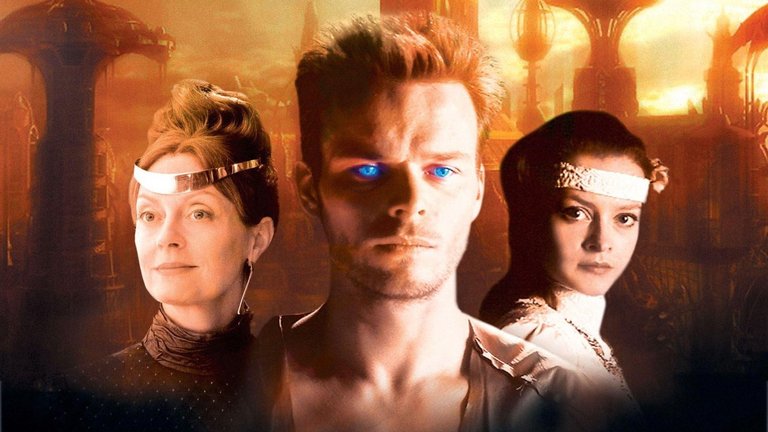
The next two parts, set fifteen years later, adapt Children of Dune. Paul’s younger sister Alia (Daniela Amavia) rules as Imperial Regent. Her reign is marked by growing Fremen discontent, intrigues by the Corrino Princess Wensicia (Susan Sarandon), and, most crucially, Alia’s possession via genetic memory by the spirit of her family’s archnemesis, Baron Vladimir Harkonnen (Ian McNeice). As Arrakis descends into civil war, Paul’s teenage children, Leto II (James McAvoy) and Ghanima (Jessica Brooks), fear for their lives and escape into the desert. Leto seeks to discover the “Golden Path” that his father failed to achieve, a destiny that will allow him to commune with the sandworms of Arrakis and secure humanity’s future.
John Harrison, widely praised for using the miniseries format to properly handle the epic scope of the source material in the 2000 adaptation, does even better in the sequel. Despite having to condense two novels into one narrative, and managing a multitude of characters and a Game of Thrones-like web of intrigues, Harrison’s script is remarkably coherent. The plot may seem less focused than in the original Dune, but this allows the audience to delve deeper into Herbert’s fictional universe. Concepts such as the Bene Tleilax and gholas – robot-like reconstructions of dead people, here represented by Paul’s late friend Duncan Idaho (Edward Atterton) – are introduced with clarity, enriching the mythology without overwhelming the viewer.
Harrison, who directed the 2000 miniseries, handed directing duties for the sequel to dependable television veteran Greg Yaitanes. Yaitanes brings a steadier hand, maintaining a consistent tone across the sprawling narrative. The series also saw some significant casting changes: Alice Krige took over the role of Lady Jessica from Saskia Reeves, bringing a more ethereal, commanding presence, while Steven Berkoff replaced Uwe Ochsenknecht as Stilgar, delivering a performance that is both gruff and deeply loyal. These changes, while noticeable, do not disrupt the continuity; instead, they inject new energy into the ensemble.
The most notable improvement over the 2000 miniseries is the larger budget, estimated at roughly $20 million – still high for television standards of the time. This allowed Children of Dune to utilise much better special effects and actual location shooting, unlike its predecessor, which often looked like a staged play. The sandworms, in particular, are rendered with impressive scale and menace, and the desert landscapes feel authentically vast and desolate. The production design, from the opulent Imperial interiors to the rustic Fremen sietches, is richly detailed, creating a believable world that honours Herbert’s vision.
The miniseries benefits enormously from its cast, especially the Greek-German actress Daniela Amavia as the unhinged Alia. Amavia masterfully portrays Alia’s descent into madness, her possession by the Baron a chilling spectacle of internal conflict. James McAvoy shines in one of his first major roles, portraying Leto II with a charismatic intensity that captures the character’s spiritual and physical transformation. His performance, both vulnerable and determined, hinted at the star he would become. Alec Newman, returning as Paul, conveys the weight of a broken messiah with poignant weariness. Susan Sarandon relishes her role as the scheming Wensicia, and Ian McNeice’s Baron Harkonnen remains a deliciously grotesque presence, even in spectral form.
Despite its qualities, Children of Dune remains relatively obscure. Ironically, it was the highest-rated miniseries in the history of the Sci-Fi Channel at the time of its broadcast. Its obscurity can be attributed to the high competition from other prominent science-fiction television shows, such as the reimagined Battlestar Galactica, which aired around the same period and captured the cultural zeitgeist more forcefully. This neglect is undeserved, for Children of Dune is a well-produced, ambitious adaptation that succeeds where many have failed: it captures the philosophical depth and political complexity of Herbert’s work while remaining accessible and engaging. Frank Herbert’s Children of Dune is a superior sequel to an already commendable adaptation. It improves upon its predecessor in nearly every aspect – from production values to narrative confidence – and features performances that elevate the material. It can be recommended not only to fans of the genre or Herbert’s novels but to any viewer seeking intelligent, character-driven science fiction.
RATING: 8/10 (+++)
==
Blog in Croatian https://draxblog.com
Blog in English https://draxreview.wordpress.com/
InLeo blog https://inleo.io/@drax.leo
InLeo: https://inleo.io/signup?referral=drax.leo
Leodex: https://leodex.io/?ref=drax
Hiveonboard: https://hiveonboard.com?ref=drax
Rising Star game: https://www.risingstargame.com?referrer=drax
1Inch: https://1inch.exchange/#/r/0x83823d8CCB74F828148258BB4457642124b1328e
BTC donations: 1EWxiMiP6iiG9rger3NuUSd6HByaxQWafG
ETH donations: 0xB305F144323b99e6f8b1d66f5D7DE78B498C32A7
BCH donations: qpvxw0jax79lhmvlgcldkzpqanf03r9cjv8y6gtmk9
Congratulations @drax! You have completed the following achievement on the Hive blockchain And have been rewarded with New badge(s)
You can view your badges on your board and compare yourself to others in the Ranking
If you no longer want to receive notifications, reply to this comment with the word
STOPCheck out our last posts: