Television Review: Guy Walks Into an Advertising Agency (Mad Men, S3x06, 2009)

Guy Walks Into an Advertising Agency (S3x06)
Airdate: 20 September 2009
Written by: Robin Veith & Matthew Weiner
Directed by: Leslie Linka Glater
Running Time: 48 minutes
It is a peculiar and celebrated hallmark of Mad Men that whole episodes can drift by in a haze of cigarette smoke and murmured subtext, where the most seismic shifts occur within a character’s glance rather than in the plot. Very little, in the conventional television sense, ‘happens’. And yet, when something does indeed happen—when the meticulously constructed world of early-1960s New York is violently punctured by an event—the result is often one of the series’ most indelible moments. Guy Walks Into an Advertising Agency, the sixth episode of the third season, stands as an exquisite case in point. Here, the catalytic event, one with profound and lasting consequences for nearly every principal character, is the product of sheer, absurd accident. This episode, written by Robin Veith and Matthew Weiner, masterfully uses a single, grotesquely comic disaster to explore themes of power, chance, and the fragile veneer of control, all while being precisely anchored to the Fourth of July weekend of 1963.
As with much of the series’ finest storytelling, the episode is deftly woven into the ongoing serial tapestry. It begins and ends by addressing the fallout from the previous episode—the birth of Eugene ‘Gene’ Draper. The domestic storyline reveals young Sally Draper’s poignant struggle to accept her new baby brother, a difficulty compounded by the fact that his name is a constant, painful reminder of her recently deceased and deeply beloved grandfather. This familial micro-drama, handled with the show’s characteristic subtlety, provides a quiet, human counterpoint to the corporate chaos about to erupt.
The main plot, however, returns us to the offices of Sterling Cooper, where the staff are once again confronted with their subjugation to their London-based corporate overlords, Puttnam, Powell & Lowe. On 1st July 1963, a staff meeting is called to announce the imminent arrival of a high-level delegation led by the imperious Saint-John Powell. He is to be accompanied by two other executives: Harold Ford (Neil Dickson) and, most significantly, Guy MacKendrick (Jamie Thomas King), a young, charismatic rising star. Their visit, coinciding with major impending personnel and policy changes, sends a ripple of anxiety and speculation through the ranks. The corporate intrusion is so profound it forces the agency to remain open on Wednesday, 3rd July, flouting the standard practice of closing before a national holiday. When queried on their poor timing, the PPL representatives offer a wonderfully condescending explanation: being British, they simply didn’t know.
This atmosphere of imposed change dovetails tragically with Joan Holloway’s personal narrative. In a devastating sequence, Joan, who has already perceived the possessive and potentially violent streak in her handsome, young husband Greg, makes the decision to quit her job to dedicate herself to domestic life. Her vision of a perfect future is shattered when Greg returns home drunk, confessing he has failed to secure a crucial surgeon’s residency—a career-ruining setback. In a cruel twist, he informs her that they must now re-evaluate their finances and that she will have to find a job, mere moments after she has voluntarily relinquished hers. The humiliation is compounded when she must still attend her own farewell party at the office, a celebration now rendered hollow and ironic. The PPL arrival only deepens the sense of instability. Lane Pryce, the British financial officer who has become somewhat sympathetic, is informed he is to be shipped off to Bombay, his office promised to the incoming wunderkind, Guy MacKendrick.
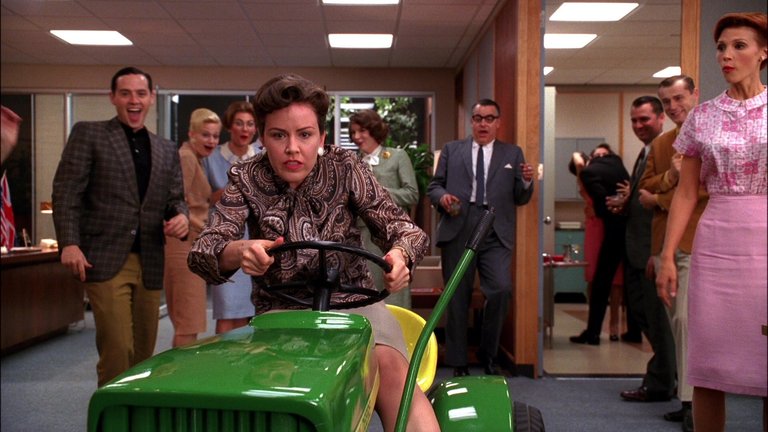
The subsequent party, like so many at Sterling Cooper, is fuelled by copious alcohol and quickly descends into raucous disarray. The episode’s central, shocking set-piece is triggered by a John Deere lawnmower, a gauche celebratory gift brought in by Ken Cosgrove after landing the account. In a moment of drunken hijinks, Smitty Smith gives secretary Lois a ride on the machine, loses control, and sends it careening across the office floor. The result is one of the most visceral and darkly hilarious scenes in television history: the lawnmower blade gruesomely severs Guy MacKendrick’s foot, spraying the stunned partygoers with blood. The scene is a masterclass in controlled chaos, and it is only through Joan’s swift, level-headed application of a tourniquet that MacKendrick’s life is saved. In an instant, the corporate destiny of the agency is rewritten.
Notably, Don Draper misses the incident entirely. He has been summoned to the Presidential Suite of the Waldorf Astoria to meet with “Connie”, the mysterious man he encountered weeks earlier. This meeting confirms the man’s identity as none other than Conrad Hilton (Chelcie Ross), the hotel magnate. Their discussion, in which Hilton probes Don about his advertising services, is a significant moment for the series, establishing a precedent for introducing real-life historical figures into its fictional fabric. The scene cleverly juxtaposes Ross with the image of the real Hilton from a 1963 Time magazine cover, blurring the lines between history and drama. Their meeting is abruptly cut short by the news of the office catastrophe.
Upon his return, Don learns the consequences: MacKendrick will likely lose his foot and thus his capacity to work, meaning Lane Pryce’s transfer to Bombay is cancelled. He will stay in his role, and the corporate reshuffle is nullified by a freak accident. The episode excels in its subtle depiction of these layered dynamics: the strained family relationships, the brutal calculus of professional choices, and the trans-Atlantic tension where a New York agency, operating in America at the zenith of its global power, must still kneel to representatives of a faded British empire.
The most memorable and analysed aspect of the episode remains the lawnmower scene. It functions on multiple levels. Primarily, it is a brutally effective piece of black comedy that suddenly reshuffles the corporate deck, undoing weeks of corporate machinations in a spray of blood and shock. More profoundly, the incident serves as a comical foreboding of a far more tragic national event. Director Lesli Linka Glatter employs specific visual cues—the sudden violence, the stunned reaction shots, the chaos erupting in a moment of celebration—to create an unmistakable associative link with the assassination of President John F. Kennedy, which would occur just months later in November 1963. The parallels are stark: a young, energetic, and charismatic leader (MacKendrick is explicitly framed as the future of the company) is cut down just as he is poised to enact great change. The episode thus becomes a brilliant piece of historical foreshadowing, using a grotesque office accident to prefigure the traumatic national accident that would truly end the ‘Camelot’ era.
The episode’s finale returns to a quieter, more reflective key. In a strong and resonant scene, Don and Sally discuss the new baby. Don tells his daughter that a baby, unlike adults, has many possibilities ahead of him. This sentiment perfectly underscores one of the series’ central motifs: the necessity of moving forward, of embracing the future’s potential rather than being paralysed by the past. It’s a poignant note that bookends the episode’s exploration of thwarted futures and sudden, accidental redirections.
If the episode possesses a flaw, it is perhaps a rare moment of overly explicit historical signposting. A scene featuring a heavy-handed reference to Vietnam and the possibility of a military draft feels somewhat anachronistic in its urgency for the summer of 1963. While the conflict was certainly a growing concern, the level of everyday anxiety depicted would become more characteristic of the later 1960s. This minor misstep, however, does little to detract from the episode’s overall power.
In the end, “Guy Walks Into an Advertising Agency” is not merely a very good episode of Mad Men; it is arguably the most memorable of Season 3. It rewards the audience’s patience with the series’ slow-burn storytelling by delivering a shocking, game-changing event that is both horrifically funny and deeply meaningful. It masterfully intertwines personal dramas with corporate politics and bold historical metaphor, all while showcasing the series’ unparalleled skill in character nuance and period detail. By confirming Conrad Hilton’s presence and orchestrating its infamous accident, the episode proves that when Mad Men decides to have something ‘happen’, it does so with unparalleled precision and lasting impact.
RATING: 8/10 (+++)
==
Blog in Croatian https://draxblog.com
Blog in English https://draxreview.wordpress.com/
InLeo blog https://inleo.io/@drax.leo
LeoDex: https://leodex.io/?ref=drax
InLeo: https://inleo.io/signup?referral=drax.leo
Hiveonboard: https://hiveonboard.com?ref=drax
1Inch: https://1inch.exchange/#/r/0x83823d8CCB74F828148258BB4457642124b1328e
BTC donations: 1EWxiMiP6iiG9rger3NuUSd6HByaxQWafG
ETH donations: 0xB305F144323b99e6f8b1d66f5D7DE78B498C32A7
BCH donations: qpvxw0jax79lhmvlgcldkzpqanf03r9cjv8y6gtmk9