Television Review: Hitler: The Rise of Evil (2003)

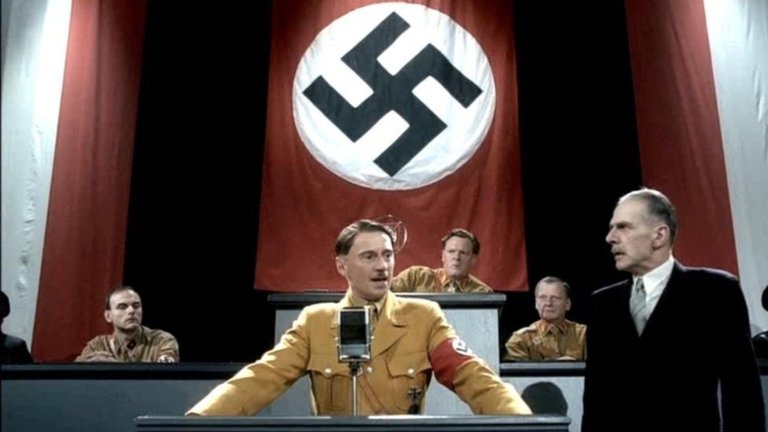
It could be argued that the entire history of the modern West, at least within its established mainstream, has been reductively framed through the prism of the Second World War. This cataclysm, in turn, is often distilled into a simplistic, almost mythological struggle between absolute Good and absolute Evil. The latter pole has found its enduring synonym not in a theological figure like Satan, but in the historical personage of Adolf Hitler. He has become the secular embodiment of irredeemable, unforgivable wickedness in the popular imagination. This Manichean framing has profoundly constrained dramatic representations of Hitler on screen. He is typically relegated to a peripheral detail—a ranting voice on a radio, a distant figure on a balcony—or his story is truncated to its spectacular, fiery demise in the Berlin bunker of 1945. Attempts to craft a genuine biographical film, one that tackles the formative years and the intricate political ascent that made the bunker ending possible, have been exceedingly rare. The most ambitious of these rare attempts is the 2003 Canadian-American two-part television miniseries, Hitler: The Rise of Evil. Directed by Christian Duguay and boasting a considerable budget and an impressive international cast, it aimed to provide a comprehensive account of how a failed artist from Austria became the Führer of Germany. Yet, ambition is not achievement. Whilst the miniseries may earn a passing grade for chronological clarity, it constitutes a profound failure as drama, historical insight, and compelling television, ultimately succumbing to the very caricatures it might have sought to complicate.
The script, written by G. Ross Parker and the accomplished playwright John Pielmeier (best known for Agnes of God and later successful adaptations of Ken Follett’s The Pillars of the Earth), takes a determinedly conventional, linear path. Part I begins in 1899 in Braunau am Inn, introducing a young Adolf (played by Thomas Sangster and Simon Sullivan) clashing with his authoritarian father and dreaming of becoming an artist. His subsequent years in Vienna are a montage of artistic rejection, poverty, and the adoption of the city's virulent anti-Semitism. The adult Hitler, portrayed by Robert Carlyle, emerges in Munich just as the First World War breaks out. His enthusiastic service on the Western Front and his devastated reaction to Germany’s defeat in 1918 are duly chronicled. The narrative then follows his fateful assignment as an army informant in post-war Munich, his entry into the tiny German Workers' Party, and his rapid transformation of it into the Nazi Party through sheer force of oratory. The disastrous Beer Hall Putsch of 1923 and his subsequent trial, where he turned the dock into a propaganda podium, conclude the first instalment.
Part II opens with Hitler in the relative comfort of Landsberg Prison, dictating Mein Kampf. Upon his early release, the series delves into his unsettling private life, particularly his possessive and abusive relationship with his teenage niece, Geli Raubal (Jenna Malone). As the political landscape shifts, Hitler reasserts control over the Nazi Party, abandoning putschism for a strategy of legal conquest via the ballot box. The Great Depression provides the catalyst. The series charts the party’s electoral surge, the scandal of Geli’s suicide, Hitler’s new relationship with Eva Braun (Zoe Telford), and the backroom manoeuvres that led President Paul von Hindenburg (Peter O’Toole) to appoint him Chancellor in January 1933. The final act accelerates through the Reichstag Fire, the Enabling Act, the brutal purge of the SA during the Night of the Long Knives, and culminates in Hitler’s consolidation of power as Führer after Hindenburg’s death in 1934. The closing credits starkly list the catastrophic human cost of the regime he built.
As a straightforward, episodic chronicle of key events from 1899 to 1934, The Rise of Evil is serviceable. A viewer with little prior knowledge could follow the basic timeline of Hitler’s life and the broad strokes of Weimar Germany’s collapse. However, to reduce the measure of a historical drama to mere comprehensibility is to set the bar subterraneously low. Beyond this basic utility, the miniseries falters, and its failures are rooted in a fundamental tension between its scale and its sensibility.
On a production level, the project is undeniably ambitious. Shot on location in the Czechia, which ably stands in for period Berlin, Vienna, and Munich, the film employs vast numbers of extras, detailed set design, and costumes to recreate the era. The cast list is replete with respected names: alongside Carlyle and O’Toole, there are Matthew Modine, Liev Schreiber, Julianna Margulies, Peter Stormare, and Stockard Channing. Yet, this solid craftsmanship is persistently undermined by Christian Duguay’s direction, which often feels overly ‘artsy’ in a manner that betrays its television origins. The use of slow-motion, dramatic chiaroscuro lighting, and a sometimes intrusive score strives for a portentous, epic gravity but frequently lands as melodramatic and aesthetically insecure. It evokes the style of a high-end television movie from the early 2000s, lacking the visual discipline or narrative confidence of a serious cinematic historical epic.
The miniseries’ most crippling flaw, however, lies at its very heart: the portrayal of Adolf Hitler by Robert Carlyle. By 2003, Carlyle had built a formidable career on playing volatile, psychologically damaged, and often terrifying individuals, most famously the feral Begbie in Trainspotting. Here, he does not so much act the part of Hitler as he transplants Begbie into historical dress. The screenwriters and Carlyle, seemingly paralysed by the fear that any nuance might be misconstrued as sympathy or justification, retreat entirely into the safest Hollywood Hitler stereotype: the raving, unhinged, violent lunatic. This Hitler is not a complex political animal but a pantomime monster. Carlyle’s performance is a compendium of tics and snarls. He is portrayed as a pathetic coward (flinching during the Putsch), an animal abuser (callously beating a dog), a sexual pervert (in his relationship with Geli), a hypocrite, and a man possessed of a preternatural talent for insulting and alienating every ally, supporter, or family member who crosses his path.
This approach creates a fatal narrative paradox. If Hitler was indeed this consistently repellent, this obviously unstable and vile in all his interpersonal dealings, the central question of the miniseries—how did he rise to power?—becomes not just unanswered but unanswerable. It renders his ascent utterly implausible. How could such a figure, devoid of charm or strategic subtlety, captivate the masses in his thousands? How could he outmanoeuvre seasoned political operators and win the crucial backing of the conservative elite, the military, and industrialists? The series gestures at the economic desperation of the Depression and the failures of the Weimar Republic, but it never meaningfully connects these conditions to the specific appeal of this man. A more daring and intellectually honest film might have explored Hitler as a vessel—a figure who gave articulate, violent expression to dark currents of resentment, nationalism, and anti-Semitism that already coursed through segments of German society. It might have shown the seductive power of his oratory, the magnetic quality that contemporaries attested to, even as they found him personally odd. Duguay and his writers lack either the inclination or the courage for such complexity. They opt instead for a simplistic caricature of evil, which, ironically, makes the historical evil less comprehensible and thus less frightening.
This failure is thrown into sharp relief when contrasted with a far superior film about Hitler, Oliver Hirschbiegel’s Downfall (2004). That film achieved something remarkable and controversial: it humanised Hitler. Through Bruno Ganz’s meticulous, haunting performance, Hitler is portrayed not as a raving demon but as a human being—ageing, physically failing, capable of courtesy to his staff, and yet utterly deluded and morally bankrupt. This humanisation is not an exoneration; it is a terrifying explanation. It forces the viewer to confront the uncomfortable truth that monstrous acts are perpetrated not by cartoon villains but by people who can appear normal, even charismatic. Downfall shows how a nation could be seduced by such a man. The Rise of Evil, by making its Hitler a one-note psychopath from the outset, lets Germany—and by extension, the viewer—off the hook. It suggests that only a society of fools or fellow monsters could follow such an obvious madman, fostering a dangerous sense of historical superiority in the audience.
Perhaps sensing the dramatic vacuum at the centre of their protagonist, Duguay and Pielmeier attempt to create moral counterweights. The most prominent is Fritz Gerlich (Matthew Modine), a crusading journalist who makes it his life’s mission to expose and stop Hitler, a quest that leads to his martyrdom in Dachau. Modine plays him with saintly conviction, but the character is a hollow archetype, a mere plot device representing ‘good’. The script notably ignores Gerlich’s fervent Catholic faith as the core motivation for his opposition, secularising his struggle into a generic fight for truth. More complex, and more wasted, is the character of Ernst Hanfstaengl (Liev Schreiber), an early elite supporter who becomes increasingly disillusioned. Schreiber is competent, but the writing is thin, ignoring Hanfstaengl’s fascinating connections to American high society (including a friendship with Franklin D. Roosevelt) and reducing his internal conflict to a few worried glances. Julianna Margulies, as his wife Helene, is given even less to do, despite the historical intrigue of Hitler’s peculiar fascination with her. These characters feel like obligatory checkboxes rather than fully realised individuals whose lives intersect tragically with history.
The miniseries’ shaky relationship with historical fidelity is further highlighted by the very public departure of its consultant, the eminent British historian Ian Kershaw. Kershaw, the author of a highly respected two-volume biography of Hitler, was initially attached to the project but later distanced himself from the final product. While not an unprecedented occurrence in historical filmmaking, it is a telling indictment from a scholar whose work meticulously analyses the structural conditions and personal agency that facilitated Hitler’s rise—precisely the analysis this film lacks.
The Rise of Evil was also hampered by self-inflicted controversy unrelated to its artistic merits. One of its producers, Ed Gernon, gave an interview drawing explicit parallels between Hitler’s rise and the contemporary political climate surrounding the US-led invasion of Iraq in 2003, even making comparisons between Hitler and President George W. Bush. The comments caused a firestorm, and Gernon was swiftly fired by the network, CBS. This incident not only created unwanted publicity but also underscored a deeper problem with the miniseries: its clumsy, heavy-handed approach to historical analogy. The film itself is so devoid of subtlety and historical insight that when a producer tries to force a modern ‘lesson’ from it, the result feels unearned and crass, a symptom of the project’s intellectual superficiality.
In the end, Hitler: The Rise of Evil is a classic example of a worthy ambition undone by creative timidity and simplistic storytelling. It assembles the pieces of a great historical tragedy—the budget, the locations, the cast, the scope—but fails to animate them with intelligence or psychological realism. By reducing Adolf Hitler to a snarling, pre-ordained monster from childhood, it makes his world-historical success inexplicable and prevents any meaningful exploration of the societal pathologies that enabled him. It offers a checklist of events but no understanding of them. For those genuinely interested in the complex, chilling story of how a democracy can commit suicide and a dictator can be born from its ruins, the three hours spent on this flawed piece of television would be far better invested in reading a single chapter of Kershaw’s biography or watching a rigorous documentary. The Rise of Evil ultimately commits the greatest sin a work about history can make: it renders the past not just simplified, but fundamentally boring and inert, a parade of cartoon villains and saintly victims that teaches us nothing about the darker potentials of human societies, including our own.
RATING: 4/10 (+)
==
Blog in Croatian https://draxblog.com
Blog in English https://draxreview.wordpress.com/
InLeo blog https://inleo.io/@drax.leo
InLeo: https://inleo.io/signup?referral=drax.leo
Leodex: https://leodex.io/?ref=drax
Hiveonboard: https://hiveonboard.com?ref=drax
Rising Star game: https://www.risingstargame.com?referrer=drax
1Inch: https://1inch.exchange/#/r/0x83823d8CCB74F828148258BB4457642124b1328e
BTC donations: 1EWxiMiP6iiG9rger3NuUSd6HByaxQWafG
ETH donations: 0xB305F144323b99e6f8b1d66f5D7DE78B498C32A7
BCH donations: qpvxw0jax79lhmvlgcldkzpqanf03r9cjv8y6gtmk9
@stayoutofherz
Hi. This account was blacklisted a while ago.