Television Review: Helen of Troy (2003)

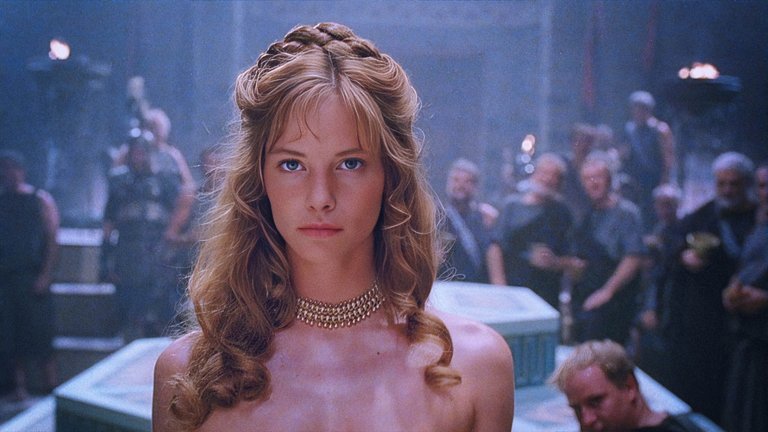
The immense commercial and critical success of Ridley Scott’s Gladiator in 2000 rekindled Hollywood studios’ interest in big-budget sword-and-sandal epics. Among the flurry of similar projects greenlit in those years, arguably the most ambitious and grandest of all was Wolfgang Petersen’s Troy (2004). Its long and complicated production, marked by casting coups and monumental set-building, created a buzz that other producers were eager to exploit. One such project, rushing to capitalise on the renewed appetite for ancient warfare and myth, was the 2003 television miniseries Helen of Troy. Produced for the USA Network, this two-part, three-hour spectacle aimed to deliver a televisual counterpart to the impending cinematic blockbuster, albeit on a smaller screen and a more modest budget.
Helen of Troy represents another adaptation of Greek myths, or more precisely, their interpretation in Homer’s Iliad and the wider epic traditions from the so-called Greek Dark Age at the turn of the 1st millennium BC. The plot, nominally set in the late Bronze Age, begins in the city of Troy on the east coast of the Aegean Sea. Thanks to its control over vital trade routes, Troy has become wealthy and powerful. King Priam (John Rhys-Davies) has just had a son named Alexandros, but a dire prophecy warns that the boy will bring misery and destruction to Troy. Priam reluctantly orders the baby killed on Mount Ida, but a merciful servant merely abandons him. The infant is adopted by a shepherd who names him Paris. Years later, Paris (Matthew Marsden), now a grown shepherd, enters a cave where he has a vision of three goddesses—Hera, Athena, and Aphrodite—offering him power, wisdom, and the most beautiful woman in the world if he judges who is the fairest. Paris opts for Aphrodite (Emily Kosloski), the goddess of love, and is rewarded with a vision of a young woman named Helen (Sienna Guillory).
Helen, who simultaneously sees a vision of Paris and falls instantly in love, is the daughter of King Tyndareus of Sparta (Richard Durden). Her legendary beauty has a dangerously destabilising effect on the men around her; it has already caused bloodshed when King Theseus of Athens (Stellan Skarsgård) abducted her, only to be killed by Helen’s brother Pollux (Craig Kelly), himself killed during her rescue. To prevent further chaos, the Greek monarchs decide to choose Helen’s future husband by drawing lots. King Agamemnon of Mycenae (Rufus Sewell) is already married to Helen’s older sister Clytemnestra (Maryam d’Abo), so the lottery proceeds. The winner is Agamemnon’s younger brother, the more temperate Menelaus (David Callis), who also serves as the story’s world-weary narrator.
Meanwhile, Paris travels to Troy to compete in a combat tournament, where he manages to defeat his own brother, Hector (Daniel Lapaine). This victory leads to his recognition by Priam and his readoption into the royal family, despite the frantic protests of his sister Cassandra (Emilia Fox), who is driven mad by her visions of Troy’s doom. As a prince, Paris is sent to Greece on a diplomatic mission. There, he sees Helen in the flesh, falls madly in love, and—with Aphrodite’s influence implied—abducts her. For Agamemnon, this is the perfect pretext for a war he has long desired, and he convinces the other Greek leaders to gather a vast armada. Helen is brought to Troy, and after negotiations for her return fail, a decade-long war becomes inevitable. What follows is ten years of bloodshed, claiming numerous heroes’ lives, until the siege ends with King Odysseus of Ithaca (Nigel Whitmy) devising the clever ruse of the wooden horse.
For viewers seeking an introduction to the history or myths of the Trojan War via screen adaptations, this miniseries does a markedly better job than Petersen’s later, more secular Troy. While screenwriter Ronni Kern’s script inevitably deviates from and condenses the mythology, the essential gist of the story remains intact. Key elements often omitted in other adaptations, such as the harrowing sacrifice of Agamemnon’s young daughter Iphigenia to appease Artemis, are included, lending the narrative a necessary mythological weight. The script consciously downplays supernatural elements, presenting the gods primarily through visions and dreams rather than physical interventions, but it does not erase them entirely. The result is a polished, by-the-numbers sword-and-sandal epic that prioritises human drama against a mythic backdrop. It only falls apart in a somewhat rushed and over-melodramatic final act, where the fall of Troy feels abrupt and the fates of certain characters are glossed over. However, this narrative hastiness is not enough to drag the overall impression below solidly competent.
The miniseries benefits enormously from an inspired cast. Sienna Guillory, in the titular role, is a compelling choice. Unlike some more recent and questionable casting decisions in historical epics, Guillory possesses a classical beauty that genuinely convinces as the face that could launch a thousand ships. She also does not shy away from the role’s inherent eroticism; the series includes scenes where she appears nude, albeit in a rather mild, PG-13 fashion. More importantly, the script attempts to portray events partially from Helen’s perspective, granting Guillory the opportunity to demonstrate her acting skills. She effectively conveys Helen’s initial innocence, her passionate obsession with Paris, and her growing anguish and guilt as the catastrophic consequences of their love unfold.
The rest of the cast is reliably solid. Matthew Marsden makes for a serviceable, if not deeply charismatic, Paris, sharing just enough chemistry with Guillory to sell the central, fateful romance. The supporting roles are filled with capable character actors: John Rhys-Davies brings gravitas to Priam, Rufus Sewell is effectively scheming and arrogant as Agamemnon, and Nigel Whitmy is a suitably cunning Odysseus. A particular standout is Emilia Fox, who is delightfully unhinged as the prophetic Cassandra. Her scenes, fraught with desperate warnings that everyone dismisses as madness, provide some of the miniseries’ most haunting moments.
Where Helen of Troy most visibly reveals its television origins is in its production design. Although a significant budget was clearly involved, comparisons with the cinematic scale of Troy highlight this as an obvious television production. The series was shot almost entirely on Malta, with many sets, locations, costumes, and props likely recycled from the production of Gladiator, which also filmed there. This recycling creates a pervasive, if unintended, anachronism: Helen of Troy often looks more like it is set in Classical Roman times than in Bronze Age Greece. The architecture, armour, and general aesthetic lean heavily into the familiar Roman imagery popularised by Scott’s film, rather than attempting to recreate the earlier Mycenaean or Hittite influences that would be historically accurate for the Trojan War period. The battle scenes, while competently staged, lack the epic sweep and brutal grandeur of their big-screen counterparts, feeling constrained by television scheduling and budget.
Despite these flaws, Helen of Troy generally succeeds on its own terms as a watchable sword-and-sandal epic. It is a handsomely mounted, well-acted, and narratively coherent rendition of one of the foundational stories of Western literature. While it cannot escape the visual and budgetary limitations of its medium, and its aesthetic choices are often anachronistic, it treats its source material with more respect than many higher-profile adaptations. For viewers interested in cinematic depictions of ancient history and myth, there are certainly worse ways to spend three hours. It is a worthwhile, if modest, footnote in the early-2000s revival of the ancient epic, a television echo of the cinematic thunder heralded by Gladiator and Troy.
RATING: 5/10 (++)
==
Blog in Croatian https://draxblog.com
Blog in English https://draxreview.wordpress.com/
InLeo blog https://inleo.io/@drax.leo
InLeo: https://inleo.io/signup?referral=drax.leo
Leodex: https://leodex.io/?ref=drax
Hiveonboard: https://hiveonboard.com?ref=drax
Rising Star game: https://www.risingstargame.com?referrer=drax
1Inch: https://1inch.exchange/#/r/0x83823d8CCB74F828148258BB4457642124b1328e
BTC donations: 1EWxiMiP6iiG9rger3NuUSd6HByaxQWafG
ETH donations: 0xB305F144323b99e6f8b1d66f5D7DE78B498C32A7
BCH donations: qpvxw0jax79lhmvlgcldkzpqanf03r9cjv8y6gtmk9
Dear @drax !
I thought that movie was more realistic than Wolfgang Petersen's Troy!
The tragic reality that women cannot choose the men they love is portrayed very well!