Television Review: Mother's Mercy (Game of Thrones, S5x10, 2015)

Mother’s Mercy (S5x10)
Airdate: 14 June 2015
Written by: David Benioff & D.B. Weiss
Directed by: David Nutter
Running Time: 60 minutes
For years, detractors of Game of Thrones enjoyed drawing a semi-humorous parallel between the sprawling fantasy epic and the glossy American primetime soap Dynasty. The comparison began as a witty observation—noting the structural similarities between the Red Wedding and Dynasty’s own Moldavian Wedding Massacre—but as the series progressed, the joke began to curdle into a prescient critique. By Season 5, as showrunners David Benioff and D.B. Weiss sailed further from the shores of George R.R. Martin’s source text, the show’s narrative began to exhibit the hallmarks of routine television: a reliance on shock over substance, a compression of complex political machinations into melodramatic beats, and a growing burden of clichés. This process reached its apotheosis in the Season 5 finale, Mother’s Mercy. The episode is a great display of engineered tension, a series of ‘clever’ cliffhangers designed to dominate water-cooler conversation and social media buzz for the ensuing year. Its final image—Jon Snow bleeding out on the snow—is undeniably iconic. Yet, in its calculated manipulation, it invites a more damning comparison than Dynasty: the infamous ‘Who Shot J.R.?’ storyline from Dallas. This was no longer a fantasy saga drawing from the well of history and myth; it was a primetime soap with dragons, where narrative integrity was sacrificed at the altar of the ‘wham’ moment.
The episode’s primary directive is clear: advance as many storylines as possible towards a season-ending precipice. The sole exception is the complete and puzzling absence of Bran Stark, Hodor, and Meera Reed beyond the Wall, a thread benched for the entire season. This omission highlights the show’s increasingly piecemeal approach to its vast tapestry, favouring immediate, visceral pay-offs over slower, world-building arcs. Every other character is marshalled towards a moment of crisis or revelation, resulting in a breathless, if often contrived, narrative sprint.
In Braavos, Arya Stark’s plot takes a darkly personal turn. Posing as the dead girl Ghita, she infiltrates a brothel where Ser Meryn Trant reveals a predilection for beating young girls as much as abusing them. Her subsequent assassination is a gruesome act of vengeance, methodical and cruel. However, upon returning to the House of Black and White, she is confronted by Jaqen H’ghar, who accuses her of stealing a face and acting for personal justice, not the god’s. The ensuing sequence—Jaqen drinking poison, his body cycling through faces including Arya’s own, leaving her blinded—is visually striking and thematically potent. It underscores the cost of her identity and the harsh pedagogy of the Faceless Men. Yet, it also feels like an arbitrary punishment designed to leave her in a state of helpless vulnerability, another cliffhanger to be resolved later.
The North provides the episode’s most significant military and political conclusion, albeit one that remains deeply controversial. Melisandre’s observation that the weather has warmed slightly is a chillingly brief justification for the horror of Shireen’s sacrifice. It fails to convince Stannis’s army, half of which deserts, repulsed. The subsequent chain of events—Queen Selyse’s suicide, Melisandre’s abandonment, and Stannis’s stubborn march on Winterfell—paints a portrait of a man whose defining trait, his iron will, becomes his fatal flaw. The battle itself is a tactical anticlimax, efficiently presented through a sweeping aerial shot: Bolton cavalry effortlessly routs Stannis’s exhausted, horseless remnant. The plausibility of this defeat is one of the episode’s stronger points, a logical conclusion to a campaign gutted by desperation and poor morale. However, the narrative then indulges in a moment of pure televisual convenience. Brienne of Tarth, having vowed to avenge Renly, happens upon the wounded Stannis in the woods. Her execution is presented with ambiguous editing—the sword swing, the cut away—leaving his death technically off-screen. This ambiguity feels like a hedge, a refusal to fully commit that undermines the gravity of the moment. Brienne’s presence is a melodramatic contrivance, providing a neat, personal closure that the messy reality of war would seldom allow.
The commotion at Winterfell allows Sansa Stark a desperate bid for freedom. Confronted on the battlements by Theon and the sadistic Myranda, who taunts her with promises of disfigurement, Sansa’s plight triggers Theon’s long-submerged conscience. He seizes Myranda and throws her to her death—a moment of visceral catharsis. Their subsequent leap from the walls into the deep snow below is another masterfully constructed cliffhanger, its consequences left tantalisingly ambiguous. While a powerful image of desperate hope, it again exemplifies the episode’s modus operandi: place characters in mortal peril, then freeze the frame.
In Dorne, the storyline reaches its clumsy, shock-value conclusion. Jaime, Bronn, Myrcella, and Trystane depart for King’s Landing. Ellaria Sand’s farewell kiss to Myrcella is loaded with sinister irony, confirmed when Myrcella, aboard ship, shares a tender moment with Jaime, admitting she always knew he was her father. This brief glimpse of emotional honesty makes her subsequent, agonising death by poison all the more brutal. Ellaria on the dock, taking the antidote, completes the tableau of perfidy. This deviation from the books—where Myrcella is maimed but survives—serves no clear narrative purpose beyond killing another Lannister child for shock value. It renders Jaime’s entire Dornish excursion a futile exercise in stupidity, and Ellaria’s actions seem politically suicidal, inviting devastating Lannister retaliation against her own family. It is cruelty for cruelty’s sake, a hollow ‘gotcha’ moment.
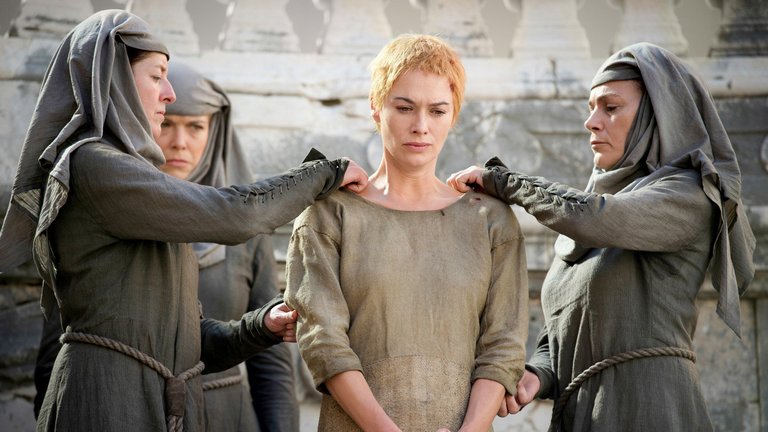
The episode’s centrepiece, both in length and impact, is Cersei Lannister’s walk of atonement. Broken by her imprisonment, she confesses to adultery (but not incest) and appeals for the ‘Mother’s mercy’ of the title. The High Sparrow’s mercy is a calculated humiliation: a naked, shorn walk from the Great Sept to the Red Keep. The scene is powerfully acted by Lena Headey, who conveys a devastating arc from defiant pride to shattered vulnerability. It is also one of Martin’s most direct borrowings from history, inspired by the penance of Jane Shore. However, the production was mired in controversy. Croatian conservatives protested the filming in Dubrovnik, though authorities later cynically exploited it for tourism. More notably, the technical execution proved distracting for some viewers. Headey, for personal reasons, used a body double, Rebecca Van Cleave, with her face digitally superimposed. While Headey’s performance in close-up is magnificent, the CGI composite in wider shots occasionally lacks seamless immersion, a small but noticeable flaw in such a pivotal scene. The sequence’s conclusion, however, is flawless: a broken Cersei, swaddled in robes, is shown the reanimated Mountain by Qyburn. In that moment, her eyes harden with a terrifying, vengeful resolve. It is the episode’s best character beat, a promise of fury to come.
In Meereen, the power vacuum left by Daenerys’s departure is filled by a sensible, if uninspired, plan: Jorah and Daario will search for her, while Tyrion will govern. Daenerys herself is stranded in the Dothraki Sea with a wounded, recalcitrant Drogon. Her capture by a massive khalasar is less a cliffhanger than a reset button, plunging her back to a status similar to her Season 1 beginnings.
Finally, at the Wall, the episode engineers its most famous cliffhanger. After sending Samwell Tarly to Oldtown—a rare moment of quiet hope—Jon Snow is lured by the false news of his uncle Benjen’s return. He is ambushed by mutineers led by Ser Alliser Thorne and the invented character Olly, stabbed repeatedly for his perceived betrayal in aiding the Wildlings. He falls, bleeding onto the snow, ‘for the Watch.’ As the screen cuts to black, the audience is left with the year-long question: is he truly dead? While this betrayal occurs in Martin’s books, the show’s simplification—replacing complex political grievances with a more straightforward grievance over the Wildlings—makes it feel more like a plot device than an inevitable political consequence. Jon Snow was, by this point, arguably the show’s central hero and certainly its most popular character among a large segment of the audience, especially female. The idea of his permanent death was commercially and narratively unthinkable, transforming the mystery from ‘if’ he would return to ‘how’. The parallel to Dallas’s ‘Who Shot J.R.?’ is inescapable: a hugely popular character is seemingly killed to generate unprecedented publicity and viewer speculation, a quintessential soap opera gambit.
Mother’s Mercy is one of the most critically acclaimed episodes of Game of Thrones, winning Emmys for Best Direction and Best Writing. The direction award is justified; David Nutter manages the sprawling, tonally disparate storylines with confident pacing and delivers several indelible images—the aerial shot of Stannis’s defeat, the stark horror of Cersei’s walk, the chilling stillness of Jon’s ‘death’. The writing award, however, is more questionable. Benioff and Weiss’s script is a good example of cliffhanger construction but a failure in organic storytelling. Almost every storyline ends with a ‘wham’ development: Stannis destroyed, Myrcella poisoned, Jon assassinated, Sansa leaping, Arya blinded, Cersei humiliated. The sheer density of catastrophe feels manipulative, a checklist of shocks designed to ensure the season ends with a bang. Furthermore, the reliance on ambiguity—did Brienne kill Stannis? Did Sansa survive the fall?—feels less like nuanced storytelling and more like a refusal to make definitive choices, keeping all options open for the writers’ room next season.
A particularly disturbing trend crystallises in this episode: a preoccupation with violence against young girls and women. From the beatings in the Braavosi brothel and Arya’s blinding, to Myrcella’s poisoning and Sansa’s threatened disfigurement and perilous leap, to the extended humiliation of Cersei, the episode subjects its female characters to a relentless parade of physical and psychological torment. While Game of Thrones has never shied from brutality, the concentration here feels exploitative, leaning into trauma as a primary driver of female character development.
Mother’s Mercy is a solid, professionally executed hour of television that also lays bare the profound flaws that would increasingly plague Game of Thrones. It is thrilling, memorable, and superbly directed. Yet, it is also cynical, manipulative, and increasingly derivative of the very soap opera tropes it once seemed to transcend. It prioritises the immediate shock over the long-term narrative consequence, replaces political complexity with personal vendettas and convenient coincidences, and indulges in a voyeuristic cruelty towards its female characters. It is the culmination of Season 5’s drift away from the nuanced, patient adaptation of Martin’s world and towards a faster, simpler, and more conventional style of television drama. It is a brilliantly constructed machine for generating buzz, but one can hear the gears grinding, signalling that the great, gritty fantasy epic was steadily becoming just another show.
RATING: 6/10 (++)
==
Blog in Croatian https://draxblog.com
Blog in English https://draxreview.wordpress.com/
InLeo blog https://inleo.io/@drax.leo
LeoDex: https://leodex.io/?ref=drax
InLeo: https://inleo.io/signup?referral=drax.leo
Hiveonboard: https://hiveonboard.com?ref=drax
Rising Star game: https://www.risingstargame.com?referrer=drax
1Inch: https://1inch.exchange/#/r/0x83823d8CCB74F828148258BB4457642124b1328e
BTC donations: 1EWxiMiP6iiG9rger3NuUSd6HByaxQWafG
ETH donations: 0xB305F144323b99e6f8b1d66f5D7DE78B498C32A7
BCH donations: qpvxw0jax79lhmvlgcldkzpqanf03r9cjv8y6gtmk9