Television Review: Oathkeeper (Game of Thrones, S4X04, 2014)

Oathkeeper (S4x04)
Airdate: 27 April 2014
Written by: Bryan Cogman
Directed by: Michelle MacLaren
Running Time: 55 minutes
The adaptation of George R.R. Martin’s sprawling literary saga A Song of Ice and Fire into the television phenomenon Game of Thrones was, from its inception, an exercise in necessary compromise. The book and the television series are two distinct media, with differing narrative economies and audience expectations. It was therefore impossible for the show to be a completely faithful transliteration of Martin’s dense, multi-perspective novels. Creative shortcuts were inevitable: multiple minor characters were fused into single composite figures, and elaborately explained political machinations were streamlined for the screen. However, by its fourth season, the series under showrunners David Benioff and D.B. Weiss began to move beyond mere condensation. They started to actively insert characters, plotlines, and entire scenes that had no direct precedent in the source material. This marked a subtle but significant shift from adaptation to augmentation, a process whereby what readers had consumed in the books and what viewers witnessed on screen began to diverge into two distinct narrative entities. One of the earlier and most telling examples of this new creative direction is Season 4’s fourth episode, pointedly titled Oathkeeper. Whilst functioning as a competent piece of episodic television, it serves as a crucial case study in the show’s growing willingness to fill narrative silences with invention, for better and for worse, and highlights the first faint tremors of the creative exhaustion that would later become more pronounced.
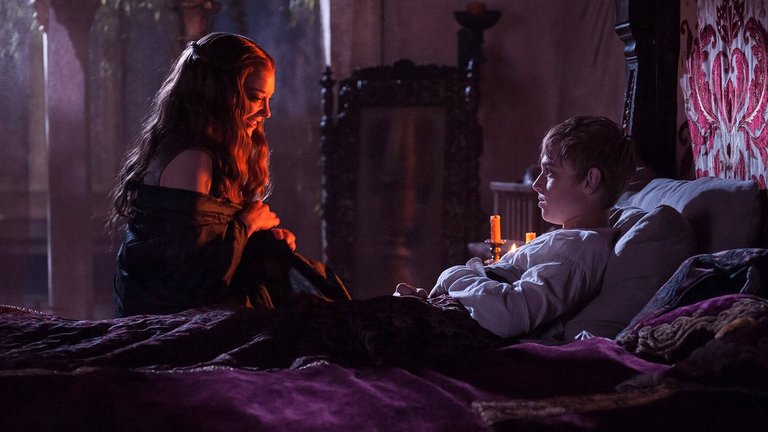
The episode continues to meticulously chart the ripple effects of King Joffrey’s murder at the Purple Wedding. A central mystery—the identity of the perpetrators—is neatly resolved through two confessional scenes. Aboard ship, the duplicitous Petyr Baelish finally reveals to Sansa Stark his role in the regicide. He explains that, despite a fruitful alliance with the Lannisters, Joffrey had become too volatile an obstacle for his “new friends.” Those friends are confirmed in King’s Landing, where the formidable Lady Olenna Tyrell calmly informs her granddaughter Margaery that she used poison concealed in Sansa’s necklace. This dual revelation is handled with typical series efficiency, though it arguably robs the event of some of the lingering ambiguity Martin favoured. With Joffrey removed, the narrative pivots to the political manoeuvring of the newly widowed Margaery. Her attempt to seduce the boy-king Tommen in his chambers shows cynical calculation. Finding him too young for overt sexual manipulation, she swiftly recalibrates, appealing instead to his sheltered sense of adventure and his poignant desire for genuine friendship. This scene is a highlight, showcasing Natalie Dormer’s ability to convey razor-sharp intelligence beneath a veneer of gentle concern, and it establishes the dynamic that will define her next political marriage.
Simultaneously, the episode delves into the moral rehabilitation of Jaime Lannister. Forced to practice one-handed swordsmanship with the mercenary Bronn, Jaime is shamed into visiting his imprisoned brother, Tyrion. Their conversation reveals Cersei’s vindictive demand for Sansa’s head and her offer of a knighthood for her return. This sparks in Jaime a memory of the oath he swore to the late Lady Catelyn Stark—to return her daughters safely. Hamstrung by his new duties as Lord Commander of the Kingsguard, he cannot fulfil this vow personally. In a moment of resonant symbolism, he performs the next best thing: he entrusts his magnificent new Valyrian steel sword, forged from Ice and named “Oathkeeper,” to Brienne of Tarth. Assigning Podrick Payne as her squire, he sends this most honourable of knights on a quest to find Sansa and protect her. This sequence is emotionally potent, cementing Jaime’s complex redemption arc and providing Brienne with a purpose worthy of her formidable virtue. It is a clear example of the show successfully streamlining book material (where the sword’s bestowal and mission have different nuances) into a powerful, character-driven beat.
Across the Narrow Sea, Daenerys Targaryen continues her crusade in Slaver’s Bay. The conquest of Meereen is achieved by subterfuge and insurrection. Grey Worm infiltrates the city via its sewers, distributing arms to the slave population with the instruction to rise up. Once they do, Daenerys makes her triumphant entry. Here, the episode presents a pivotal moral test for the Mother of Dragons. Advised by Ser Barristan Selmy to be merciful, she instead chooses a brutal, eye-for-an-eye justice. Commanding that 163 Meereenese masters be crucified in retribution for the 163 slave children crucified on the road to the city, she delivers a stark lesson in the perils of absolutist rule. This moment is chillingly effective, complicating her liberator image with a thirst for vengeful violence.
However, this plot strand also contains one of the episode’s most jarring creative missteps. The graffiti daubed on the city walls, reading “Kill the Masters,” is rendered in modern English. This is a baffling failure of world-building. The characters speak in High Valyrian, a constructed language audiences hear consistently, yet they are apparently literate in contemporary English. David J. Peterson, the linguist who crafted Valyrian and Dothraki, later revealed he was prepared to develop a functional writing system, but producers demurred, believing it would alienate viewers. This decision, aimed at simplicity, severely undermines immersion. For an audience by now deeply accustomed to the textured detail and linguistic depth of Martin’s world, it feels like a lazy concession, a betrayal of the show’s own established standards for verisimilitude.
North of the Wall, the narrative introduces a subplot almost entirely of the show’s own devising, which exemplifies the new strategy of narrative invention. Jon Snow, preparing an expedition to deal with the mutineers at Craster’s Keep, notices a new recruit: the formidable Locke. Posing as a former gamekeeper who took the black to avoid losing a hand, Locke’s true mission—to find and capture Bran Stark—is known only to the viewer. This insertion of a character from the Northern storyline (where in the books he serves Roose Bolton) into the Watch is a clever, if contrived, way to raise stakes. The expedition itself heads to Craster’s, now a hellish stronghold held by the vicious Karl Tanner and his fellow mutineers. This segment exists to fill a blank space in the books. In Martin’s narrative, the fate of Craster’s Keep after the mutiny is left obscure, and Bran Stark never ventures there. The show uses it to create a tense, if gratuitous, set-piece. The mutineers are depicted engaging in rape and sexual abuse of Craster’s widowed daughters, a scene reportedly filmed with disturbing graphicness using pornographic film actresses before being toned down for broadcast. Whilst intending to portray the depths of their depravity, it risks feeling exploitative. Karl Tanner is given lengthy, self-mythologising monologues about his past as a “fookin’ legend” in Gin Alley, dialogue that feels less like natural characterisation and more like exposition hastily plastered over a thin plot contrivance. It is here that one first detects a whiff of creative exhaustion—a willingness to insert violent, sensational filler to maintain momentum and tie up loose ends, rather than trust the slower-burning political and mythological threads.
The episode’s final sequence, however, is great and that justifies much. In the frozen wastes of the Far North, a chilling figure—a White Walker later codified as the Night King, portrayed with eerie stillness by Richard Brake—receives a male infant from Craster’s sacrifices. In a silent, glacial ritual, he touches the baby’s cheek, its eyes turning a piercing, icy blue. This single, wordless image is profoundly impactful. It answers a haunting question about the Others’ origins and methods, transforming them from mere supernatural threats into a species with a perverse biology and culture. It is a stark, brilliant reminder that whilst the southern kingdoms squabble over crowns, the true existential menace is methodically building its army in the eternal winter.
Written by Bryan Cogman and deftly directed by Michelle MacLaren, Oathkeeper is, on a technical level, a generally solid piece of television. MacLaren’s direction is assured, particularly in the intimate scenes of political intrigue in King’s Landing and the haunting finale. Yet, tonally, it is an uneven and largely transitional episode. Its primary function is to connect dots and prepare the ground for future confrontations. For every successful element—the poignant conclusion of Jaime’s gift, Margaery’s cunning, the terrifying implication of the final scene—there is a corresponding misstep or compromise. The clumsy English graffiti breaks the spell of Essos, and the Craster’s Keep subplot, whilst tense, feels like a manufactured conflict designed to give Bran and Jon something to do in the absence of book material. It represents the show’s early foray into significant narrative invention, revealing both its strengths (generating iconic mythological moments) and its emerging weaknesses (a tendency towards contrived, violence-driven filler). As such, Oathkeeper is a fascinating inflection point: the moment where Game of Thrones began to consciously walk its own path, for better or worse, and where the first cracks in its meticulously built world began to subtly show.
RATING: 6/10 (++)
==
Blog in Croatian https://draxblog.com
Blog in English https://draxreview.wordpress.com/
InLeo blog https://inleo.io/@drax.leo
LeoDex: https://leodex.io/?ref=drax
InLeo: https://inleo.io/signup?referral=drax.leo
Hiveonboard: https://hiveonboard.com?ref=drax
Rising Star game: https://www.risingstargame.com?referrer=drax
1Inch: https://1inch.exchange/#/r/0x83823d8CCB74F828148258BB4457642124b1328e
BTC donations: 1EWxiMiP6iiG9rger3NuUSd6HByaxQWafG
ETH donations: 0xB305F144323b99e6f8b1d66f5D7DE78B498C32A7
BCH donations: qpvxw0jax79lhmvlgcldkzpqanf03r9cjv8y6gtmk9