Television Review: Power Play (Star Trek: The Next Generation, S5X15, 1992)

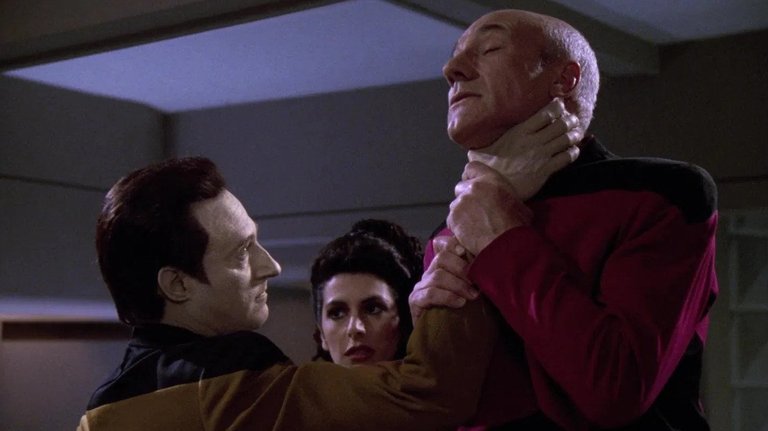
Power Play (S05E15)
Airdate: 24 February 1992
Written by: René Balcer, Herbert J. Wright & Brannon Braga
Directed by: David Livingston
Running Time: 46 minutes
One of the enduring benefits of Star Trek: The Next Generation’s episodic structure was its creators’ ability to provide a considerable variety across seasons, freely switching between genres, tonal registers, and narrative focuses. This flexibility is neatly illustrated within the fifth season itself, which, within the space of consecutive episodes, traded the comparatively humorous and light-hearted scenario of the Enterprise being hijacked in Conundrum for a markedly darker treatment of a similar premise in the following instalment, “Power Play”. Where the former played its amnesia-induced command confusion with a wink and a nod, the latter delves into a tense, claustrophobic tale of bodily possession and hostage crisis, demonstrating the series’ range even when revisiting familiar narrative territory.
The plot commences with the USS Enterprise-D detecting a distress signal emanating from the desolate moon Mab-Bu VI. As Data notes the historical disappearance of the USS Essex in that sector two centuries prior, and Counsellor Troi senses inexplicable life signs on the surface, Captain Picard dispatches an away team—consisting of Commander Riker, Data, and Troi—to investigate via shuttlecraft, as transporter function is impeded by the moon’s violent ionic storms. The mission goes awry immediately: the shuttle crashes, though Chief O’Brien heroically manages to beam down with power boosters to facilitate the team’s retrieval. Before this can be accomplished, however, a mysterious energy entities possess Data, Troi, and O’Brien. Only Riker, who has sustained a broken arm in the crash, remains unaffected.
Upon their return to the Enterprise, the possessed trio swiftly attempts to seize control of the ship. When a direct takeover of the bridge fails, they retreat to Ten Forward, taking numerous hostages—including Chief O’Brien’s wife, Keiko, and their infant daughter, Molly. The entities controlling our officers claim to be the lingering consciousnesses of the long-lost Essex crew. Riker’s immunity, due to his injury, leads Dr. Crusher to hypothesise that severe pain can disrupt the possession. Picard consequently devises a plan wherein Geordi La Forge and Ensign Ro Laren stealthily employ neural stimulators to trigger pain receptors in the hijackers, hoping to force the entities out. The scheme is thwarted at the last moment by Data, who evades the beam. With options dwindling, Picard is compelled to accede to the hijackers’ demands to beam five hundred more of their kind aboard. They are then revealed to be non-corporeal prisoners, originally incarcerated on the moon, who first overwhelmed the Essex and now seek passage back to their homeworld. In a final gambit, Picard turns the tables: he has the newly arrived entities contained in a cargo bay and threatens to eject them into space via the escape pods. Faced with the annihilation of their comrades, the possessors relent, releasing their hosts and allowing Troi, Data, and O’Brien to return to normal.
Power Play is, fundamentally, a TNG episode that does not bother with intriguing scientific concepts, weighty social issues, or profound philosophical dilemmas. It is a by-the-numbers narrative of crew members being possessed—a scenario employed numerous times in The Original Series and one that would be revisited in later TNG episodes and other Trek series, including Deep Space Nine’s The Assignment, in which Keiko, rather than Miles, falls under the thrall of a malevolent entity. Reportedly, producer Michael Piller was less than enthused by the script, likely viewing it as derivative. Yet, the episode compensates substantially for its lack of originality through superb execution. Director David Livingston insisted on taking the show in a darker direction, both literally—with shadowy, atmospheric lighting—and tonally, while championing taut action sequences. Although the initial moon segment, with its styrofoam rocks and obvious studio set, appears somewhat corny by contemporary standards, it introduces the pragmatic concept of transporter power boosters, a piece of Star Trek technobabble that would gain traction in later narratives.
The script, written by René Balcer, Herbert J. Wright, and Brannon Braga, is far from perfect but is notably economical and efficient. The possession occurs early, and the hijacking unfolds without protracted mystery; Picard and the senior crew, to their credit, rapidly ascertain the situation and respond with plausible urgency. There are logical hiccups, primarily the entities’ unnecessary and ultimately futile deception in posing as the Essex crew—a ruse that adds little to their leverage. Furthermore, the epilogue, in which the defeated entities are simply left alone, feels somewhat anti-climactic.
What ultimately elevates Power Play above its formulaic premise is the splendid opportunity it affords actors Marina Sirtis, Brent Spiner, and Colm Meaney to portray characters utterly alien to their usual roles. This is a delight, particularly in Spiner’s case, as he relishes the chance to play a cold, calculating villain, setting the stage for a climactic and brutal hand-to-hand confrontation with Lieutenant Worf. Meaney is especially effective, transforming the ordinarily affable, dependable Chief O’Brien into a figure of genuine menace; his chilling disdain for his own baby daughter and the lecherous, predatory gaze he directs at Keiko create moments of genuine discomfort, showcasing a range seldom required of the character. Sirtis, too, sheds Troi’s empathic warmth for a steely, ruthless demeanour.
Power Play is a compelling, if not groundbreaking, instalment of Star Trek: The Next Generation. It leverages a well-worn sci‑fi trope to deliver a tightly directed, suspenseful episode that functions primarily as a character actor’s showcase. While it may lack the intellectual heft or innovative spirit of the series’ finest hours, its confident pacing, atmospheric tension, and committed performances ensure it remains a solid and entertainingly dark entry in the show’s extensive catalogue.
RATING: 7/10 (+++)
Blog in Croatian https://draxblog.com
Blog in English https://draxreview.wordpress.com/
InLeo blog https://inleo.io/@drax.leo
LeoDex: https://leodex.io/?ref=drax
InLeo: https://inleo.io/signup?referral=drax.leo
Hiveonboard: https://hiveonboard.com?ref=drax
Rising Star game: https://www.risingstargame.com?referrer=drax
1Inch: https://1inch.exchange/#/r/0x83823d8CCB74F828148258BB4457642124b1328e
BTC donations: 1EWxiMiP6iiG9rger3NuUSd6HByaxQWafG
ETH donations: 0xB305F144323b99e6f8b1d66f5D7DE78B498C32A7
BCH donations: qpvxw0jax79lhmvlgcldkzpqanf03r9cjv8y6gtmk9