Television Review: Quality of Life (Star Trek: The Next Generation, S6X09, 1992)

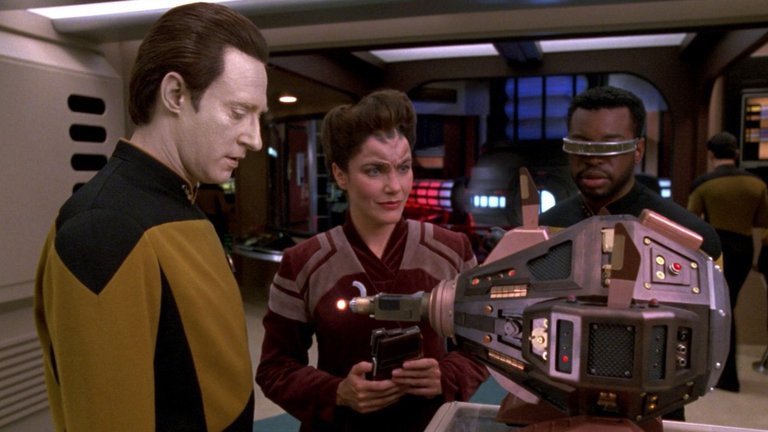
Quality of Life (S06E09)
Airdate: 16 November 1992
Written by: Naren Shankar
Directed by: Jonathan Frakes
Running Time: 46 minutes
The contemporary, often fevered debates surrounding the true nature and limits of artificial intelligence would feel remarkably familiar to any seasoned science-fiction enthusiast. For decades, the genre has wrestled with the profound questions of sentience, consciousness, and what truly constitutes life. Star Trek, in its various incarnations, has been no different, frequently using its futuristic setting as a laboratory for these philosophical inquiries. The apotheosis of this tradition within Star Trek: The Next Generation is undoubtedly the epochal second-season episode, The Measure of a Man, a courtroom drama that compellingly argued for Data’s right to self-determination. It was the moment the series definitively shed the shadow of its own shaky beginnings and embraced its potential for intellectual rigour. The show returned to this fertile ground in its penultimate season with Quality of Life (S6E09), a direct thematic sequel that, while intelligent and thoughtfully crafted, ultimately fails to ascend to the narrative and philosophical heights of its revered predecessor.
The plot finds the USS Enterprise arriving at the planet Tyria 7A to assist researchers developing a perilous new mining technology known as the “particle fountain.” The project is fraught with danger, a situation mitigated only by the ingenious work of Dr. Farallon (Ellen Fry). She has created the Exocomps, compact robots with advanced heuristic learning algorithms that perform repairs with remarkable efficiency. The episode’s central conflict is ignited when, during a routine procedure, an Exocomp refuses a direct order to enter a service tunnel, which moments later suffers a catastrophic explosion. This act of apparent self-preservation intrigues Data, who begins to suspect the machines have evolved beyond their programming. His hypothesis is strengthened by a subsequent experiment where the Exocomps demonstrate an ability to discern that their human instructors are attempting to deceive them into performing unnecessary repairs. For Data, this capacity for judgement and suspicion is incontrovertible proof of sentience.
Data’s concerns are initially dismissed, even by their creator, Dr. Farallon, who views them as invaluable but ultimately disposable tools. The stakes are raised dramatically when the research facility experiences a catastrophic failure, flooding areas with lethal radiation. Geordi La Forge and Captain Picard are trapped inside, and their transport is blocked. The plan to send Exocomps to affect a repair is halted by Data, who, invoking the precedent of his own trial, refuses to transport them. He declares he cannot conscript sentient beings into a suicide mission against their will. In a resolution that prioritises ethical principle over expediency, Data proposes simply asking the Exocomps for help. They agree, and three units successfully rescue the officers, with one sacrificing itself to complete the task. In the denouement, Dr. Farallon remains philosophically uncertain but vows to treat the Exocomps as potentially sentient henceforth. The episode closes with Data drawing a direct parallel to Picard, noting that he stood for the Exocomps just as Picard once stood for him—a symmetry Picard acknowledges.
On a production level, Quality of Life benefits significantly from its pedigree. The episode was written by Naren Shankar, a staff member with a physics degree from Cornell University who often served as the show’s scientific advisor. Consequently, despite the requisite “technobabble,” the episode engages with more tangible, “hard sci-fi” concepts than most, grounding its speculation in a layer of plausible engineering. It was directed by Jonathan Frakes, who by this time had cemented his reputation as one of TNG’s most capable directors. His signature style—heavy on dramatic zooms and a subtly shaky, vérité camera—is employed effectively here, amplifying the tension during the crisis sequences and lending a sense of urgency to the sterile engineering environments.
As a piece of television, it is a relatively simple, almost “bottle” episode, largely confined to the Enterprise and the research station. Its success hinges on the clever design of the Exocomps themselves and a strong guest performance from Ellen Fry. Dr. Farallon is a believable, nuanced antagonist; her conflict stems not from malice but from proprietary pride and a very human reluctance to acknowledge the profound implications of her own creation. Her professional dynamic with La Forge is refreshingly straightforward, avoiding any awkward rehash of Dr. Brahms storyline.
Yet, for all its intelligence and commendable emphasis on ethical consistency, Quality of Life is undermined by several significant flaws. The most glaring is the narrative convenience of its conclusion. Data’s actions—effectively mutiny by refusing a direct order and potentially endangering the Captain and Chief Engineer—would, in any realistic Starfleet context, be the subject of a fierce controversy, if not a direct court-martial. The episode sidesteps this entirely for a “feelgood” ending where his judgement is vindicated without consequence, a resolution that feels emotionally satisfying but intellectually lax. Furthermore, the script commits a notable continuity error. In arguing for the Exocomps’ uniqueness, Data states he is “alone in the universe” and cannot reproduce, a claim that directly contradicts established canon from episodes like The Offspring (where he creates a daughter, Lal) and existence of his “brother” Lore. This oversight suggests a certain carelessness in aligning the episode’s rhetoric with the series’ own lore.
Quality of Life is a good, thoughtful episode of The Next Generation. It asks important questions about the slippery slope towards sentience and the ethical duties owed to newly conscious life, themes reminiscent not only of The Measure of a Man but also of earlier episodes like Evolution, which dealt with Wesley Crusher’s accidentally intelligent nanites. However, where The Measure of a Man presented a rigorously balanced debate with lasting consequences, Quality of Life opts for a simpler, more procedural problem-solving approach. Its philosophical exploration, while present, is less deep, and its resolution is achieved with a degree of narrative contrivance. It is therefore a worthy but ultimately lesser follow-up—a competent exploration of a classic Trek theme that, due to its internal contradictions and missed opportunities, never quite achieves the timeless greatness of the trial it so consciously echoes.
RATING: 7/10 (+++)
Blog in Croatian https://draxblog.com
Blog in English https://draxreview.wordpress.com/
InLeo blog https://inleo.io/@drax.leo
LeoDex: https://leodex.io/?ref=drax
InLeo: https://inleo.io/signup?referral=drax.leo
Hiveonboard: https://hiveonboard.com?ref=drax
Rising Star game: https://www.risingstargame.com?referrer=drax
1Inch: https://1inch.exchange/#/r/0x83823d8CCB74F828148258BB4457642124b1328e
BTC donations: 1EWxiMiP6iiG9rger3NuUSd6HByaxQWafG
ETH donations: 0xB305F144323b99e6f8b1d66f5D7DE78B498C32A7
BCH donations: qpvxw0jax79lhmvlgcldkzpqanf03r9cjv8y6gtmk9