Television Review: Riverworld (2003)

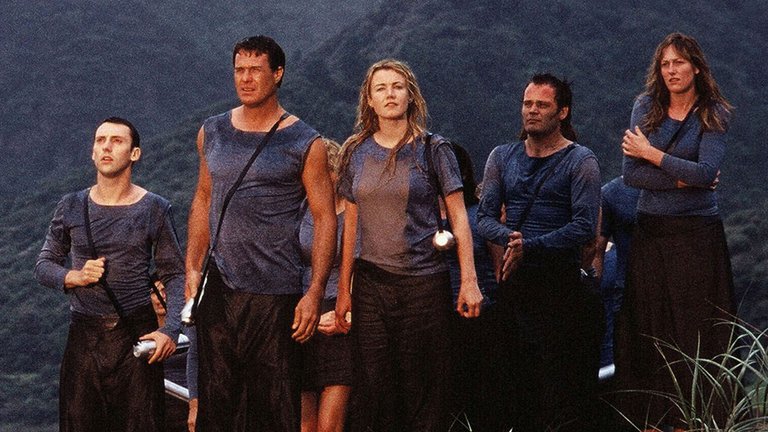
Some classic works of science fiction literature have all the luck when it comes to screen adaptation. The most telling example is Frank Herbert’s Dune, which, across decades, has received three very different, yet interesting and mostly successful interpretations, each finding its own audience and critical regard. It is quite another matter for Riverworld, the cycle of five novels by Hugo Award-winning author Philip José Farmer. Its fascinating premise—all of humanity resurrected along the banks of a seemingly endless river—would, on paper, allow for immense flexibility and creative exploration for any film or television auteur. Yet this potential has, thus far, led only to two underwhelming attempts, both produced by the Sci-Fi Channel. The first of these, the 2003 television film directed by Kari Skogland, stands as a particularly frustrating case study in how to squander a brilliant concept through a combination of timid writing, generic characterisation, and a fundamental misunderstanding of the source material’s appeal.
The plot, as presented, begins in the then-future of 2009. American astronaut Jeff Hale (played by Brad Johnson) dies when his space shuttle is struck by debris from a meteor shower. He awakens in a strange jade-green bubble submerged in water, is assaulted by a mysterious figure that floods his mind with visions, and then emerges, naked, to swim to the riverbank. Here, he, like countless others, finds mysterious containers—‘grails’—providing clothes and basic necessities. He quickly learns that every person on this world has been resurrected at their physical prime from different eras of Earth’s history. Hale’s initial group includes the Englishwoman Alice Liddell (Emily Lloyd), who died in 1934; Mali (Karen Holness), an African woman taken by slavers; Lev Ruach (Jeremy Birchall), a Jewish victim of Auschwitz; and the Roman Lucius Domitius Ahenobarbus (Jonathan Cake). Two more unusual figures join them: a young mute girl named Gwenafra (Nikita Hearsley) and an extraterrestrial, Monat (Brian Moore), who reveals that Earth and all humanity were destroyed in 2039. The narrative soon introduces a further layer: some were resurrected years earlier and have built empires. Hale’s group is captured by one such warlord, Valdemar (Kevin Smith), leader of the Vandals, who enslaves them. After a daring escape, Hale finds a community of fugitives led by Samuel Clemens (Cameron Daddo), who has built a riverboat, the Go For Broke, with the aim of exploring this strange world. The central conflict crystallises when Ahenobarbus usurps Valdemar’s empire and reveals himself to be the Roman Emperor Nero, setting up a generic struggle between Hale’s idealism and Nero’s tyranny.
Stuart Hazeldine’s script is very loosely based on motifs from the first two novels, To Your Scattered Bodies Go and The Fabulous Riverboat. This ‘looseness’ is the adaptation’s primary flaw. Riverworld’s premise offers enormous potential for rich, philosophical ‘what-if’ scenarios, featuring interactions between historical celebrities and ordinary people from vastly different epochs. The 2003 film discards this almost entirely. Most egregiously, it replaces the novels’ iconic protagonist, the brilliant, complex, and historically real explorer Sir Richard Francis Burton, with the invented Jeff Hale, a generic American astronaut played by Brad Johnson, a former model and ‘Marlboro Man’. This substitution immediately lowers the intellectual stakes, trading Burton’s linguistic genius, cultural curiosity, and volcanic temperament for a bland, all-action hero whose most defining characteristic is his profession. It is a clear bid for a conventional, easily marketable lead, but it strips the story of its unique historical texture and psychological depth.
This reductionism extends to the other historical figures the script bothers to include. Only Samuel Clemens is readily identifiable, and even he is reduced to a plot device—the man with the boat. Jonathan Cake’s Nero is wrecked by uninspired dialogue that plays directly into Hollywood’s quasi-historical clichés of decadent, sneering villainy, offering no fresh insight into the infamous emperor. Alice Liddell, the real-life muse for Lewis Carroll’s Alice in Wonderland, is so poorly written that a viewer without prior knowledge would struggle to discern her identity or narrative significance. Emily Lloyd brings a fragile, period-appropriate dignity to the role, a poignant performance given that her promising career was soon sidelined by well-documented struggles with mental health. The film also marks a tragic footnote: the role of Valdemar was the last for Kevin Smith, the New Zealand actor beloved as Ares in Xena: Warrior Princess, who died shortly after filming in an accident in China.
On a technical level, Canadian director Kari Skogland does a relatively decent job with the material provided. The Sci-Fi Channel evidently supplied a sufficient budget for early-21st-century television CGI. The alien world is rendered effectively, with the mysterious grail stations and strange devices providing just enough visual intrigue to distinguish the setting from a generic post-apocalyptic wasteland. However, the production design often betrays its television roots and budget. Many of the costumes, props, and sets for the Vandal sequences look suspiciously like recycled stock from Xena or Hercules: The Legendary Journeys, lending a cheap, familiar feel to what should be utterly alien. The character of Monat suffers most; his alien make-up appears decidedly artificial and rubbery, disrupting immersion whenever he appears.
The film is arguably at its most compelling in its opening act, which captures a genuine sense of existential mystery and visceral confusion. The scenes of hundreds of naked, disoriented people stumbling from the river have a raw, unsettling power. This promising atmosphere of profound dislocation, however, is never resolved or meaningfully explored. The mystery of the ‘Ethicals’—the beings behind the resurrection—is pushed to the background in favour of a predictable, pedestrian power struggle between Hale and Nero.
Like so many television pilots of its era, Riverworld concludes with a cliffhanger twist (involving the true nature of the river) that, due to the film’s failure to generate a series, leaves the audience with an annoyingly unresolved narrative. This failure can be attributed to several factors, not least a profound misjudgement in timing. The opening scene depicting a space shuttle disaster, filmed in 2001, aired in 2003, mere months after the very real destruction of the Space Shuttle Columbia. The unfortunate resonance likely made the opening jarring and tasteless for many viewers, creating an immediate barrier to engagement.
The 2003 Riverworld is a profound disappointment. It takes one of science fiction’s most audacious and philosophically fertile premises and reduces it to the level of a passable, but utterly generic, Saturday-night telefantasy adventure. It prioritises safe, archetypal conflict over the source material’s challenging intellectual curiosity, and replaces rich historical figures with bland ciphers. It demonstrates competent, if unremarkable, craft but lacks the courage to be truly strange or thought-provoking. That the Sci-Fi Channel felt compelled to reboot the project just seven years later with a new mini-series speaks volumes about this adaptation’s perceived shortcomings.
RATING: 4/10 (+)
==
Blog in Croatian https://draxblog.com
Blog in English https://draxreview.wordpress.com/
InLeo blog https://inleo.io/@drax.leo
InLeo: https://inleo.io/signup?referral=drax.leo
Leodex: https://leodex.io/?ref=drax
Hiveonboard: https://hiveonboard.com?ref=drax
Rising Star game: https://www.risingstargame.com?referrer=drax
1Inch: https://1inch.exchange/#/r/0x83823d8CCB74F828148258BB4457642124b1328e
BTC donations: 1EWxiMiP6iiG9rger3NuUSd6HByaxQWafG
ETH donations: 0xB305F144323b99e6f8b1d66f5D7DE78B498C32A7
BCH donations: qpvxw0jax79lhmvlgcldkzpqanf03r9cjv8y6gtmk9
Congratulations @drax! You have completed the following achievement on the Hive blockchain And have been rewarded with New badge(s)
Your next target is to reach 280000 upvotes.
You can view your badges on your board and compare yourself to others in the Ranking
If you no longer want to receive notifications, reply to this comment with the word
STOP