Television Review: Silicon Avatar (Star Trek: The Next Generation, S5X04, 1991)

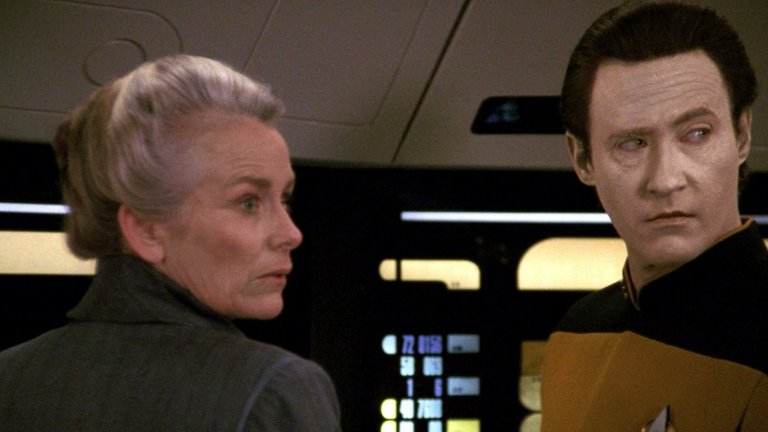
Silicon Avatar (S05E04)
Airdate: 14 October 1991
Written by: Jeri Taylor
Directed by: Cliff Bole
Running Time: 46 minutes
The fifth season of Star Trek: The Next Generation kicked off with considerable swagger, delivering a sequence of high-octane episodes that firmly established the show’s creative peak. However, the momentum that carried the season through its opening episodes inevitably had to stall, and it did so somewhat abruptly with the fourth instalment, Silicon Avatar. While the episode possesses a certain grim allure and technical competency, it ultimately stands as a critical misfire. The script, originally developed by Lawrence V. Conley and later refined by Jeri Taylor—a writer who was reportedly drawing upon her own experiences of motherhood to explore the depths of maternal grief—fails to balance its emotional hooks with compelling drama.
The narrative wastes little time in establishing a visceral threat, thrusting Riker, Dr. Crusher, and Data onto the planet Melona IV just as the Federation is attempting to colonise it. It is a picturesque location, but the atmosphere is shattered when the sky darkens and the Crystaline Entity descends. The creature is a systematic destroyer, and Riker is forced to watch in helpless horror as the population—including the woman he was flirting with, Carmen Davila (Susan Diol)—is exterminated. The survivors take refuge in caverns, with the entrance sealed by phasers, and are later rescued by the Enterprise-D. This opening sequence establishes a genuine life-or-death stakes, providing the perfect backdrop for a thriller.
However, the episode’s promise is undermined by the introduction of Dr. Kila Marr (Ellen Geer), a xenobiologist brought aboard to assist in tracking the Entity. She is a woman driven by trauma; her son was killed by the Crystaline Entity during the destruction of Omicron Theta. Her hostility towards Data is palpable, stemming from her knowledge that his "brother" Lore has communicated with the creature and a desire to understand why Data survived the latest encounter. She becomes obsessed with accessing her son’s journals and letters, eventually asking Data to imitate his voice. This personal vendetta is the engine of the plot, setting the stage for Marr to design a communication device using gravitons.
Marr’s character arc is meant to be tragic, but her actions border on the unhinged. Despite Picard’s orders to attempt communication before any hostile action, she utilises the graviton device as a weapon, destroying the Entity. She is driven by a decades-long desire for revenge, motivated by personal loss. Picard is disgusted by her emotional volatility and orders her to be detained. In the episode’s most brutal moment, Data confronts her, delivering a stinging rebuke that her son would never have condoned such an act, rendering her entire life’s work pointless.
The production values are undeniably high, aided by the direction of Cliff . It is also noted as a direct sequel to Datalore and draws clear inspiration from Moby Dick, with echoes of the TOS classic Doomsday Machine in its depiction of a colossal space predator. Yet, these elements are not enough to save the script from being one of the weaker entries of the season.
The critical failure lies in the script’s insistence on moralising over action. The episode starts strongly with life-or-death situations but pivots awkwardly into a debate about Starfleet ethics and the handling of space creatures. Riker makes a compelling case that the Entity is a dangerous scourge that must be stopped at all costs. In contrast, Picard’s response is framed as the superior moral choice, yet it comes across as incredibly sanctimonious. When Picard compares the Entity to a sperm whale that inadvertently devours cuttlefish, he ignores the predatory nature of the Crystaline Entity and the fact that Lore has manipulated Data. This comparison feels like a lazy sermon on deep ecology characteristic of early 1990s Hollywood liberalism, suggesting that the creature has a right to exist even if it eats planets.
Fans and critics alike have generally ranked "Silicon Avatar" as average at best, a sentiment echoed by Brent Spiner, who was reportedly displeased with the quality of the writing.^2,8^ The episode feels like it is trying too hard to be profound about revenge and grief, but the characterisation of Picard as a paragon of virtue for ordering "live and let live" seems at odds with the reality of the situation. A sentient lifeform was murdered under Picard's watch, a woman destroyed her entire career and morality because of misguided revenge, and her sole solace and last remaining connection to those loved ones gave her a sobering reminder of the cost of her actions. It is a morose ending, but one that feels unearned due to the heavy-handed script that prioritises rhetorical points over narrative logic.
RATING: 5/10 (++)
Blog in Croatian https://draxblog.com
Blog in English https://draxreview.wordpress.com/
InLeo blog https://inleo.io/@drax.leo
LeoDex: https://leodex.io/?ref=drax
InLeo: https://inleo.io/signup?referral=drax.leo
Hiveonboard: https://hiveonboard.com?ref=drax
Rising Star game: https://www.risingstargame.com?referrer=drax
1Inch: https://1inch.exchange/#/r/0x83823d8CCB74F828148258BB4457642124b1328e
BTC donations: 1EWxiMiP6iiG9rger3NuUSd6HByaxQWafG
ETH donations: 0xB305F144323b99e6f8b1d66f5D7DE78B498C32A7
BCH donations: qpvxw0jax79lhmvlgcldkzpqanf03r9cjv8y6gtmk9
Congratulations @drax! You have completed the following achievement on the Hive blockchain And have been rewarded with New badge(s)
You can view your badges on your board and compare yourself to others in the Ranking
If you no longer want to receive notifications, reply to this comment with the word
STOPCheck out our last posts: