Television Review: Stormborn (Game of Thrones, S7X02, 2017)

Stormborn (S7x02)
Airdate: 23 July 2017
Written by: Bryan Cogman
Directed by: Mark Mylod
Running Time: 58 minutes
The final two seasons of Game of Thrones presented the creative team with a profound and perhaps insurmountable narrative problem: how to maintain genuine suspense and dramatic interest when the ultimate outcome of the central conflict appeared all but preordained. By the start of Season 7, the “game of thrones” itself—the political struggle for dominion over Westeros—seemed a foregone conclusion. Queen Cersei Lannister, having seized the Iron Throne through a spectacular act of terror, nominally ruled the Seven Kingdoms. Yet she faced overwhelming, arguably impossible, odds. Her army was decimated, exhausted, and demoralised; the treasury was empty; she was despised by nobility and smallfolk alike; and every remaining faction was coalescing against her. To compound her predicament, her opponents were rallying around Daenerys Targaryen, a charismatic young queen with fresh armies, powerful allies, and three formidable dragons. Stormborn, the season’s second episode, directed by Mark Mylod and written by Bryan Cogman, represents the show’s concerted effort to rebalance the scales, to inject a semblance of parity into the conflict and, in doing so, make its eventual resolution feel less predictable. It achieves this through a mix of strategic realignments, the introduction of a potential dragon-killing weapon, and, in its final moments, a devastating naval ambush that brutally reshapes the board. The episode is thus a fascinating study in narrative course-correction, albeit one that relies heavily on exposition, fan service, and a single, visceral action sequence to camouflage its essentially static nature.
The episode’s title refers to Daenerys’s sobriquet, earned by being born amidst the great storm that raged at Dragonstone. That same location provides the backdrop for the episode’s core strategic debate, as Daenerys convenes her war council. The scene efficiently establishes the fragile, fractious nature of her alliance. Representatives from Dorne (Ellaria Sand) and the Reach (Lady Olenna Tyrell)—traditional rivals united only by their shared hatred of Cersei—sit alongside the eunuch soldiers of the Unsullied and the feared Dothraki horselords. The political dissent is palpable. Varys, subjected to a pointed interrogation by Daenerys about his past loyalties, delivers an unapologetic defence of his consistent principle: service to the realm, not to any single monarch. It’s a moment of compelling moral clarity for a character often shrouded in ambiguity. He is joined by Melisandre, who sees in Daenerys the fulfilment of prophecy, further weaving the threads of magic and destiny into the political tapestry. The central conflict, however, is between Ellaria’s thirst for a swift, brutal assault on King’s Landing and Tyrion Lannister’s counsel for a measured, circumspect approach.
Tyrion’s plan is based on political cunning, designed to win the war without losing the peace. He argues against a direct attack, which would see the Unsullied and Dothraki—foreign invaders in the eyes of Westerosi—laying waste to the capital. Such a spectacle, he rightly fears, would allow Cersei to rally the otherwise hostile lords and smallfolk under the banner of defending the homeland from a savage external threat. Instead, he advocates a passive siege of King’s Landing by the Tyrell and Dornish armies, while striking at the Lannisters’ true source of power: their gold mines and home seat at Casterly Rock, to be captured by the Unsullied. This reasoning is immediately validated by parallel events in King’s Landing. Cersei, with Jaime at her side, actively spins the gathering threat as a foreign invasion. She summons the major lords of the Reach, including the formidable Randyll Tarly, appealing to their patriotism and xenophobia. Jaime’s attempt to sway Tarly—a man who admits he doesn’t like Cersei but respects Jaime—is a tense, finely acted scene that underscores the murky loyalties of the era. Furthermore, Qyburn presents Cersei with a potential game-changer: a massive scorpion, a ballista-like weapon he claims can, with a lucky shot, pierce a dragon’s skull. In a single episode, the playing field is subtly levelled; Daenerys’s overwhelming advantage is checked by political reality and a nascent technological countermeasure.
While the high lords plot, the episode dedicates significant time to the journeys of its scattered protagonists, often veering into overt fan service. Arya Stark, travelling south to fulfil her murderous list, pauses at the Inn at the Crossroads. Her brief, warm reunion with the genial Hot Pie provides the episode’s most touching moment of pure humanity. More importantly, his news—that the Boltons were defeated and her brother Jon is King in the North—causes her to abandon her quest for Cersei and turn her steps homeward to Winterfell. This decision leads to a poignant, wordless encounter with her long-lost direwolf, Nymeria. Now the leader of a fierce wolf pack, Nymeria eyes her former companion before turning away into the woods. Arya’s quiet acceptance (“That’s not you”) is a powerful metaphor for her own transformation; both she and her wolf have become something wilder and more independent, unable to return to a tame, domestic past. In Oldtown, Samwell Tarly’s storyline offers a different kind of grit. Frustrated by the Maesters’ inaction, he undertakes a desperate, gruesome procedure to cure Jorah Mormont of greyscale, violating every rule of the Citadel in a race against time. It’s a subplot of visceral horror and steadfast loyalty, momentarily shifting the focus from the game of thrones to the more existential threat brewing in the North.
That northern threat is the impetus for the episode’s most significant political journey. In Winterfell, Jon Snow receives Daenerys’s summons to Dragonstone. Sansa, backed by the wary northern lords, vehemently argues against it, invoking the fate of their grandfather, burned alive by the Mad King after answering a similar summons. Jon’s decision to go—driven by the desperate need for dragonglass to fight the White Walkers and the tantalising possibility of using dragons against the Army of the Dead—highlights the series’ evolving priority. The petty squabbles for the Iron Throne are becoming a dangerous distraction from the true war for survival. Before departing, Jon issues a stark warning to Petyr Baelish, whose creeping advances towards Sansa have not gone unnoticed: “Touch my sister and I’ll kill you myself.” It’s a moment of raw, brotherly protection that resonates, though it does little to mask the contrivance of Jon leaving the North vulnerable at such a critical juncture.
For all this political manoeuvring and character migration, Stormborn is, for its majority, an episode where very little actually happens. It is a table-setting instalment, concerned with exposition, realignment, and the careful positioning of pieces for the conflicts to come. This static quality is alleviated by doses of fan service aimed at the loyal audience. Beyond Arya’s reunions, the episode delivers a notably explicit sex scene between Grey Worm and Missandei. As the Unsullied prepare to depart for Casterly Rock, the two finally act on their long-subtle feelings. The scene is notable for its specific choreography. In a narrative where a sexual encounter between a woman and a male eunuch could easily veer into the awkward or crass, screenwriter Bryan Cogman made a deliberate and savvy choice. , Cogman cited the precedent of Hal Ashby’s Oscar-winning 1978 drama Coming Home. In that film, the love scene between Sally (Jane Fonda) and the paraplegic veteran Luke (Jon Voight) is remembered for its explicit yet romantic nature, particularly for its focus on cunnilingus as a means of intimate connection that transcends traditional physical limitations. Cogman applies this same logic to Grey Worm and Missandei; the scene emphasises emotional intimacy and service, with Grey Worm focusing on Missandei’s pleasure, thus navigating the potential “cringe” factor with a degree of taste and narrative purpose, making it more about tender connection than gratuitous nudity.
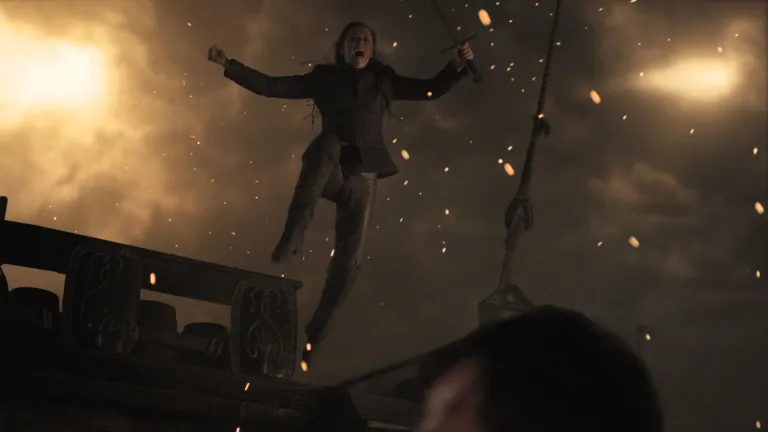
This fan service, however, is merely a prelude to the episode’s true purpose: the shocking, action-packed final sequence. The scene aboard Yara Greyjoy’s fleet, carrying Ellaria and the Sand Snakes back to Dorne, begins with a moment of relaxed sensuality as Yara and Ellaria flirt, promising a night of lesbian activity. This tranquillity is shattered by the sudden, brutal attack of Euron Greyjoy’s fleet. The ensuing battle is provides chaotic, close-quarters combat. Directed with claustrophobic intensity, it is a whirlwind of axe blows, splintering wood, and desperate struggles. The Sand Snakes, Obara and Nymeria, are unceremoniously killed—Obara impaled by a spear, Nymeria throttled with her own whip. Ellaria and Tyene are captured, as is Yara. Theon Greyjoy, confronted with the spectre of his own past cowardice and trauma, freezes. Paralysed by the memory of Ramsay Bolton, he abandons his sister to her fate, leaping overboard into the dark sea rather than fighting to the death.
This sequence is the episode’s undeniable highlight, providing the visceral action and narrative shock the preceding fifty minutes lacked. Its purposes are manifold. First, it dramatically rebalances the strategic equation. Daenerys suffers her first major loss; her naval superiority and Dornish alliance are gutted in a single stroke. Cersei, through her new ally Euron, scores a spectacular, morale-boosting victory. The message is clear: Daenerys’s path to the throne will not be a “bed of roses.” Second, it serves as a form of narrative housekeeping. The Dornish storyline, introduced in Season 5, had been a persistent sore point for the series, widely criticised by fans of George R.R. Martin’s novels for its drastic deviations and poor execution, particularly notable for farcical incompetence in episode Unbowed, Unbent, Unbroken, which featured clumsy, weightless scuffle that passed for its fight scene, creating profound fan backlash. *Stormborn+ offers a form of grim redemption. By eliminating the Sand Snakes in a well-choreographed, sensible fight—one where they are overwhelmed on a crowded ship, unable to utilise their signature acrobatic combat style—the showrunners effectively draw a line under a failed narrative experiment. It is a tacit admission of past error, executed with a brutal efficiency that the earlier Dorne episodes sorely lacked.
In the end, Stormborn is an episode of dualities. It is both static and explosive, expository and decisive. It succeeds in its primary goal of making Daenerys’s campaign seem less like an inevitable coronation and more like a difficult war, thanks to Tyrion’s clever strategy, Cersei’s propaganda, Qyburn’s dragon-killer, and Euron’s devastating ambush. Its character moments, from Arya’s bittersweet reunions to Sam’s grim determination, largely land with emotional resonance. Yet, it cannot escape the feeling of being a necessary, somewhat mechanical step in a larger plan. The heavy reliance on fan service and the concentration of real action into a final, spectacular set-piece reveal a series increasingly conscious of its own pacing and audience expectations.
RATING: 6/10 (++)
==
Blog in Croatian https://draxblog.com
Blog in English https://draxreview.wordpress.com/
InLeo blog https://inleo.io/@drax.leo
Substack https://draxster.substack.com
LeoDex: https://leodex.io/?ref=drax
InLeo: https://inleo.io/signup?referral=drax.leo
Hiveonboard: https://hiveonboard.com?ref=drax
Rising Star game: https://www.risingstargame.com?referrer=drax
1Inch: https://1inch.exchange/#/r/0x83823d8CCB74F828148258BB4457642124b1328e
BTC donations: 1EWxiMiP6iiG9rger3NuUSd6HByaxQWafG
ETH donations: 0xB305F144323b99e6f8b1d66f5D7DE78B498C32A7
BCH donations: qpvxw0jax79lhmvlgcldkzpqanf03r9cjv8y6gtmk9