Television Review: The Cost of Living (Lost, S3X05, 2006)

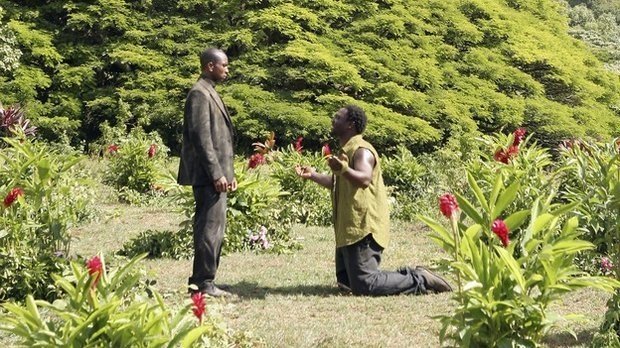
The Cost of Living (S03E05)
Airdate: 1 November 2006
Written by: Alison Schapker & Monica Owusu-Breen
Directed by: Jack Bender
Running Time: 43 minutes
Lost was, at its essence, a profoundly dark television programme, one that trafficked in existential dread, moral ambiguity, and the relentless erosion of hope. While the second and third seasons had introduced glimmers of optimism—providing tentative answers to the Island’s enigmas and the modest comforts of civilisation to ensure the survivors' continued existence—this illumination served merely to render the subsequent shadows deeper and more suffocating. The darkness returned with spectacular and shocking force in the fifth episode of the third season, The Cost of Living. Here, the show demonstrated its willingness to embrace the abyss wholeheartedly, delivering not merely psychological dread but a literal manifestation of darkness in the form of the Smoke Monster, alongside a narrative turn that would permanently alter the series' trajectory and remind viewers that the Island remained an unforgiving, lethal entity.
The episode’s central figure is Mr. Eko, the former Nigerian warlord turned reluctant man of faith, who had been dragged to the beach camp in a half-delirious, barely conscious state following the traumatic events of the earlier instalment. Tormented by vivid, hallucinatory visions of his deceased brother Yemi, the feverish Eko staggers from the camp in pursuit of spectral redemption, compelled by forces he cannot comprehend. Locke, having assumed a position of spiritual and practical leadership, organises a search party comprising Sayid, Desmond, Nikki, and Paulo. Locke deduces that Eko’s desperate pilgrimage leads inexorably toward the remains of the Beechcraft—a location that conveniently coincides with the entrance to the Pearl Station, which Locke wishes to investigate in the hope of establishing communication with other stations on the Island, convinced that technology might yet provide salvation where faith has faltered.
Interwoven with this desperate trek are flashbacks to Eko’s life in Nigeria following the Beechcraft’s departure. Mistaken for a Catholic priest by local soldiers, Eko assumes his brother’s clerical identity, intending to amass sufficient funds to flee the country. This deception obliges him to minister to Yemi’s parishioners, who suffer under the brutal extortion of Emeka (Hakim Kae-Kazim), a murderous militia leader. When Eko secretly sells a supply of vaccines on the black market—a commodity Emeka considers his own—the warlord descends upon the church with the intention of severing Eko’s hands. Instead, Eko reveals his own capacity for savagery, dispatching Emeka and his men with a machete in a scene of shocking brutality. Emerging from the defiled church drenched in blood and wielding the weapon, Eko is confronted by Amina (Muna Utaru), a parishioner who informs him that the sacred space has been profaned beyond use. This sin necessitates his later atonement through the construction of the church on the Island—a project left tragically unfinished.
Upon reuniting with Eko at the Beechcraft site, Locke’s party prepares to descend into the earth while Eko insists upon remaining above ground, claiming he must continue his vigil. Within the Pearl Station, the explorers discover a bank of television monitors displaying feeds from other stations, including one manned by a sinister, weathered figure with an eyepatch—portrayed by Andrew Divoff—whose presence hints at the vast, hostile infrastructure controlling the Island and suggests that the survivors are under constant, malevolent observation. Meanwhile, on the surface, Eko discovers that Yemi’s remains have mysteriously vanished from the aircraft wreckage. He encounters a vision of his brother demanding confession for his sins, which Eko defiantly refuses, asserting that he has done nothing requiring forgiveness. The apparition admits it is not Yemi, and shortly thereafter, the Smoke Monster—a roiling column of black vapor—grapples with Eko, lifting and smashing him against the ground with terrifying force. When Locke’s party emerges from the hatch, they find Eko mortally wounded. In his final moments, he whispers to Locke that "they are next," before succumbing to his injuries.
Parallel to Eko’s tragic arc, the episode explores the Byzantine power dynamics within the Others' camp, where Jack finds himself going through treacherous social landscape of manipulation and deceit. Ben Linus invites Jack to attend a funeral for Colleen, conducted with Hindu-inspired rites that speak to the Others' peculiar spiritual syncretism, subsequently revealing his spinal tumour and his calculated scheme to gradually wear down Jack's resistance and recruit him to his cause. Conversely, Juliet Burke embarks upon a campaign of seduction and deception, openly flirting with Jack before delivering a covert message via video recording. In a display of audacious duplicity, she holds cue cards stating that Ben is dangerous and must be killed during surgery—while simultaneously speaking aloud words of trust and medical procedure, a deception designed to circumvent Ben's audio surveillance and ensnare Jack in a conspiracy of murder.
Eko represented one of the most compelling additions to the cast following the first season—a charismatic, morally complex figure whose narrative depth frequently overshadowed that of the original survivors, including his philosophical rival Locke. To dispatch such a prominent character in so brutal and abrupt a manner, particularly with Eko’s final refusal of the religious redemption he had sought, constituted a profound narrative shock. It served as a stark reminder that no character’s survival was guaranteed. The introduction of Nikki and Paulo—particularly Nikki, clad in skimpy attire suggesting the disposable cannon fodder of slasher cinema—proved a clever red herring, diverting audience expectations away from Eko’s demise.
Yet for all its dramatic impact, Eko’s death felt curiously rushed and somewhat contradictory to his established character arc—principally because the narrative decision originated not from organic storytelling but from practical necessity. Adewale Akinnuoye-Agbaje, who portrayed Eko with such gravitas and physical presence, had grown deeply unhappy with the filming conditions in Hawaii and, according to reports, wished to return to Britain due to familial concerns. Originally contracted for a single season, he demanded that his character be killed off to enable his return to Britain and independent film projects there. The producers acquiesced, establishing a precedent for the elimination of regular characters that would be invoked throughout the series’ remaining duration, fundamentally altering the contract between the show and its audience regarding narrative safety.
Despite these behind-the-scenes complications, the episode—competently directed by Jack Bender—functions with ruthless efficiency. It accomplishes the difficult task of removing a major character whilst simultaneously advancing the overarching mythology, introducing potential new antagonists in the form of the eyepatched observer, and enriching the portrayal of the Others' society with additional layers of office politics, intrigue, and sexual manipulation.
The sequence in which Juliet deceives Ben’s surveillance apparatus—speaking words of assurance whilst displaying contradictory messages on cue cards—stands as particularly ingenious filmmaking. It serves as an explicit homage to Bob Dylan’s 1965 promotional film for "Subterranean Homesick Blues," widely regarded as one of the most influential short films ever produced and a progenitor of the modern music video. In Dylan’s original, the musician flips through cue cards bearing the lyrics whilst staring deadpan into the camera, creating a tension between the visual and auditory text; Juliet’s adaptation of this technique transforms the homage into a moment of genuine suspense and subterfuge, as she literally tells Jack to "ignore everything I’m saying" whilst vocalising platitudes of cooperation. In this moment, the series demonstrates its continued capacity for visual innovation and cultural reference, even as it deals with the difficult business of narrative attrition. The Cost of Living ultimately proves that in the world of Lost, the price of survival remains steep, and the Island demands payment in blood, offering no guarantees of redemption or longevity to even its most compelling inhabitants.
RATING: 7/10 (+++)
==
Blog in Croatian https://draxblog.com
Blog in English https://draxreview.wordpress.com/
InLeo blog https://inleo.io/@drax.leo
LeoDex: https://leodex.io/?ref=drax
InLeo: https://inleo.io/signup?referral=drax.leo
Hiveonboard: https://hiveonboard.com?ref=drax
Rising Star game: https://www.risingstargame.com?referrer=drax
1Inch: https://1inch.exchange/#/r/0x83823d8CCB74F828148258BB4457642124b1328e
BTC donations: 1EWxiMiP6iiG9rger3NuUSd6HByaxQWafG
ETH donations: 0xB305F144323b99e6f8b1d66f5D7DE78B498C32A7
BCH donations: qpvxw0jax79lhmvlgcldkzpqanf03r9cjv8y6gtmk9