Television Review: The Dance of Dragons (Game of Thrones, S5X09, 2015)

The Dance of Dragons (S5x09)
Airdate: 7 June 2015
Written by: David Benioff & D.B. Weiss
Directed by: David Nutter
Running Time: 52 minutes
The decision to adapt George R.R. Martin’s sprawling epic A Song of Ice and Fire for television proved to be immensely rewarding for HBO and most of those involved. However, it carried one fundamental, crippling flaw: the source material was, and remains, unfinished. By the midpoint of the series, specifically by the end of Season 5, showrunners David Benioff and D.B. Weiss had effectively exhausted the published narrative ore from Martin’s rich mines. Consequently, they were forced into a position of creative alchemy—condensing plots, altering character trajectories, and, most perilously, inventing new storylines wholesale. Season 5 stands as the starkest testament to this transition, a year where the show’s narrative engine began to sputter and roar on its own invented fuel. The penultimate episode, The Dance of Dragons, encapsulates this dichotomy perfectly, showcasing both the breathtaking spectacle the production could achieve and the jarring, often controversial, narrative shortcuts it began to take.
The episode’s title operates on multiple, clever levels. It directly references A Dance with Dragons, Martin’s fifth and most recent novel, published in July 2011. It also alludes to the historic Targaryen civil war, a topic of brief discussion among character, which would later form the basis for Fire & Blood and its television adaptation, prequel series House of the Dragon. Most pertinently, it serves as a metaphor for the episode’s climactic sequence: a literal dance of fire and death as Drogon descends upon the fighting pits. This layered titling is a hallmark of the show’s earlier, more literate seasons, a subtlety that becomes somewhat ironic given the episode’s broader narrative bluntness elsewhere.
In Dorne, the plot reaches a nadir of rushed resolution. Jaime Lannister, whose clumsy covert mission failed spectacularly, now achieves through awkward diplomacy what stealth could not: the return of Myrcella. The deal itself is sensible, preserving the dynastic marriage but allowing Trystane to accompany her to King’s Landing—a move that delights Myrcella because of genuine affection sorely lacking in most political unions in Westeros. Jaime also secures Bronn’s freedom. Yet, the consequences for the attempted coup are absurdly minimal. Ellaria Sand and the Sand Snakes, guilty of treason and attempted murder of a royal princess, are simply warned by Prince Doran that they will not get a “third chance.” This resolution feels less like the cunning politics of Sunspear and more like a hurried narrative broom sweeping a poorly conceived subplot under the rug, neutering any sense of real danger or consequence.
Braavos offers a more intriguing, if grim, character beat. Arya’s surveillance of the “Thin Man” is interrupted by the arrival of Mace Tyrell’s delegation to the Iron Bank. The true catalyst, however, is the sight of Ser Meryn Trant. The show deftly ties this back to Arya’s foundational trauma—the death of Syrio Forel—fuelling her vengeful focus. Her pursuit leads to a brothel, where Trant’s depravity is revealed: a preference for girls way below usual age. This moment is unflinchingly dark, serving dual purposes. It removes any lingering doubt about Trant’s deserving place on Arya’s list, and it starkly illustrates the moral rot festering within the institutions of the so-called civilised world. It is a efficient, if deeply unpleasant, piece of character work.
North of the Wall, Jon Snow executes a hard-won humanitarian mission, leading thousands of Wildling refugees through the gates. The silent, seething hostility from the Night’s Watch brothers is palpable and brilliantly underplayed, a ticking clock of resentment that will define the season’s finale. This sequence works because it is rooted in established conflict and character logic. South of the Wall, however, the narrative accelerates into contrivance. Ramsay Bolton’s daring raid on Stannis’s camp, executed with a ludicrously small band, is a smashing success. The wholesale destruction of food, horses, and siege engines is so comprehensive it beggars belief, functioning purely as a blunt instrument to force Stannis into an unthinkable choice. With his campaign in ruins, he sends Davos away and succumbs to Melisandre’s fanaticism. The sacrifice of his daughter, Shireen, is the episode’s most devastating and controversial act.
This scene is, undeniably, powerful television. Directed with chilling solemnity by David Nutter and acted with devastating conviction by Stephen Dillane and Kerry Ingram, it is a masterpiece of horror. The audience’s perspective aligns with Selyse, whose fanatical faith shatters the moment she hears her daughter’s screams, realising the monstrous abstraction of her beliefs. It succeeds in its primary goal: burning all bridges of audience sympathy for Stannis Baratheon. Yet, the controversy is wholly justified. It represents a drastic departure from the novels, where Shireen remains safe at Castle Black. While Benioff and Weiss later claimed this fate came from Martin himself, its placement here feels less like organic character tragedy and more like a calculated, shock-value plot device to dismantle Stannis’s storyline with maximum visceral impact. It is “shock for shock’s sake,” a charge that had begun to dog the series following Sansa’s rape in the earlier episode. For many viewers, this was a breaking point, a signal that nuanced character erosion was being replaced by brutal, audience-prodding spectacle.
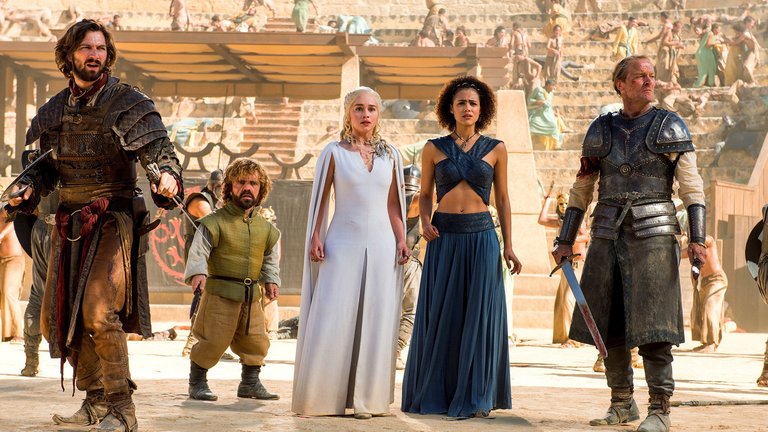
That spectacle arrives, in spades, with the Meereenese finale. Daenerys’s attendance at the Daznak Pit is a sequence of extraordinary scale and technical prowess. Shot in the Plaza de Toros in Osuna, Spain, and augmented with digital majesty to house a thousand extras, it is the most spectacular location the show had yet presented. The direction is taut, the chaos of the Sons of the Harpy’s attack genuinely thrilling. The death of Hizdahr zo Loraq—a character of ambiguous loyalty who survives in the books—is a notable alteration. The timely arrival of Drogon is a deus ex machina, but one earned by seasons of dragon lore and executed with Emmy-winning visual effects. The image of Daenerys mounting her dragon and soaring away is iconography of the highest order, a triumphant fantasy moment that the series could deliver like no other.
The Dance of Dragons is an episode of stark contrasts and defining compromises. It showcases the show’s peak production capabilities in its breathtaking final act, a sequence that rightly won awards and captured the global imagination. Yet, it is equally defined by the quieter, more harrowing horror of Shireen’s pyre, a scene that exposes the growing narrative strains of adapting an unfinished saga. The episode stands as a microcosm of Season 5 and the series’ future: when leaning on Martin’s plotted complexity, as in Jon Snow’s storyline, it remained compelling; when forced to invent under pressure, it often opted for brutal efficiency over nuanced plausibility.
RATING: 7/10 (+++)
==
Blog in Croatian https://draxblog.com
Blog in English https://draxreview.wordpress.com/
InLeo blog https://inleo.io/@drax.leo
LeoDex: https://leodex.io/?ref=drax
InLeo: https://inleo.io/signup?referral=drax.leo
Hiveonboard: https://hiveonboard.com?ref=drax
Rising Star game: https://www.risingstargame.com?referrer=drax
1Inch: https://1inch.exchange/#/r/0x83823d8CCB74F828148258BB4457642124b1328e
BTC donations: 1EWxiMiP6iiG9rger3NuUSd6HByaxQWafG
ETH donations: 0xB305F144323b99e6f8b1d66f5D7DE78B498C32A7
BCH donations: qpvxw0jax79lhmvlgcldkzpqanf03r9cjv8y6gtmk9