Television Review: The Fog (Mad Men, S3x05, 2009)

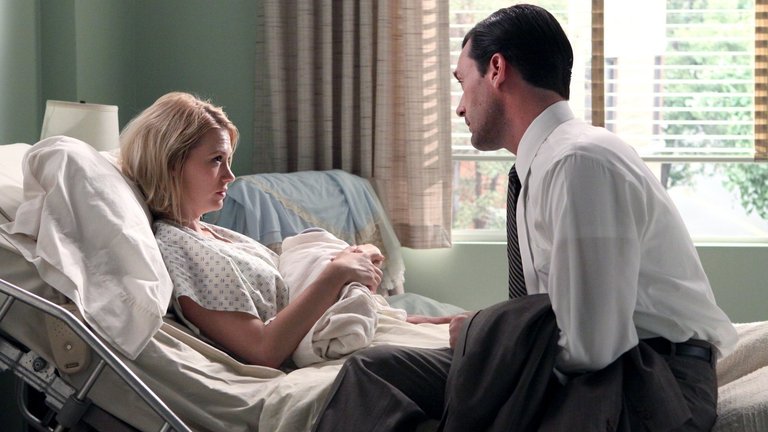
The Fog (S3x05)
Airdate: 13 September 2009
Written by: Kater Gordon
Directed by: Phil Abrahan
Running Time: 48 minutes
The defining strength of series like Mad Men lies in their architectural precision. In a narrative landscape often dominated by the shock of grand historical events, Matthew Weiner’s drama excels in its ability to move plots and characters from point A to point B with a clockmaker’s consistency, using established historical markers as its fixed bearings. This is true even within the relatively uneventful calendar of 1963—a year whose cataclysmic conclusion in Dallas looms over the season but whose preceding months offer fewer obvious dramatic hooks. Here, the series’ mechanics become most visible: the precision applied to historical backdrop is mirrored in the meticulous, often predictable, development of its regular plotlines and character arcs. The Fog, the fifth episode of Season 3, is a telling example of this method. It executes its moves with flawless technical competence, yet in doing so, it reveals both the assured craft and the occasional dramatic safeness that can emerge when a series follows its own blueprint too faithfully.
This precision is immediately evident in the script by Kater Gordon, which is meticulously set between the 20th and 22nd of June 1963. The days are framed by two deaths: the recent passing of Betty Draper’s father, Gene Hofstadt, and the real-world assassination of Black civil rights activist Medgar Evers in Mississippi on June 12th. These events are the psychological poles between which the episode’s drama oscillates. The episode opens with Don and Betty being summoned to Sally’s school following an altercation. Here, the teacher’s name is revealed as Suzanne Farrell, a young woman whose intense, almost intrusive dedication to Sally immediately signals a narrative vector distinct from Betty’s weary, pregnant desire to simply move on. Suzanne’s later, thinly-veiled late-night call to Don under the pretext of further discussion confirms her romantic interest, planting a seed for future subplots. Yet, this is part of the season’s pattern of Don risking his adultery too close to home, a precision in repeating his cycles of infidelity that borders on the schematic.
Don’s attention, however, is forcibly redirected when Betty goes into labour. The ensuing hospital sequence forms the episode’s core. In the waiting room, Don shares a bottle of whiskey with Dennis Hobart, a Sing Sing prison guard. Their conversation—a blend of masculine anxiety and naive hope about fatherhood—is a perfectly crafted vignette of period-specific male bonding, yet it feels like a deliberate, almost clinical exercise in thematic contrast: Don, the affluent adman, and Hobart, the working-class guard, both momentarily united by biological inevitability. Meanwhile, Betty is subjected to the period’s popular medical practice of “twilight sleep”, a cocktail of drugs designed to ease birth. This becomes the conduit for the episode’s titular fog, a stream of hallucinatory visions. She encounters her deceased father Gene, her mother Ruth (Lou Mamboni), and, most strikingly, Medgar Evers. This vision is the episode’s most audacious attempt to tether personal trauma to the national political landscape. The birth of a son, whom Betty names Eugene after her father, provides a neat, emotional closure, but the progression feels inevitable. The audience could well have guessed Betty would give birth around this time, and so she does; the mechanics are impeccable, but the surprise is negligible.
Concurrently, the professional world of Sterling Cooper is gripped by a different kind of unease. The new PPL regime, embodied by the austerely pragmatic Lane Pryce, has imposed cost-cutting measures, casting a pall over the office. This financial tension catalyses two key developments. First, a call from Herman “Duck” Phillips, who has resurrected his career at rival firm Grey. He attempts to poach both Pete Campbell and Peggy Olson. Their reactions are precisely delineated: Pete, burdened by pride and his complex rivalry with Peggy, rejects it outright; Peggy flirts with the idea but ultimately demurs, choosing instead to ask Don for a raise—a request he coldly refuses, citing the firm’s finances. This interaction reinforces the show’s enduring hierarchy and Peggy’s frustrated ascent.
The second, more thematically rich, development involves Pete Campbell. Frustrated with being assigned “dog” accounts like Admiral television, Pete demonstrates his occasional prescience. Noting that Admiral sales are dipping everywhere except in Black communities, he devises a pitch focused on that very market, even suggesting the use of Black media and hinting at “integrating” their marketing approach. In his research, he awkwardly questions Hollis, the firm’s Black elevator operator, about why Black people might prefer Admiral. This moment is a direct, deliberate callback to the series’ opening scene in the pilot, where Don Draper questioned a Black waiter about his cigarette preferences. That scene established the pervasive, casual racism of the era, and Draper’s unique, almost anthropological detachment. Pete’s version is clumsier, more transactional, but it underscores the same dynamic: the white corporate world’s myopic, instrumental view of Black consumers. His progressive idea is, unsurprisingly, rejected by the Admiral executives, a historical verisimilitude that shows Pete, as point seven notes, a little bit ahead of his time. It’s a nuanced tragedy of foresight wasted on a world not ready to listen.
The episode’s craft extends to its aesthetic choices, which are a mix of the effective and the curiously anachronistic. The music accompanying Betty’s visions—Me voy a morir de tanto amor by Alberto Iglesias, from the 2001 film Lucía y el sexo—is, as noted, a clear anachronism for a 1963-set piece. Yet, its haunting quality undeniably fits the ethereal, disorienting mood of the sequence, a case where emotional resonance trumps historical purity. More subtly telling is Duck Phillips’ sartorial choice during his lunch with Pete and Peggy: a turtleneck sweater, worn without a tie. In the uniform world of Madison Avenue suits, this is a visual declaration of rebellion, a symbol of the emerging, more casual 1960s sensibility that would eventually dismantle the very establishment Duck once represented. It’s a small, precise detail that speaks volumes.
The Fog is an episode that embodies the virtues and limitations of Mad Men’s mid-season craftsmanship. It is superbly constructed, each narrative thread dovetailing with historical touchstones and character consistency. The script is tight, the performances nuanced, and the thematic ambition—connecting domestic birth pangs with national racial violence—is commendable. However, this very precision can feel like a well-rehearsed performance. The beats of Betty’s labour, Pete’s frustrated ingenuity, and Don’s passive navigation of crises unfold with a predictability that lacks the disruptive spark of the series’ best episodes. It functions as part of the season’s broader project of showing the last gasps of an era, moving its pieces deliberately towards the November cataclysm. As a piece of television, it is impeccably made; as a dramatic experience, it sometimes feels like watching a masterful machine operate, hearing every gear click perfectly into place, and occasionally longing for a moment of unexpected, unscripted friction.
RATING: 6/10 (++)
==
Blog in Croatian https://draxblog.com
Blog in English https://draxreview.wordpress.com/
InLeo blog https://inleo.io/@drax.leo
LeoDex: https://leodex.io/?ref=drax
InLeo: https://inleo.io/signup?referral=drax.leo
Hiveonboard: https://hiveonboard.com?ref=drax
Rising Star game: https://www.risingstargame.com?referrer=drax
1Inch: https://1inch.exchange/#/r/0x83823d8CCB74F828148258BB4457642124b1328e
BTC donations: 1EWxiMiP6iiG9rger3NuUSd6HByaxQWafG
ETH donations: 0xB305F144323b99e6f8b1d66f5D7DE78B498C32A7
BCH donations: qpvxw0jax79lhmvlgcldkzpqanf03r9cjv8y6gtmk9