Television Review: The Game (Star Trek: The Next Generation, S5X06, 1991)

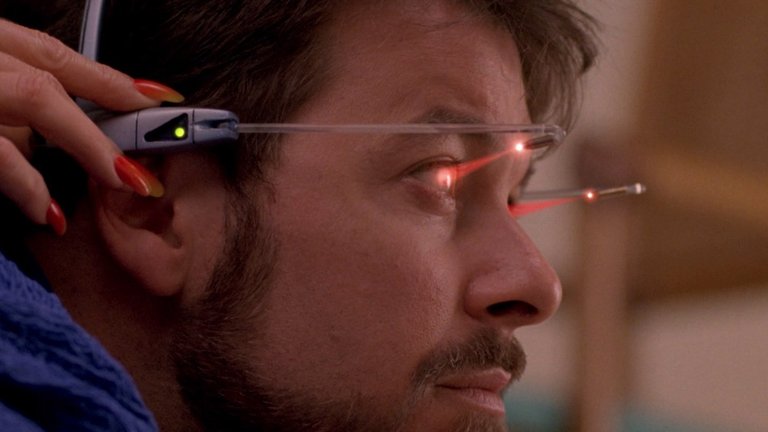
The Game (S05E06)
Airdate: 28 October 1991
Written by: Brannon Braga
Directed by: Corey Allen
Running Time: 46 minutes
During the seven-year run of Star Trek: The Next Generation, it was an inevitability that among the extensive catalogue of episodes produced, some would distinguish themselves by their uncanny ability to look ahead into the actual future of humanity. The Game, which aired as the sixth episode of Season 5, stands out in this regard for recognising a trend that few people in the early 1990s took seriously, yet which has since evolved into a defining characteristic of modern existence. The episode is notable for predicting the phenomenon of compulsive consumption and passive engagement with technology, using it as the foundation for its premise. It was also the very first episode broadcast after the death of the franchise's creator, Gene Roddenberry, who was still credited as executive producer despite his passing, a testament to his enduring legacy on the show. The episode was written by Brannon Braga, building upon a story conceived by Roddenberry's personal assistant, Susan Sackett, and Fred Bronson, the latter of whom was reportedly inspired by his own habit of playing Tetris on his personal computer.
The plot begins on the pleasure planet of Risa, where Commander Riker has embarked on yet another vacation to enjoy the company of a Ktarian woman named Etana (Katharine Moffat). Etana introduces Riker to a deceptively simple device—a game unit—and explains that it is merely a source of entertainment. However, the device works by stimulating the pleasure centres within the brain, providing a constant reward loop that hooks the player almost immediately. Riker tries the game and finds himself captivated by its simplicity and the rush of dopamine it provides. Upon his return to the USS Enterprise-D, he encounters Counselor Troi and, while discussing her fondness for chocolate, offers her the game as a superior alternative.
In the meantime, a shuttlecraft brings Wesley Crusher back to the ship; he had taken a brief respite from Starfleet Academy to visit his mother and old friends. He exchanges anecdotes about life at the academy with Captain Picard, but his attention quickly shifts to Ensign Robin Lafleur. Although she is initially impressed by him, their budding romance is soon eclipsed by more pressing matters.
Wesley, being naturally inquisitive, cannot fail to notice the immense popularity of Riker's game among the crew, a craze that has seemingly gripped everyone from the bridge officers to the senior staff. Even his mother, Dr. Crusher, tries a little too hard to convince him to participate, raising his suspicions. Wesley and Robin begin to investigate the device's physiological effects, discovering that it is not just a toy but an immensely addictive substance that can hijack neural pathways. They conclude that the game represents a significant danger to the ship's functionality. The situation escalates when the game has indeed spread to everyone, rendering the crew inactive and compliant. Data, being an android is not receptive to pleasure stimulation. However, Dr. Crusher disables him to prevent him from interfering. Wesley soon finds himself the only person on the ship not affected by the drug, a state of isolation that makes him the key to the ship's salvation. As the episode builds to its climax, a Ktarian ship, commanded by Etana, approaches the Enterprise to take it over from its brainwashed crew.
The concept of a video game being addictive was something relatively new and was not taken seriously in the early 1990s. Yet, looking at the current date in the 2020s, with entire generations being captured by cellphone screens and suffering from addiction to social media, the premise of The Game looks almost prophetic. Brannon Braga later explained that he took the script in a different direction from the clichés that were prevalent at the time. While video games in his era were often viewed as the domain of children and juveniles, Braga subverted this by making the adults—the commanding officers and senior staff—the ones addicted, while it was the juvenile character, Wesley, who had to save them. This reversal adds a layer of social commentary to the episode that was perhaps ahead of its time.
However, the return of Wesley Crusher is the primary reason why some "Trekkies" did not particularly appreciate this episode. For many long-time viewers, Wesley became a polarising figure, viewed as the "boy genius" who constantly interfered with the crew's duties and solved problems that the adults should have been able to handle. Here again, he plays the role of the saviour, dismantling the game's influence just as he did in his early season appearances. This narrative choice, while functional, feels repetitive and fails to move the character beyond his original archetype.
Much more valid criticism towards the episode concerns the premise not being particularly polished. The episode struggles to explain how the game manages to affect people with non-human brains, such as Lieutenant Worf, or those who rely on visual aids like Geordi La Forge. Furthermore, the whole scenario is highly predictable because it is essentially a direct rip-off of The Invasion of the Body Snatchers. The resolution is also weak because it relies on an action occurring off-screen, leaving the climax feeling rushed and lacking a tangible payoff for the viewer.
On the positive side, director Cory Allen does a very good job of maintaining tension despite these narrative flaws, particularly in the climax where the brainwashed crew member forces Wesley to play the game. The direction in this scene offers obvious visual nods to Stanley Kubrick's A Clockwork Orange. The episode also benefits from good chemistry between Patrick Stewart and Wil Wheaton, as well as a charming performance from Ashley Judd in her second and final appearance on the series as Robin Lafleur. Despite its flaws, The Game remains a fascinating snapshot of the late 20th century's anxieties regarding technology and the human desire for instant gratification.
RATING: 6/10 (++)
Blog in Croatian https://draxblog.com
Blog in English https://draxreview.wordpress.com/
InLeo blog https://inleo.io/@drax.leo
LeoDex: https://leodex.io/?ref=drax
InLeo: https://inleo.io/signup?referral=drax.leo
Hiveonboard: https://hiveonboard.com?ref=drax
Rising Star game: https://www.risingstargame.com?referrer=drax
1Inch: https://1inch.exchange/#/r/0x83823d8CCB74F828148258BB4457642124b1328e
BTC donations: 1EWxiMiP6iiG9rger3NuUSd6HByaxQWafG
ETH donations: 0xB305F144323b99e6f8b1d66f5D7DE78B498C32A7
BCH donations: qpvxw0jax79lhmvlgcldkzpqanf03r9cjv8y6gtmk9