Television Review: The Gypsy and the Hobo (Mad Men, S3x11, 2009)

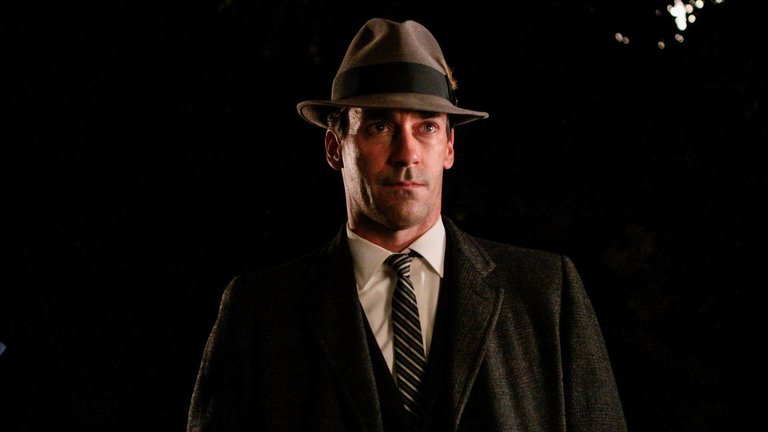
The Gypsy and the Hobo (S3x11)
Airdate: 25 October 2009
Written by: Marti Noxon, Cathy Humphrys & Matthew Weiner
Directed by: Jennifer Getzinger
Running Time: 48 minutes
Mad Men, throughout its run, maintained a meticulous framing of its episodes around specific, identifiable points in time, using the backdrop of history to underscore the personal revolutions of its characters. The show’s third season, however, ran into a distinct structural problem with the year 1963. The year was, until its cataclysmic end in Dallas, a relatively uneventful—the writers were deprived of the grand historical touchstones that peppered earlier seasons. The solution, as in many dramatic series, was to pivot towards the communal calendar of public holidays. In the case of the eleventh episode, The Gypsy and the Hobo, the chosen holiday is Halloween, a day traditionally dedicated to the wearing of masks. The episode’s central, devastating irony is that it is on this day of sanctioned disguise that the most consequential mask worn by the protagonist, Don Draper, is finally and irrevocably torn off.
The plot is set in motion several days before Halloween. Betty Draper, ostensibly taking the children to Philadelphia to visit her brother’s family, provides Don with the perfect opportunity to pursue his affair with their children’s teacher, Suzanne Farrell. He employs his well-worn excuse of pressing work commitments. The reality, however, is that Betty’s trip is a business necessity: she is attempting to settle her father’s contentious estate. In the office, she dismisses her brother William to confer privately with her attorney, Milton Lowell (Dan Desmond). Here, the expected discussion of probate is swiftly abandoned. Instead, Betty reveals her discovery of Don’s true identity as Dick Whitman, the ultimate foundation of his years of deception. She seeks legal advice, explicitly floating divorce as the most sensible reaction. Lowell, embodying the pragmatic, patriarchal legal establishment of the era, counsels caution. He posits that she has a good life with three children and that divorce is a difficult, messy procedure—unless she can secure proof of infidelity. This moment is crucial; it establishes Betty not as a hysterical wife but as a calculating strategist, already mapping the battlefield of her marriage’s dissolution.
The irony of Lowell’s advice is immediately and brutally underscored. Don, emboldened by his assumed freedom, drives Suzanne to his own home to retrieve an item, only to find Betty and the children have returned early. Suzanne remains unseen, but a far greater reckoning awaits. Confronted by Betty with the damning contents of his locked desk—the physical evidence of his stolen identity—Don’s facade crumbles. After initial, futile denials, he launches into a quiet, tearful confession. Jon Hamm’s performance here is exemplary in its raw vulnerability, a man finally speaking his foundational truth. Yet, the episode’s critical power derives from Betty’s reception of it. January Jones portrays Betty with an icy, unmoved stillness. She absorbs his biography—a narrative already fully known to the audience—without a flicker of surprise or sympathy. The dramatic “wham” moment of revelation is thus deliberately neutered; its impact is not on Betty, but on the dynamic between them. As this domestic drama unfolds, Suzanne waits in the car, a forgotten spectre of the affair, until she finally departs, her patience exhausted. The following day, a terse phone conversation from Don’s Sterling Cooper office makes the inevitable clear: their relationship is terminally punctured by the reality of his exposed life.
Parallel to this central unraveling, Roger Sterling is confronted by a ghost from his own past. Annabelle Mathis (Mary Page Keller), recently widowed owner of the dog food company Candlecott Farms, arrives as a client with a PR crisis (the 1961 film The Misfits has revealed her product contains horse meat). For Annabelle, however, the meeting is profoundly personal. She and Roger were once romantically involved before the war, and she arrives carrying a torch, seeing her widowhood as a chance to correct history. In a moment that subverts Roger’s established character as a self-deluding man in a midlife crisis, he firmly and realistically rejects her advances. His refusal is not born of newfound virtue but of a clear-eyed understanding of his recent marriage to the much younger Jane. The episode cleverly contrasts Annabelle’s romantic fantasy, which she gauchely compares to Casablanca, with Roger’s weary pragmatism. Her subsequent decision to withdraw her company’s business from Sterling Cooper is a petty, personal retaliation that highlights the messy intersection of professional and private lives—a theme central to the entire series.
Spurred perhaps by this encounter with regretted paths, Roger seeks out Joan Holloway (now Harris). Learning of her husband Greg’s professional failures and their resulting financial strain, Roger offers to help her find work. Meanwhile, Joan is desperately trying to orchestrate Greg’s career, here attempting to coach him for psychiatric residency interview. Greg’s abject failure in the interview and his subsequent wallowing in self-pity trigger a shocking, and arguably flawed, moment of violence: Joan loses her composure and strikes him on the head with a vase. The aftermath of this assault is handled with puzzling brevity. Greg suffers no serious physical consequences, and the psychological fallout is glossed over almost immediately as he announces his decision to join the U.S. Army. He frames this as a pragmatic solution: the military’s need for surgeons will guarantee him a residency and secure their finances. Joan, visibly horrified at the prospect of a peripatetic life as an officer’s wife, nonetheless performs acceptance, plastering on a smile and pretending to be happy. This subplot feels the most contrived. The act of violence seems disproportionate and psychologically unmotivated within the episode’s otherwise nuanced framework, and its rapid resolution undermines any serious exploration of the couple’s toxic dynamic. Furthermore, Greg’s enlistment is laden with a heavy-handed, anachronistic irony regarding the Vietnam War—a conflict whose shadow feels somewhat artificially imposed on this 1963 narrative.
The episode’s denouement returns to the Halloween motif. Don and Betty, performing a semblance of normalcy, accompany their children Sally and Bobby trick-or-treating. They stop at the home of their neighbour, Carlton Hanson. Looking at the costumed children, Hanson identifies Sally as a “gypsy” and Bobby as a “hobo.” He then turns his gaze to the parents and asks, rhetorically, “And what are you supposed to be?” The question hangs in the air, a perfectly crafted piece of dramatic irony. It inadvertently alludes to Don’s true, humble “hobo” origins and to Betty’s current performance as the dutiful wife. In this moment, they are both wearing the ultimate masks, pretending for the outside world—and for themselves—that the foundational crack in their marriage has not appeared.
Co-written by Marti Noxon, Cathryn Humphris, and Matthew Weiner, The Gypsy and the Hobo is, for all its momentous revelation, a surprisingly cold and clinical hour of television. This is its greatest strength and, for some viewers, a potential weakness. The writing and acting are impeccable, but the emotional temperature is deliberately low, mirroring Betty’s business-like demeanour as she seeks to put her things in order. Don’s confession, while powerfully acted, reveals nothing new to the audience. Consequently, the scene lacks the shocking “wham” impact it might have possessed had the viewer been discovering the truth alongside Betty. Instead, the power is displaced onto the chilling normalcy that follows. The apparent return to the status quo—the couple continuing to cohabit, to parent, to perform their social roles—is far more unsettling than any explosive argument. The audience, armed with foreknowledge, understands this calm is the eye of the storm. We know nothing will be the same, and the episode’s coldness makes the inevitable collapse feel both more certain and more terrifying.
The episode’s exploration of the chasm between image and reality is deftly mirrored in Roger’s subplot. His rejection of Annabelle Mathis presents a rare moment of clarity and self-possession for a character often depicted as pathetic and self-deceiving. By refusing to indulge a nostalgic fantasy, Roger emerges as more grounded and realistic than the romanticising Annabelle. This subplot serves as a thematic counterpoint: where Don’s entire life is a fabricated image now crumbling, Roger actively chooses reality over a comforting illusion, even at a professional cost.
The Gypsy and the Hobo is a pivotal episode that executes a narrative milestone with remarkable restraint. It forgoes emotional pyrotechnics in favour of a slow, chilling realism. The use of Halloween as a backdrop is brilliantly ironic, highlighting the perpetual masquerade of its characters. While the subplot involving Joan and Greg succumbs to melodramatic violence and somewhat anachronistic historical signalling, the core narrative of the Drapers is handled with devastating precision. The episode leaves us not with a climax, but with a pregnant, dreadful quiet. The mask is off, but the performance, for the sake of the children and the neighbourhood, must go on—and that, the episode suggests, is the greatest horror of all.
RATING: 8/10 (+++)
==
Blog in Croatian https://draxblog.com
Blog in English https://draxreview.wordpress.com/
InLeo blog https://inleo.io/@drax.leo
Substack https://draxster.substack.com/
LeoDex: https://leodex.io/?ref=drax
InLeo: https://inleo.io/signup?referral=drax.leo
Hiveonboard: https://hiveonboard.com?ref=drax
1Inch: https://1inch.exchange/#/r/0x83823d8CCB74F828148258BB4457642124b1328e
BTC donations: 1EWxiMiP6iiG9rger3NuUSd6HByaxQWafG
ETH donations: 0xB305F144323b99e6f8b1d66f5D7DE78B498C32A7
BCH donations: qpvxw0jax79lhmvlgcldkzpqanf03r9cjv8y6gtmk9