Television Review: The Iron Throne (Game of Thrones, S8X06, 2019)

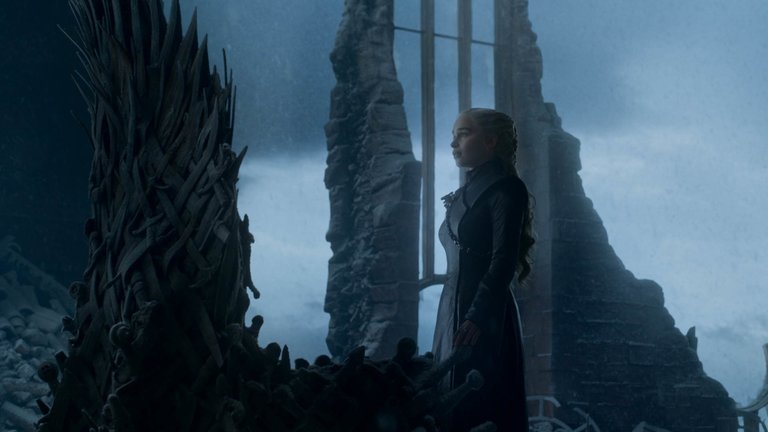
The Iron Throne (S8x06)
Airdate: 19 May 2019
Written by: David Benioff & D. B. Weiss
Directed by: David Benioff & D. B. Weiss
Running Time: 77 minutes
The final episode of Game of Thrones, presented with the unenviable task of tying together eight years of storytelling, faced an unexpectedly demanding challenge from showrunners David Benioff and D. B. Weiss. They were not only required to provide adequate closure to the most celebrated, most popular, and most iconic piece of television of its time, but also to somehow repair the significant damage caused by the decline in quality which culminated in the final season, and particularly its penultimate episode. That episode, widely regarded as the most divisive, most disappointing, and for many even the most traumatic piece of television in recent history, left a scar on the series' legacy that seemed impossible to heal. While the creators undoubtedly tried to address the grievances of the audience, The Iron Throne—the episode which they both wrote and directed—predictably failed in that task, serving as a bittersweet but ultimately bland conclusion to a saga that had once promised so much more.
Like most of the Season 8 episodes, this finale begins with a strong, atmospheric sequence that pulls the audience back to ground zero of the devastation of King’s Landing. We are introduced to Tyrion Lannister, wandering in absolute silence through incinerated ruins, surrounded by the countless immolated remains of innocent women and children. This visual montage is haunting and powerful, effectively communicating the scale of the tragedy that has occurred. Venturing deeper into the ruins of the Red Keep and the secret tunnels, Tyrion comes across the bodies of his brother and sister, Jaime and Cersei, buried under rubble, thereby confirming their fates in a moment of despair. This opening serves as a stark reminder of the cost of war and sets a sombre tone that the rest of the episode struggles to maintain consistently.
The narrative quickly pivots to Jon Snow, who witnesses Grey Worm leading Unsullied soldiers in gathering the few surviving Lannister troops. Despite Jon’s protestations that the war has been won and that further violence is unnecessary, Grey Worm executes the surrendered soldiers one by one. Jon, believing he must intercede personally to try and change his aunt’s mind, witnesses Daenerys drunk with victory giving a grandiose speech to thousands of Unsullied and Dothraki. She promises to continue her campaign to “liberate” the entire world, a word she effectively equates with conquest. Tyrion, disgusted by this turn of events, throws away his Hand of the Queen pin. Daenerys reacts by having him arrested for treason, marking the end of her trusted advisor's service. Jon shares a brief, tense moment with Arya, who looks at Daenerys with disdain and describes her simply as “the killer,” a comment that all but suggests that the Westerosi have merely replaced one tyrant with another.
Jon is eventually allowed a visit to Tyrion, who is detained and likely facing his last days. Tyrion pleads with Jon to do what is right, but Jon, heartbroken and seemingly lacking the resolve to commit such a drastic act, hesitates. He first attempts to reason with Daenerys, who is basking in triumph in the remains of the throne room, accompanied by Drogon. He embraces her, hoping to appeal to her humanity, but when that fails, he acts with decisive finality, stabbing her in the heart with the dagger. Daenerys dies looking at him, her expression one of utter betrayal. Drogon reacts to the death of his mother with mournful lashing, breathing fire that melts the Iron Throne symbolically removing the very symbol of the misery and conflict that has plagued Westeros for generations. He then takes her body in his claws and flies away, never to be seen again.
The plot then fast-forwards a few weeks. Tyrion, still a prisoner, is brought to the Dragonpit by the Unsullied. Here, he is greeted by representatives of the remaining great houses and the commanders of the coalition that won the Last War. This assembly is supposed to try him for treason, but the topic shifts instead to establishing a permanent political settlement to prevent future wars. Tyrion, in a masterstroke of rhetoric, successfully argues that Bran Stark, due to his unique status as the Three-Eyed-Raven, possesses a level of authority that no other character can claim. Consequently, Bran is elected king. The issue of his inability to have children is rendered moot by a decision to make the monarchy elective rather than hereditary. In a separate development, Sansa Stark is granted independence for the North and is crowned its queen. Bran immediately names Tyrion his Hand of the King.
Later, Tyrion visits Jon in his cell and informs him that a compromise regarding his fate has been reached. The Unsullied wanted Jon executed for killing their beloved queen, while the North would never accept the death of its beloved king and hero. The solution is Jon’s exile to the Wall, where he joins the Night’s Watch. Despite the original purpose of the Night’s Watch having been made moot by the elimination of the White Walkers, it now serves as a practical refuge for the realm’s least desirable people.
In the parts of King’s Landing that escaped destruction, a semblance of normalcy returns under Bran’s rule. Brienne of Tarth, who has spent plenty of time immortalising the chivalric deeds of Jaime Lannister in the Book of Brothers, becomes part of Bran’s Small Council. The council is also attended by the new Grand Maester Samwell Tarly, Ser Davos Seaworth, and Bronn as the new Lord Protector of Highgarden, a position he secured through his opportunistic charm. The series concludes with Jon Snow departing from the port. He watches as the Unsullied and Grey Worm sail away to Naath, leaving behind his siblings who have taken different paths. Sansa is crowned Queen in the North, while Arya expresses a desire to see whether there is any land to be found in the uncharted areas west of Westeros,. Jon arrives at Castle Black, reunites with his earless direwolf Ghost, and joins Tormund, who is leading a huge band of wildlings northwards. As they enter the newly liberated land beyond the Wall, a small blade of grass in the snow suggests that winter is over and that spring might finally come, providing a conventional, happy ending.
Benioff and Weiss have concluded that the only way to remove the bitter taste from the viewers' mouth, following the genocidal erasure of humanity in the penultimate episode, is to provide a conventional happy ending. This leads to a structural division of the episode into three distinct parts: the immediate aftermath of the carnage, ending with Daenerys’s death; the second part, which establishes the political settlement; and the third part, an epilogue symbolically placing the major characters where they are "supposed to be" and ending the dreaded winter. While this structure provides a sense of completion, it also feels manufactured, relying on convenient story beats rather than organic character development.
The first part of this structure is the darkest and arguably the least subtle in displaying the showrunners' intentions. This is most clearly suggested by a shot in which Daenerys is framed with Drogon’s massive wings spread out in the background, visually positioning her as a devil-like demon against the dark sky. She also delivers speech to the lines of Unsullied that look like stormtroopers at a Nuremberg rally, a visual choice that emphasises her status as a conqueror rather than a liberator. Yet, despite this powerful set of visual storytelling, Benioff and Weiss feel compelled to spell out what Jon has to do through a prolonged, somewhat repetitive discussion with Tyrion that doesn't bring any new arguments to the table. This exchange feels artificially inserted, appearing only to have the episode near-feature length worthy of a series finale, rather than stemming naturally from the emotional weight of the moment.
The conference at the Dragonpit, a fictional world's equivalent of the Yalta Conference or the Congress of Vienna, is strangely anti-climactic. The solution being brought to the table is unrealistically simple and neat, resolving complex political conflicts with a few handwaves. The only concession to the realism of the old Game of Thrones is the disdainful reaction of the participants to Samwell's idea that ordinary people should have some say in electing their rulers. This democratic sentiment, which would make Westeros look more like our seemingly enlightened world, is dismissed with a collective eyeroll, a choice that seems to reflect the showrunners' own disinterest in political realism, or perhaps their acknowledgement of how such sentiments have lost their appeal among Western elites in the decade since Brexit and Trump's election. The result is a resolution that feels too perfect for the chaotic world they have built.
In the end, this structure works best for everyone involved, at least superficially. Jon Snow rediscovers himself as a part of the Night's Watch, reuniting with his beloved direwolf and entering the place beyond the Wall where he was last truly happy with Ygritte. Brienne has lost her beloved Jaime but can comfort herself by immortalising him in official histories, finding closure in his legacy. Tyrion returns to the position where he has proven himself to be the most effective. Bronn finally achieves his goal of becoming the ultimate social climber, holding a position of high power in the realm. Sansa becomes a great queen in her own right, ruling her independent kingdom. These are all character arcs that provide satisfaction for the audience, but they come at the cost of narrative logic and emotional depth.
On the other hand, the showrunners clearly lack the way to provide a credible or satisfying ending for Arya Stark. Taking rather lame inspirations from The Lord of the Rings: The Return of the King, the episode has her suddenly transform into Westerosi version of Christopher Columbus. Her desire to sail west is introduced abruptly and without context, turning her into an adventurer for the sake of it, rather than a character with a clear narrative purpose. It feels like a fan fiction addition that attempts to give her agency but ultimately leaves her story feeling incomplete and unearned.
The episode also suffers from a drastic case of plot armour, an obvious desire from Benioff and Weiss not to harm the most popular characters, thus avoiding making the fan backlash even greater. Just like with the Battle of Winterfell, if a character is popular and iconic enough, no permanent harm will happen to him or her. Daenerys is the exception, because by this point she had become the genocidal villain and her demise is completely justified. Yet, the showrunners keep their favourites by making them almost miraculously avoid the consequences of their actions. Tyrion, while being arrested, avoids the immediate wrath of Daenerys. Jon avoids being immolated by the grief-stricken Drogon, who lashes out at the Iron Throne instead. Both men avoid being lynched by the Unsullied, whose leader Grey Worm is by this point as unhinged and far gone as Daenerys. The episode simply fails to portray the tense negotiations and reasoning that would, in Daenerys’s sudden absence, have prevented a new round of bloodshed. The transition from war to peace is too swift and lacks the necessary tension to be believable.
The final episode of Game of Thrones had a genuine opportunity to correct what was wrong about the preceding episodes, but those opportunities were, much like the series for much of its latter seasons, missed. While the episode features moments of beauty and a few strong performances, it ultimately suffers from a rushed pace, a lack of narrative logic, and a reliance on fan service over character integrity. Game of Thrones does not end as the greatest television show of its time, but rather as its greatest disappointment.
RATING: 4/10 (+)
==
Blog in Croatian https://draxblog.com
Blog in English https://draxreview.wordpress.com/
InLeo blog https://inleo.io/@drax.leo
Substack https://draxster.substack.com
LeoDex: https://leodex.io/?ref=drax
InLeo: https://inleo.io/signup?referral=drax.leo
Hiveonboard: https://hiveonboard.com?ref=drax
Rising Star game: https://www.risingstargame.com?referrer=drax
1Inch: https://1inch.exchange/#/r/0x83823d8CCB74F828148258BB4457642124b1328e
BTC donations: 1EWxiMiP6iiG9rger3NuUSd6HByaxQWafG
ETH donations: 0xB305F144323b99e6f8b1d66f5D7DE78B498C32A7
BCH donations: qpvxw0jax79lhmvlgcldkzpqanf03r9cjv8y6gtmk9