Television Review: The Long Bright Dark (True Detective, S1x01, 2014)

The Long Bright Dark (S1x01)
Airdate: 12 January 2014
Written by: Nic Pizzolatto
Directed by: Cary Jo Fukunaga
Running Time: 60 minutes
HBO's True Detective arrived in 2014 with considerable fanfare, yet its opening episode reveals a series that appears somewhat adrift from the premium network's typical sensibilities. Rather than conforming to the glossy, immediately accessible template that HBO had perfected, this debut instalment feels as though it has wandered in from a competitor's slate—specifically, it resembles an American transplant of those relentlessly grim, atmospherically oppressive Nordic crime dramas that had come to dominate European television. The Danish Forbrydelsen (The Killing) springs immediately to mind, and one cannot help but note that such shows had already proven their viability for American audiences through successful remakes.
What distinguishes True Detective from its Scandinavian predecessors, at least structurally, is its temporal complexity. The narrative refuses to unfold in linear fashion; instead, it shuttles between 1995 and 2012 via flashbacks and interrogation-room narration. This temporal dislocation is not merely a stylistic flourish—it serves as the episode's primary dramatic engine, compelling the viewer to piece together not only the central mystery but the intervening years that have so fundamentally altered the two protagonists.
The choice of Louisiana as the series' backdrop raises inevitable questions about creative versus financial motivations. The cynical observer might dismiss this as yet another production chasing Louisiana's generous tax incentives and filming subsidies, a practice that has drawn Hollywood southward with increasing frequency. Yet this scepticism ought to be tempered by the knowledge that series creator Nic Pizzolatto hails from the state himself. For the time being, at least, the setting carries an authenticity that transcends mere fiscal convenience.
Regarding the plot proper—the investigation into a ritualistic murder that promises to spiral into a hunt for a serial killer—there is little here that feels genuinely innovative. Such premises have become staples of the crime genre, and experienced viewers will recognise familiar territory. However, wisdom dictates that anthology crime dramas of this ilk ought not to be judged solely upon their opening chapters. With seven episodes remaining in this initial run, there exists ample opportunity for subplots to emerge and dramatic reversals to complicate what initially appears straightforward.
Where the episode truly distinguishes itself is not in its narrative architecture but in its characterisation—and, crucially, in the performers entrusted with bringing those characters to life. Woody Harrelson and Matthew McConaughey represent something of a coup for television casting; both men enjoyed legitimate stardom on the big screen, and their migration to the small screen reflects both the shifting economics of the entertainment industry and the increasing creative respectability of long-form television. What proves most intriguing is how the series' structural conceit—its temporal bifurcation—enables these actors to explore dimensions of their characters that would prove impossible within the compressed timeframe of a feature film.
The episode presents us with two versions of each man: their 1995 incarnations, during the initial investigation, and their 2012 selves, being interviewed by detectives who may have uncovered connections to the original case. This doubling allows Harrelson and McConaughey to construct performances that invite the audience to speculate about the intervening decades. What forces could transform these men so profoundly?
At first glance, the character dynamic appears to rely upon well-worn buddy-cop conventions. Harrelson's Detective Martin Hart is introduced as the grounded counterpart—diligent in his professional duties, devoted father and husband, the ostensibly stable presence. McConaughey's Rustin "Rust" Cohle, by contrast, arrives as the damaged philosopher, self-medicating his familial trauma through alcohol, narcotics, and occasional outbursts of violence or nihilistic philosophising that visibly unsettle his more conventional partner. It is the archetypal pairing of the straight man and the loose cannon.
Yet the 2012 sequences introduce a delicious irony that complicates this initial impression. The men we encounter seventeen years later appear to have effectively swapped positions. Hart, who adhered so scrupulously to the rules, now carries himself with the wearied demeanour of someone who has suffered the consequences of his rectitude. Cohle, the unbalanced loser who seemed destined for self-destruction, presents a different face entirely—though precisely what that face signifies remains tantalisingly unclear.
This inversion suggests that Pizzolatto has constructed something more sophisticated than the standard procedural partnership. The episode plants seeds of doubt about our initial assessments. Perhaps Hart's apparent normalcy concealed deeper fractures; perhaps Cohle's dissolution masked a peculiar integrity that would ultimately prove more durable than conventional respectability.
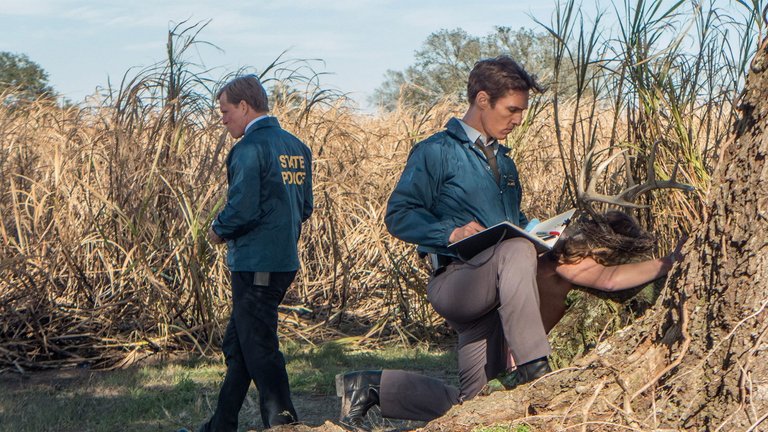
The ritualistic elements of the murder—antler crowns, cryptic symbols, the swampy Gothic atmosphere—establish a visual vocabulary that distinguishes the series from more pedestrian crime dramas. Director Cary Joji Fukunaga employs the Louisiana landscape not merely as backdrop but as active participant, the humidity and decay seeming to seep into every frame.
Ultimately, The Long Bright Dark succeeds not because it revolutionises the crime genre—it manifestly does not—but because it establishes a framework within which its exceptional performers can explore the complexities of masculinity, partnership, and moral compromise. The central mystery, whilst competently constructed, functions primarily as a vehicle for character study. As with many ambitious television dramas, the journey promises to prove more compelling than the destination. The episode leaves us with questions worth pursuing—not merely whodunit, but who these men were, who they have become, and what price they paid for the difference.
RATING: 7/10 (+++)
(Note: The text in the original Croatian version is available here.)
Blog in Croatian https://draxblog.com
Blog in English https://draxreview.wordpress.com/
InLeo blog https://inleo.io/@drax.leo
LeoDex: https://leodex.io/?ref=drax
Hiveonboard: https://hiveonboard.com?ref=drax
InLeo: https://inleo.io/signup?referral=drax.leo
1Inch: https://1inch.exchange/#/r/0x83823d8CCB74F828148258BB4457642124b1328e
BTC donations: 1EWxiMiP6iiG9rger3NuUSd6HByaxQWafG
ETH donations: 0xB305F144323b99e6f8b1d66f5D7DE78B498C32A7
BCH donations: qpvxw0jax79lhmvlgcldkzpqanf03r9cjv8y6gtmk9